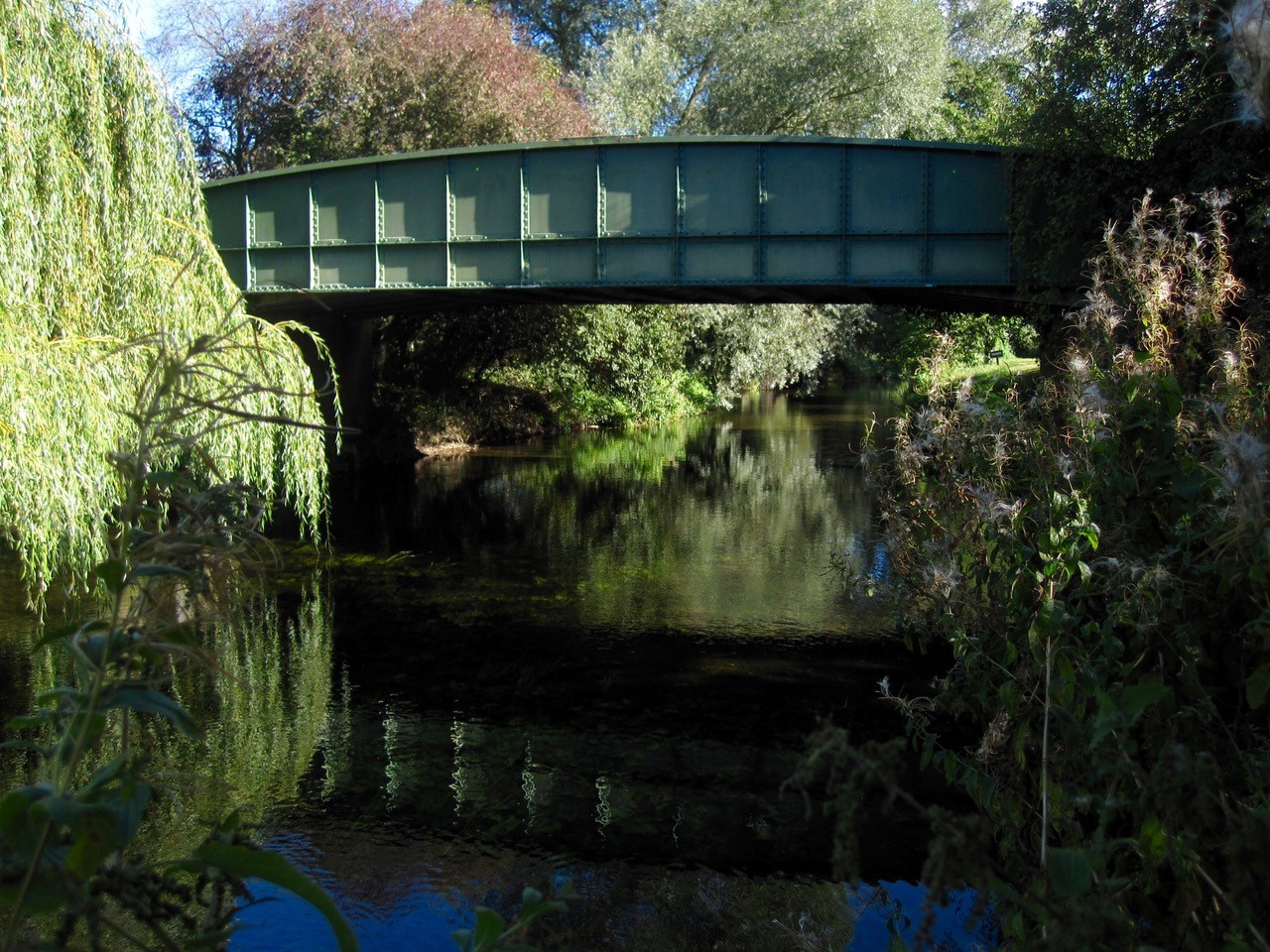
We have objected to plans to replace the historic Boxted bridge over the River Stour in North Essex, in support of a local campaign to protect the structure. Essex Highways has proposed demolishing the bridge and replacing it with a wider one.
Boxted bridge is in the heart of the Dedham Vale, a designated Area of Outstanding Natural Beauty. It is a steel girder bridge built in 1897 and an important part of the waterways heritage of the area. The river is popular for navigation by small craft such as canoes and paddleboards.
Replacing the bridge with a new and much wider bridge would be harmful to the setting of Boxted Mill. It would result in loss of a structure of intrinsic historic significance.
Alongside the community, we feel that the bridge should be repaired and retained, not replaced.
The decision to scrap the Eastern Leg of HS2 between the East Midlands and Leeds in favour of upgrading existing routes is good news for several waterways that were threatened by the proposals.
We have welcomed this in our submission to an Inquiry into the Government’s Integrated Rail Plan (IRP), which affects several waterways and canal restoration projects. However, we continue to be critical of the intention to press ahead with the Western Leg of HS2 2b. Additionally, there is a lack of detail on the Northern Powerhouse Rail (NPR) routes which may adversely affect other waterways.
The IRP was published in November 2021. It covers HS2 Phase 2b, NPR and some Midlands Rail Hub proposals and sets out the Government’s decisions on new high speed lines and major upgrades of the rail network in the North and Midlands over the next 30 years.
Our submission was made in response to an invitation by the House of Commons Transport Select Committee to anyone concerned by the implications of the IRP and how it integrates with HS2.
HS2 Phase 2b East will now end at East Midlands Parkway station but the IRP says nothing about its route through Measham which still threatens a large housing site that was set to contribute significantly to the restoration of the Ashby Canal. The review of this route which was promised in 2018 should now be speedily completed to allow the restoration to proceed.
HS2 Phase 2b West
The IRP confirms the intention to proceed with HS2 Phase 2b West from Crewe to Manchester, which will have major impacts on the environment and heritage of the Middlewich Branch of the Shropshire Union Canal and on the Trent & Mersey Canal north of Middlewich. We have been critical of the engineering design of this route, crossing the Cheshire salt field with its unpredictable subsidence problems, and its poor integration with the NPR proposals for east-west connectivity. Therefore, we are advocating for progress on this route to be paused while new proposals are considered.
New Transpennine Route
The NPR proposals for a new Transpennine route have been cut back to upgrades of the existing route via Huddersfield to Leeds, with a new section of high speed line from Manchester to Marsden, east of Standedge tunnel. But finding a new route through hilly terrain and dense built development will be a major challenge. We have called for more information about the routes of new sections of NPR line, and where widening of existing lines outside the present railway land take is planned, which could impact several waterways. They should also make clear if they plan to re-open the two original single track tunnels at Standedge, which would affect the current operational safety measures for the canal tunnel.
Warrington to HS2 West
Another section of high speed line is proposed between Warrington and a connection with HS2 West. This uses a freight line which crosses the St Helens (Sankey) Canal at low level on a former swing bridge which would permanently prevent its full restoration. Either a raised crossing should be provided or if this is not feasible than a different route for NPR through Warrington Central should be considered.
Protecting the Waterways from the worst effects of HS2
We’re campaigning to protect canals and rivers from the damaging effects of HS2, especially where the tranquillity of the waterways is under threat. Our HS2 route changes have already reduced waterways crossings – saving the project £50 million – and we have secured agreement for a new canal restoration route, a new mooring basin, changes in viaduct designs and improved noise protection.
Together we have achieved a lot for the waterways, including progress towards carbon net zero waterways and raising awareness of the importance of waterways heritage. We have raised the profile of the inland waterways at government and local levels. In addition, we helped to reopen stretches of waterway, and restore other sections, operated locks, tidied towpaths, responded to planning applications and much more.
As we come towards the end of the year, here are just some of our highlights.
January – NEW SILVER PROPELLER LOCATIONS TO DISCOVER
The Kelpies – Forth & Clyde Canal. Photo by Pauline McGill
Following on from a year where people had appreciated their local waterways in new ways, it was only appropriate to start 2021 by highlighting the All Party Parliamentary Group for the Waterways meeting about the importance of sufficiently funding rivers and canals.
The year also brought four new Silver Propeller Challenge locations, from Coventry Basin up to the Kelpies. We have now had eight crews successfully complete the challenge, despite being hampered by restrictions in 2020 and 2021. This challenge continues to encourage people to visit restoration hot spots, lesser-known gems and places that offer potential for the future.
February – CELEBRATING 75 YEARS OF CAMPAIGNS
Regent’s Canal, 1950 – one of IWA’s boat trips so that members could discover new waterways. Photo courtesy Canal & River Trust.
In February, we celebrated both the beginning of IWA and new leadership. We looked back on IWA’s proud, 75-year legacy of campaigning for the waterways. In doing so, we raised vital funds to protect waterways heritage with our 75th Anniversary Auction, hosted by celebrity auctioneer, Charles Hanson.
Looking to the future, our new CEO, Phil Hornsey, joined IWA. Building on IWA’s significant campaigning legacy, we are looking forward to the next phase of the charity’s vision with him at the helm.
In May we celebrated IWA Canalway Cavalcade – an event that normally takes place every year in London’s Little Venice – with a digital event encouraging supporters to share their memories of the event. Join us for IWA Canalway Cavalcade 2022.
Work parties continued throughout the year, where restrictions allowed.
June – 7,000 MILEs inland waterways uncovered
In June, our unique waterways directory update revealed 7,000 miles of British waterways. Of these, 5,000 of the miles are navigable today whilst the other 2,000 miles are either derelict or under restoration. This was as a result of further research in Scotland, improved coverage of former routes of river navigations and including more branches of the Grand Union Canal in the London area.
July – restoration gets a boost
Canal Camp volunteers hard at work
July saw our Waterway Recovery Group’s Canal Camps back out digging. Our hard-working volunteers boosted the work of restorations on the Derby Canal, the Rivery Waveney, Shrewsbury & Newport Canal and the Montgomery Canal. Given the additional Covid-safe working practices, it was a particularly impressive achievement this year.
August – iwa festival of water reveals unique heritage of worcester
IWA Festival of Water 2021 at Perdiswell Park, Worcester
IWA Festival of Water 2021 was held in Worcester at Perdiswell Park. Originally planned for 2020, it was a fitting celebration of the meeting between Rolt and Aickman 75 years ago that started IWA. Not only that, the event celebrated the history of Worcester with a heritage walk, along with the usual festival fun.
September – saving structures and stretches
A survey to help plan for the future of Aberdulais Aqueduct
September was a busy month for campaigning, with plans to save Aberdulais Aqueduct a step closer. The Grade II* listed aqueduct was at risk of further neglect following damage by flooding. We are hoping that the survey will give a better idea of the scale of the repair work and potential cost implications. Another campaigning win, the Uttoxeter Canal saw off a planning application that would have blocked the restoration.
October – saving waterways heritage
The heritage of the waterways, at risk from underfunding and climate pressures.
In October, we launched our campaign to save waterways heritage. As well as celebrating the rich, living heritage of the waterways, our campaign video highlighted the risk to this. People around Britain shared photos they had found of hidden waterways heritage, celebrating some of the less well-known canal and river heritage such as mile posts and rope marks.
November – Funding announced for the waterways sector
The Montgomery Canal
We were delighted that Bridgwater Docks will receive funding from the Government’s Towns Fund and the Montgomery Canal restoration will receive funding from the Government’s Levelling Up Fund. The local Branches have both campaigned for this funding, and we look forward to the positives that the regenerated waterways will bring to local people.
December – wendover canal
Wendover Arm re-watering
It’s always nice to end the year on a positive note where possible. As such, we were delighted to see a further section of the Wendover Canal back in water. The restoration has had a good amount of technical support from our Restoration Hub, supporting local canal trust volunteers. Therefore, it is a great example of successful restoration partnership working.
As COP26 begins in Glasgow, we are celebrating the success of our recent trial of Hydrotreated Vegetable Oil (HVO) in boats. A cross-section of the existing fleet on the inland waterways network have been using the fuel for propulsion, domestic use and heating. These boats include those with relatively modern diesel engines as well as older, more traditional engines and even a few historic boats.
HVO Trial in boats
This trial, sponsored by Crown Oils, has come about thanks to our IWA Sustainable Boating Group which was set up to explore ways of ensuring that the inland waterways meet the Government’s target of zero carbon emissions by 2050.
There are over 80,000 powered craft on the network. We are well aware that a viable alternative to diesel fuel needs to be found to reach net zero targets. HVO is a second generation biofuel which appears to have all of the necessary requirements going for it.
For example:
it mixes well with other diesel fuels
is already approved by most engine manufacturers
has none of the diesel bug issues that have plagued first-generation biodiesel
is stable when stored
remains free flowing to -25°C
brings a 10% drop in fuel consumption
The feedback from IWA members who are trialling this new fuel has been overwhelmingly positive. HVO is indeed a viable alternative to diesel fuel. It is also a straight drop-in replacement compatible with fuel that is already in a boat’s tank.
HVO is 90%+ carbon neutral
As well as being 90%+ carbon neutral, there is no need to change the boat’s means of propulsion or to modify the existing engine in any way. This means there is no requirement for an engine upgrade or any kind of trade-in. So, all diesel engines powering today’s inland waterways craft can easily become nearly carbon neutral overnight, simply by changing their fuel to HVO.
Domestic use and Heating
This is all very well and good for propulsion but what about domestic use such as cooking and heating? In these trials, boaters discovered that diesel-fuelled domestic devices were happy to operate on HVO. Specifically, they reported a cleaner burn with reduced fumes and smoke and less cleaning required. The lack of smoke has been a commonly noted benefit as well as quieter engine noise.
So what is the catch?
So what is the catch? At this time, the two main issues with HVO are a lack of availability and taxation issues affecting the price. The first of these will hopefully be resolved as demand increases. Once the market has been established, supply will inevitably increase and in turn, the price may drop. However, we will call on the Government to introduce tax cuts on HVO to make it more affordable, whilst appealing for boaters to switch their fuel source.
Additionally, HVO, like all biodiesels, is manufactured from vegetable oils. Currently, the HVO being supplied to the inland waterways is manufactured exclusively from waste and recycled oils. This means that it does not adversely affect the world supply of food and food oils. However, we recognise that as demand increases there is a risk that this will change and so we will work to ensure that it doesn’t.
Fortunately, the use of diesel on the inland waterways is relatively small and is likely to decrease as boats move to electric drive.
Protecting the unique waterways environment
Jonathan Mosse who leads on alternative fuels for the IWA Sustainable Boating Group says, “While we all agree that electric drives in one form or another are most certainly the future for inland waterway craft, these are still a long way off for most of the existing fleet. For the foreseeable future, the reality is that the vast majority of engines and generators will still be diesel-powered. We need to urgently find a way to change to a more sustainable fuel for our boats. This is something that not only reduces carbon emissions but also protects the unique waterways environment. We believe we have found the answer in HVO and the time to change is now.”
Bowman Bradley, Chair of the Group, adds “We are pleased that a small number of fuel suppliers are now stocking HVO. We are encouraging more boatyards and marinas to do so. Individual boat owners can assist this more widespread supply by requesting HVO wherever they fill up.”
Photographers submitted their images across four categories: Heritage & Restoration; Waterscape; Built Environment; and Life & Laughter.
Our judging panel included exceptional waterways photographers Derek Pratt and Kev Maslin. Derek is the author of several books and articles on canal and river photography and has a library of over 80,000 photos taken over a period of 45 years. Kev runs photography walks along the canal and his work has featured in BBC Wildlife and Waterways World magazines, as well as in the popular Geo Projects maps.
Congratulations to this year’s worthy winners. Enormous thanks to Kev Maslin & Derek Pratt for judging this year’s competition – and to everyone who entered.
The category winners are as follows.
Waterscape
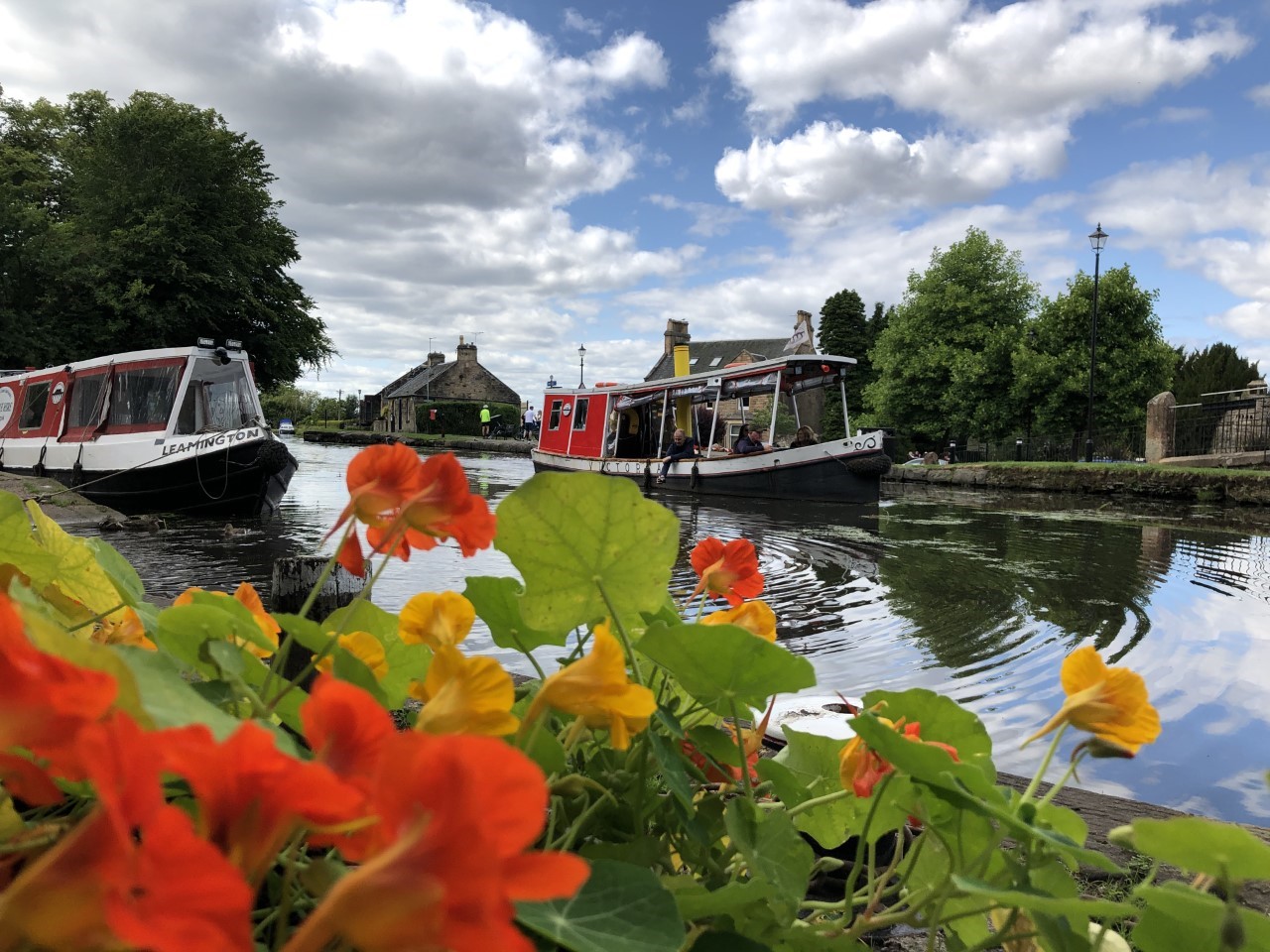
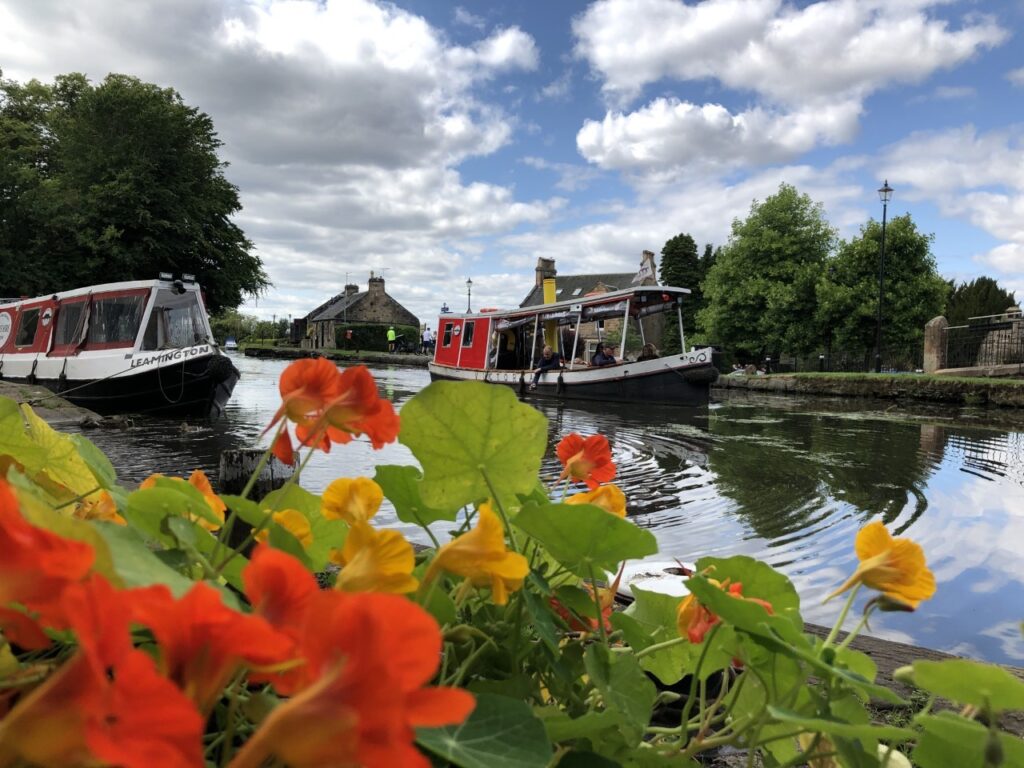
Replica steam trip boat Victoria, Linlithgow Basin, Union Canal – Maureen Wilson
The use of two compositional techniques makes this low level shot a winner. The bows of the boat are neatly placed on a third, while the colourful foreground blooms lead the eye nicely into the picture. The lovely blue sky with puffy clouds provides additional interest.
-Kev Maslin
Replica steam trip boat Victoria, Linlithgow Basin, Union Canal – Maureen Wilson
Built Environment
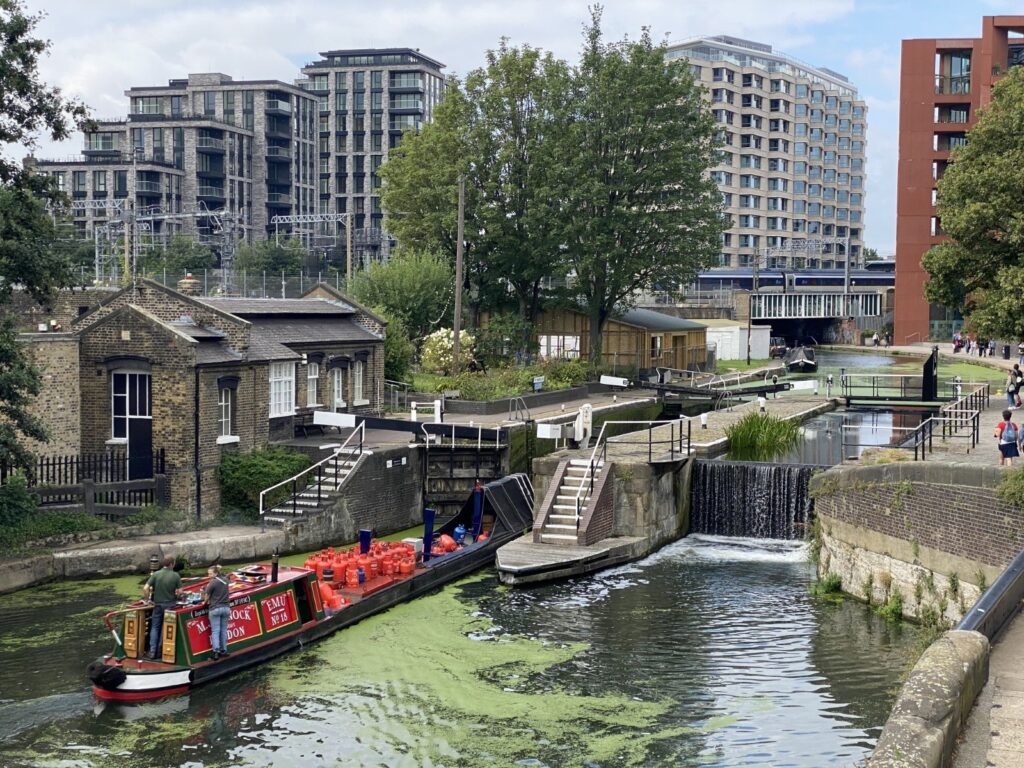
Emu at St Pancras -Tim Lewis
London provides the perfect backdrop for this interesting study of the built environment. It is well composed and taken from a slightly elevated viewpoint, which gives an excellent overall view of St Pancras Lock and its surroundings. The inclusion of the picture-perfect fuel boat ‘Emu’ adds a dash of colour and ably demonstrates what the canals were originally built for.
-Kev Maslin
Emu at St Pancras -Tim Lewis
Heritage and Restoration
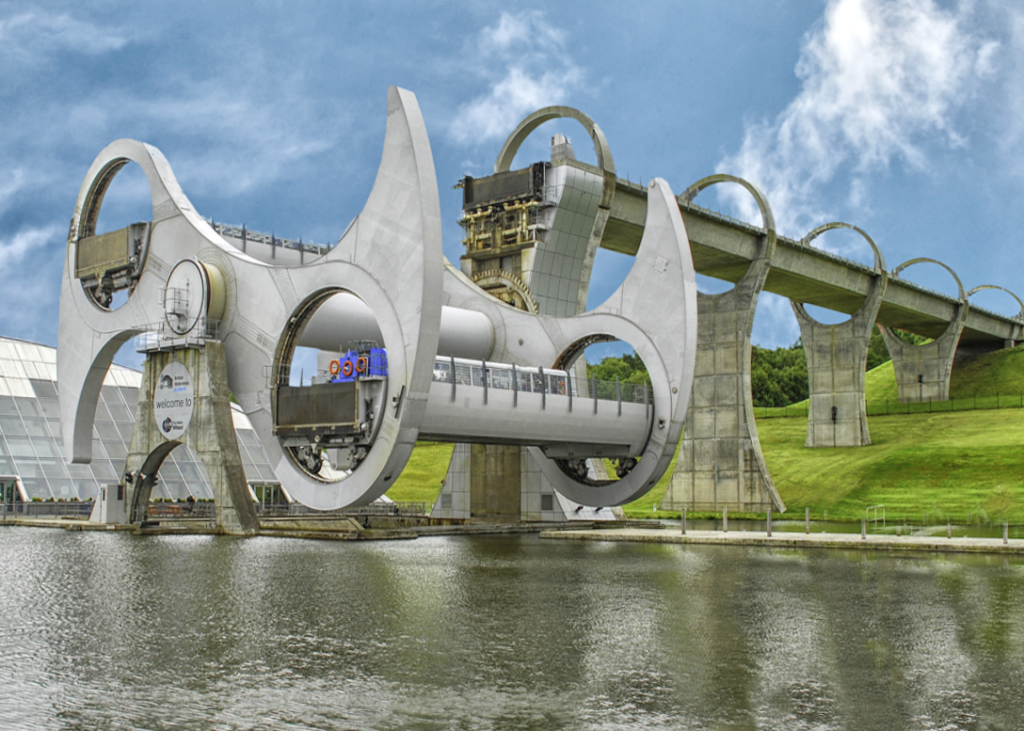
Falkirk Wheel, Forth & Clyde Canal – Nigel Essery
This delightful photo of the Falkirk Wheel shows the rotating boat lift working as it takes a boat between the aqueduct above and the basin below. The lift restored the link between the Forth & Clyde and Union canals, replacing 11 derelict locks. Good light and a blue sky make this an interesting and unusual shot.
-Derek Pratt
Falkirk Wheel, Forth & Clyde Canal – Nigel Essery
Life & Laughter & overall competition winner
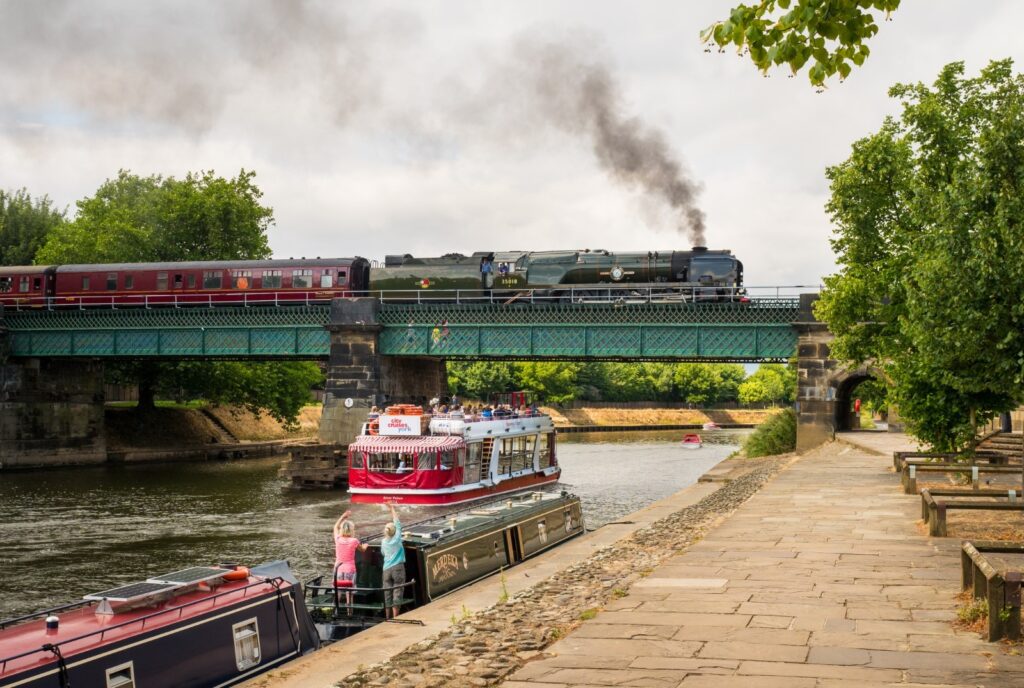
Waving at the train crossing the River Ouse at York – Alan Stopher
Kev and I chose this photo of the river Ouse at York as the overall winner in the competition.
Capturing a photo of a moving steam train over a bridge with a cruising boat on the waterway below is extremely difficult. The people waving from the moored boat adds that little extra something to what is already a very good picture. The moored boats and the edge of the paved towpath lead the eye into the picture to complete an excellent composition.
-Derek Pratt
Waving at the train crossing the River Ouse at York – Alan Stopher
IWA’s Sue O’Hare walks us through the history and heritage of Britain’s bridges, how they have developed over time and highlights some fascinating but lesser-known bridges as well as better-known ones.
Bridge, Aqueduct, Tunnel?
The Oxford English Dictionary defines a bridge as “a structure carrying a road, path, railway, etc. across a stream, river, ravine, road, railway etc.” For the purposes of this article we will focus on bridges over waterways, rather than aqueducts carrying waterways themselves. Of course there are also aqueducts which carry one waterway over another. The main connected inland waterway network of Britain has six examples of these. But even having narrowed our scope, it is still a bit blurry. When does a bridge become a tunnel?
The Earliest River Crossings
Places where rivers could be crossed are historically important as they often developed into settlements. Many town or village names reflect these origins (for instance, both Cambridge and Oxford).
The earliest river crossings were probably fords, shallow places where people, animals and vehicles could cross. The Romans sometimes paved the fords to make crossing easier. For example, this was done at Littleborough between Torksey and Gainsborough, probably the lowest crossing of the Trent.
Ferries were the next stage of evolution and also have a long history. The Queensferry Passage route across the Firth of Forth dates from the 11th century. A river crossing service across the Mersey is said to have operated since the 1150s.
Medieval River Bridges
Bridges were much more expensive than fords or ferries. That said, they were safer, had higher capacity and could be used in most conditions. The Romans built many bridges in the UK, but they were constructed of timber and none have survived. Again on the Trent, there was a Roman bridge just below the site of the current Cromwell Lock at the head of the tidal section.
Our oldest surviving waterway bridges are medieval in origin. Perhaps the oldest is High Bridge in Lincoln, which was built about 1160 and carries the High Street across the Witham Navigation. It is likely that it replaced a timber bridge carrying the Roman road Ermine Street, possibly originally built as early as the 1st century AD. The bridge now supports a row of Tudor timber-framed shops. Bridges like this were common in the Middle Ages, the best known being the old London Bridge.
Most medieval bridges were removed a long time ago because they obstructed the river flow and shipping. Only High Bridge and Pulteney Bridge in Bath survive in Britain as waterway bridges with buildings on them. The narrow, crooked arch of High Bridge is often called the ‘Glory Hole’. It was also called the ‘Murder Hole’ in the medieval period, when it was said that murder victims would be dropped in the river there and eventually float out to sea. The bridge limits the size of boats that can navigate between the Fossdyke at Brayford Pool and Boston and the sea.
The oldest is High Bridge in Lincoln, which was built about 1160 and carries the High Street across the Witham Navigation.
Ferrybridge in Yorkshire demonstrates the evolution from ferry to bridge in its name. It stands where the Great North Road (the A1) crosses the River Aire. The first bridge was built in 1198 but collapsed in 1228, resulting in the drowning of crusaders passing over at the time. In 1804, a larger bridge replaced the rebuilt bridge. Architect John Carr of York designed it to accommodate the increasing traffic on both the road and the Aire and Calder Navigation. In turn this was superseded by the modern A1 bridge in 1967.
The River Avon has a good number of bridges of medieval origins, some of which can be quite challenging to both boaters and vehicle drivers. A good example is Bidford Bridge in Bidford-on-Avon, remembered by Shakespeare as “drunken Bidford”, where the single navigation arch is unusually close to one bank of the river. Similarly the navigation arch of the medieval bridge over the River Medway at East Farleigh in Kent is not in line with the adjacent lock. The bridge dates from the 14th century. It is set amid orchards and oasthouses and has been described as ‘the finest bridge in the south of England’. Cromwell’s parliamentary troops marched over it in 1648 on their way to fight the Royalists in Maidstone.
East Farleigh bridge over the Medway – Sue O’Hare
On the Thames the oldest bridge is at Radcot, near the junction with the Thames and Severn Canal at Lechlade. The three-arch bridge now crosses a backwater. It is believed to date from the early 13th century, slightly pre-dating New Bridge further downstream near the confluence of the Thames and the Windrush. The Nene also has some old bridges, the most notable being at Irthlingborough with 19 arches and built during the 14th century.
On the River Dee in Chester a bridge was recorded in the Domesday Book, and the Old Dee Bridge was rebuilt in 1387 from red sandstone with seven arches, all with different dimensions. Cambridge offers the unique experience for powered craft of navigating the Backs. This is the stretch of the River Cam flowing behind several of the colleges, giving the classic view of King’s College Chapel. There are many old bridges to negotiate as well as punt traffic, so it is only permitted in winter.
Role of the Church
In medieval England it was often religious communities which built and maintained bridges. This is because they possessed the capacity to raise finance and the necessary architects and builders. Abingdon Bridge on the Thames was built in 1446 by the Fraternity of the Holy Cross. Radcot Bridge used to be surmounted by a cross, in accordance with the sacred character of bridges. Indeed indulgences were granted by the Church to those who contributed to bridge building and repairing.
It was common across Europe to build chapels on or near bridges. They catered for the spiritual needs of travellers and pilgrims. Many chapels were established as chantries, where a priest would say masses for passers-by and for the repose of the souls of the bridge’s benefactors. They were swept away by the Reformation through the Abolition of Chantries Acts of 1547 and 1549. Only four survive – at Bradford-on-Avon; St Ives on the River Great Ouse; Wakefield on the River Calder; and Rotherham on the River Don.
St Ives town bridge, Cambs by Cat Buck
There was relatively little further major bridge building activity for the next two hundred years. The coming of the canals changed all that.
Canal Bridges
The cutting of canals across the landscape divided estates and farms as well as roads and tracks. Canal builders had to reconnect them by providing large numbers of bridges. We are fortunate that many of the bridges have survived in their original form. Sometimes the canal engineer was responsible for the design of the bridges and there are examples by Brindley, Rennie and Telford. However they were often subcontracted to local builders. Constructed from local materials, they blend into the surroundings in a way which has been enhanced by weathering and mellowing over time.
Canal bridges are many and varied (Canal and River Trust alone is responsible for over 3,000). Most were built during the 80 years from 1760 to 1840. There are two basic types: fixed and moveable.
Fixed Canal Bridges
The single-arched humpback bridge is by far the most common type, carrying a minor road or providing agricultural access. Local materials include stone (in the north of England and the Cotswolds); red brick (in the Midlands and the south); Birmingham ‘blue brick’; and later cast iron. More recent additions or replacements have used modern materials such as reinforced concrete or steel.
Even the simple humpback bridge can be visually striking. Brindley’s unusually wide arch at Great Haywood Junction in Staffordshire must be one of the most frequently photographed.
Great Haywood Junction. Photo by Sue O’Hare
The high bridges spanning the Shropshire Union Canal’s deep cuttings are up to four times as high as normal bridges. Early bridges were all aligned so that they crossed the canal at right angles. However, in 1797 William Jessop designed the first true skew bridge, March Barn Bridge on the Rochdale Canal. Jessop used the method developed by William Chapman for the Kildare Canal in Ireland, with winding courses of stone to solve the problem of the angle.
Where canals crossed estates whose owners needed to be kept happy, much grander designs of bridges were used. Examples include Cassiobury Park at Watford on the Grand Union Canal and Chillington near Brewood on the Shropshire Union Canal. There is also the Gothic-style Drayton Turret footbridge over a swivel bridge on the Birmingham & Fazeley Canal near Sir Robert Peel’s Drayton Manor.
Drayton Turret footbridge, Birmingham & Fazeley Canal. Photo by Sue O’Hare
The unusually-shaped Cherry Eye Bridge on the Caldon Canal is also thought to be in deference to the local landowner (its name comes from a condition of the local ironstone miners’ eyes).
Cherry Eye Bridge Caldon Canal. Photo by Sue O’Hare
Many interesting and distinctive features of canal bridges were developed because they were needed to work the canals.
Wear: Generally the towpath continues through the arch of the bridge, but this soon led to wear from constant abrasion by boat lines. Cast-iron protection plates were later installed on the bridge sides, which in turn acquired deep grooves.
Dealing with towropes: Sometimes the narrowness of the arch did not allow for a towpath, and a narrow arch or small tunnel was provided for the horse. One way of dealing with the towrope in this situation was to use a split bridge with twin arms leaving a central gap for the rope. Examples of this can be seen on the Stratford-upon-Avon Canal in particular. Where the towpath changes from one side of the canal to another, a special form of bridge was designed to stop the towrope being tangled. These are known as roving, turnover or ‘snake’ bridges and are especially common on the Macclesfield Canal. They have such beautifully flowing lines that they are one of the most attractive waterway features.
Crossing locks: Many locks have small bridges at the tail to avoid the need to use the walkways on the gates. These may be wooden, brick or concrete.
Night navigation: On some canals such as the Leeds and Liverpool the bridge arches were whitewashed and the centre of the navigable bridge hole marked with a vertical stripe. These features can still be seen.
Roving Bridge No 76, Macclesfield Canal Congleton Sue O’Hare
Once the use of cast iron for bridges was established at Ironbridge on the River Severn in 1781, it became an increasingly common material for canal bridges. Its strength and lightness enabled longer, flatter arches. The Horseley Ironworks of Toll End in Birmingham developed a signature bridge design. This was used widely around the BCN over the period 1820-30, and at Braunston Junction between the Oxford and Grand Union Canals. Another notable example is the Britannia Foundry Derby bridge at Hawkesbury Junction between the Coventry and Oxford Canals.
Britannia Foundry Derby Bridge at Hawkesbury Junction. Photo by Sue O’Hare
Later canals have grand bridges across deep cuttings. Perhaps most famous is Telford’s Galton Bridge, 75 feet above the Birmingham Main Line. The design is similar to his Holt Fleet Bridge and Mythe Bridge over the Severn. These were later followed by William Tierney Clark’s designs for Marlow Suspension Bridge; the original Hammersmith Suspension Bridge over the Thames; and perhaps most impressively by Brunel’s Clifton Suspension Bridge over the Avon Gorge below Bristol.
The coming of the railways brought new forms of bridge to the canal, starting at Patricroft Bridge on the Bridgewater Canal. This was designed by George Stephenson to carry the first passenger railway (the Liverpool and Manchester Railway) across the first major industrial canal. Some spectacular bridges and viaducts followed, including two particularly striking Pennine examples, both skewed: the castellated Gauxholme Viaduct over the Rochdale Canal near Todmorden; and the Saddleworth Viaduct carrying the railway over the Huddersfield Narrow Canal near Uppermill, which itself is crossing the River Tame on the Saddleworth Aqueduct. Also memorable are Brunel’s red-brick railway bridges over the Thames at Moulsford, Basildon and Maidenhead.
Saddleworth Viaduct and Lock 23W on Old Sag Aqueduct over the River Tame, Huddersfield Narrow Canal. Photo by Sue O’Hare
Completing the picture are the bridges that carry pipes and other industrial features over waterways. They range from simple pipes, to the Tata chemicals works that straddle the Trent and Mersey Canal at Wincham near Northwich.
Tata Chemical Works at Wincham, Trent & Mersey Canal. Photo by Sue O’Hare
Moveable Canal Bridges
Moveable bridges are cheaper to build but more expensive to maintain, and can cause delays for both boats and traffic crossing the bridge. They tend to be mainly used for farm or pedestrian access and on navigations used by large ships. In England and Wales moveable bridges are generally operated by the boat user except on the large navigations, whereas in Scotland this has been much less common.
There are three main types:
Bascule bridges or drawbridges These are often referred to as lift bridges and lift up from one side of the waterway. They are counterweighted and usually operated manually or with a windlass. Most are found on narrow canals such as the Llangollen Canal and South Oxford Canal. However the broad Basingstoke Canal has a powered lift bridge at North Warnborough. Broad lift bridges are also used on the Lowland Canals in Scotland.
Open lift bridge on the Llangollen Canal by Sheila Wilson
Swing, swivel or turnbridges These are simpler, turning round a single point. Usually they are pivoted on one bank, though there was a railway swing bridge at Endon on the Caldon Canal which pivoted in the middle of the waterway. Swing bridges are especially common on the Leeds and Liverpool Canal, where many have been converted to electrical operation. They are also common on waterways used by tall vessels, such as the Gloucester and Sharpness Canal, the Manchester Ship Canal, the disused Sankey Canal, the Yorkshire waterways and the Weaver Navigation.
When railways were first built they generally crossed canals on the level in order to avoid the need for earthworks and gradients. For this reason they used swing bridges, as can be seen near each end of the Caledonian Canal at Banavie and Clachnaharry. The early exception was George Stephenson’s Liverpool and Manchester Railway, which crossed the Sankey Canal on the 1830 Sankey Viaduct near Earlestown – the earliest major railway viaduct in the world.
Town Bridge, Northwich, Weaver Navigation – Sue O’Hare
Vertical lift bridges Here the bridge deck remains horizontal while being lifted vertically. The Huddersfield Broad Canal has the Turnbridge, also known as the Locomotive Lift Bridge, which was originally operated by windlass but is now electrified. In 1934 West Riding County Council built an electric lift bridge across the Barnsley Canal near Royston, but the canal was abandoned in 1953. Also opened in 1934, the Tees Newport Bridge was the first large vertical-lift bridge in Britain. It links Middlesbrough with Stockton-on-Tees. It no longer lifts, but still acts as a road bridge.
Turnbridge, Huddersfield Broad Canal. Photo by Jacqui Hatcher
Two modern examples have been built across the Manchester Ship Canal. The Centenary Bridge is a road bridge linking Eccles with Trafford Park. It was opened in 1994 as part of the Manchester Ship Canal’s centenary celebrations. The Salford Quays Millennium Bridge, also known as the Lowry Bridge, is a footbridge opened in 2000 beside the Lowry Centre. It links Salford Quays with Trafford Wharf and the Imperial War Museum North. It has a lift of 60 feet and a custom lighting system, and is featured in the opening of the BBC North West Tonight TV news show.
Salford Quays Millenium Bridge, Manchester Ship Canal. Photo by Graham and Marilyn Speechley
Other rarer types of moveable bridge include:
Transporter bridges These carry a gondola across a waterway, suspended from a tall span on wires or a metal frame. The concept was invented in 1873 by Charles Smith, the manager of an engine works in Hartlepool. It was useful in locations where it was impractical to build the long approach ramps needed to reach a high span, and in places where ferries are not easily able to cross. However transporter bridges can carry only a limited load and the idea has been little used since traffic grew.
The Widnes and Runcorn Transporter Bridge was Britain’s first transporter bridge and the largest of its type ever built in the world. Completed in 1905, it crossed the River Mersey and the Manchester Ship Canal. The two towers were 180 feet high and the transporter car was designed to carry 4 two-horse farm wagons and 300 passengers. It took 2½ minutes to cross in reasonable conditions. It continued in use until 1961, when it was replaced by the conventional Silver Jubilee Bridge and demolished.
There are only three remaining transporter bridges in the UK: the Tees Transporter Bridge in Middlesbrough, the Newport Transporter Bridge across the River Usk in Wales (currently closed for restoration) and the Warrington Transporter Bridge (now disused). The Royal Victoria Dock Bridge in East London is a modern footbridge designed to allow use as a transporter bridge but currently only used as a high-level footbridge.
Roller bridges This is another way to tackle the problem of crossing navigable water in flat surroundings without needing earthworks and excessive gradients to reach a high bridge. An amateur industrial archaeologist recently rediscovered a railway rolling bridge across the abandoned Ulverston Canal in Cumbria. The bridge was built in 1883 by the engineer Frank Stileman. It carried the railway track diagonally and crossed the canal at towpath level. To enable boats to pass, the central part of the bridge was rolled back on wheels into a small dock built into one bank. The bridge was listed in 2012 and is believed to be the only surviving example of its kind in Europe. There is also a modern rolling footbridge across the Forth and Clyde Canal at Speirs Wharf in Glasgow.
Modern Bridges
In the 20th century the focus on building and improving roads led to the upgrading of existing bridges and the building of new ones. Highway authorities started replacing or widening original canal bridges before the Second World War, often with rather utilitarian structures. The motorway network then made a substantial impact. The first section of the M1, opened in 1959, included a crossing of the Northampton Arm of the Grand Union Canal almost above Lock 12. The concrete pipe-like structure has been considerably enlivened by murals depicting the history of Northampton and the canal’s natural history, painted by local school children working with the IWA Northampton Branch.
On the BCN the elevated section of the M5 runs to the north west of the city centre across Titford Pools and is built directly above the Old Main Line in Oldbury. There is an unusual juxtaposition of transport routes where Telford’s Steward Aqueduct carries the Old Main Line across his New Main Line, which in turn is crossed by the Birmingham and Wolverhampton section of the West Coast Main Line railway and above that the M5.
The M5/M6 junction at Gravelly Hill north east of Birmingham city centre, known as Spaghetti Junction, is more or less directly above Salford Junction. Again this is a fascinating story of Britain’s transport infrastructure, on multiple levels. The Grand Union Canal, Tame Valley Canal and Birmingham & Fazeley Canal meet at Salford Junction, as do the motorways, the A38 and A5127 roads, the Cross-City and Walsall railway lines, the Rivers Tame and Rea and Hockley Brook, as well as electricity lines and gas pipelines. The design requirements included the placing of the pillars to allow a horse-drawn narrowboat to pass without its towrope being fouled.
Perhaps the most intriguing media appearance of Spaghetti Junction is in the 1973 film Take Me High, when Cliff Richard sped below it on a hovercraft. This little-known film foresaw the regeneration of Birmingham around its canals, as well as the gourmet burger!
Salford Junction and Spaghetti Junction, Birmingham. Photo by Sue O’Hare
One of the most recent motorway bridges is the M5 culvert on the Droitwich Junction Canal. This originally carried the Body Brook and now has another role as part of the restored canal. It has an exceptionally low air draft of a nominal 6 feet, which can be further reduced by the flow into the canal from the Brook.
The Millennium in 2000 brought a wide range of interesting new bridges, including Millennium Bridges in Exeter, Glasgow, London, Teesquay (Stockton-on-Tees) and York. A particularly unusual example is the Gateshead Millennium Bridge. This is a tilt bridge, with a deck for pedestrians and cyclists and a supporting arch. To allow boats to pass, the arches rotate together around a pivot on each side of the river – hence its nickname of the ‘winking bridge’. Only two others of this type are known, both in Belgium.
Innovative bridges are also popular as part of regeneration programmes, as at Salford Quays.
Other examples include
Merchant’s Bridge across the Bridgewater Canal at Castlefield in Manchester
Islington Place Bridge over the Birmingham & Fazeley Canal at Farmer’s Bridge in Birmingham
Diglis Bridge across the Severn in Worcester
The Infinity Bridge in Stockton-on-Tees, named because the bridge and its reflection make up an infinity symbol.
Islington Place footbridge, Birmingham & Fazeley Canal, Farmer’s Bridge. Photo by Sue O’Hare
Paddington Basin on the Paddington Arm of the Grand Union Canal in London has two unusual bridges. It used to have a third, the Helix Bridge, but this was removed in 2013. It was a glass and steel pedestrian bridge with a helical frame which rotated as the bridge retracted, to look as if it was corkscrewing across the canal. The two remaining bridges act as both pedestrian crossings and moving pieces of public art. The Fan Bridge splays like a fan as it rises, while the Rolling Bridge curls itself up into a ball.
IWA facilitated the online meeting, with presentations from the Residential Boat Owners Association, the National Bargee Travellers Association and Canal & River Trust. The groups highlighted areas where the Government could provide more support for those living on the waterways.
Michael Fabricant MP, Chair of the Group, led the meeting. It was attended by MPs and peers, officials from Defra and representatives of many waterway organisations and navigation authorities. Also attending were representatives from a number of new and established community mooring co-operatives.
Support for liveaboard boaters
The presentations and the lively discussion that followed identified a number of key issues. More support from Government and other public bodies would be beneficial to:
Make sure that health, social services or other local authority services are available and accessible to liveaboard communities
Better co-ordinate between navigation authorities and planning authorities to allow a more constructive and positive response when residential mooring developments are being considered
Support and help for setting up more boater-managed community or co-operative style moorings
Better support for reducing the impact on boaters of anti-social behaviour in inner city locations
Support for navigation authorities in making waterway infrastructure more resilient to the impacts of climate change and extreme weather
Help for boaters to adapt to low carbon technology to support Government net zero carbon targets
Ensure no adverse impacts on boaters’ legitimate way of life through the Police, Crime, Sentencing and Courts Bill 2021
Putting arrangements in place to rectify the missed opportunity in the 2021 Census to collect data about how many people are living on boats, which in turn will help to improve access to public services.
The meeting concluded with Michael Fabricant MP stating that the APPGW would write to the Defra Minister with responsible for waterways, Rebecca Pow MP, to ask her to convene a meeting to discuss these issues with representatives of relevant organisations and government departments.
As well as providing the Secretariat for the APPGW, IWA also lobbies government directly. IWA will continue to press relevant government departments and local authorities to make progress in these areas.
Hybrid electric drives and, ultimately, hydrogen-powered fuel cells will undoubtedly become the standard specification for new boats in the years ahead. In the meantime, however, IWA has been puzzling over how to green the diesel-driven boats currently on our inland waterways. These engines may well have a useful life of up to 40 years, making their replacement with a brand-new hybrid drive both unnecessary and uneconomic for the average boater.
Dino-Diesel Replacement
The solution IWA has identified, in tandem with other organisations and commercial operators, is to replace fossil fuel diesel (often referred to as dino-diesel) with a carbon-neutral alternative. Initially this was biodiesel produced by a process known as transesterification, using methanol and sodium hydroxide (or similar) as a catalyst. But these two components mean that the fuel is, in fact, only about 87% carbon neutral. This product has become known as first generation biodiesel. For a number of reasons, it is generally considered totally unsuitable for marine use.
Fortunately, early this century the Finns starting developing a process for converting animal fats and waste vegetable oil into diesel fuel, employing hydrogen. Today this alternative, known as second generation biofuel, is becoming readily available and is already in regular commercial marine use. More than 90% carbon neutral, and with none of the shortcomings displayed by its first generation cousin, it looks like being the drop-in replacement fuel for those keen to run their existing diesel engines into a carbon-neutral future.
HVO perks FOR BOATERS
Hydrotreated Vegetable Oil (HVO) carries a wide range of endorsements from Vetus to Volvo, Kubota to Yanmar. It is completely stable when stored (up to ten years), remains free-flowing down to at least -25°C and is not hygroscopic (attracts water). In other words, unlike first generation biodiesel, it does not promote the development and growth of diesel bug. What’s more, it is 100% miscible, meaning that it happily mixes with all other diesel fuels.
Strict tracing of the feedstock ensures that HVO is made from waste oils. It is not directly produced on land otherwise reserved for growing food. It also boasts up to 30% lower nitrogen oxide outputs – and the potential to reduce particulate emissions by nearly 90%. Combined with a higher cetane value, it’s superior in every way to dino-diesel.
IWA has started a conversation with the Canal & River Trust (soon to be cascaded down through other Association of Inland Navigation Authorities members) to explore the place that HVO will occupy in their Position Paper on Sustainable Boating. As with all these things, price and availability are everything, and currently outlets for the fuel are fairly limited.
HVO campaigning
Going forward, IWA will be pressing for greater use of HVO on our waterways. You can read more about our vision for sustainable propulsion, which has already gained considerable respect and traction across the inland waterways.
Availability of the fuel is still limited in the UK, and IWA has been at the forefront of its promotion on the inland waterways. We are working with fuel companies, existing users and potential outlets to raise its overall profile. This follows IWA trials with HVO on boats, encompassing propulsion through to heating and cooking. So far absolutely no problems have been encountered and users often report a cleaner burn with lower visible emissions.
Fuel-boat
One of the most exciting initiatives on the HVO front is the fuel-boat Barnet. It has just started trading on London waterways following an extensive refit. With the exception of the Thames tideway, Barnet is the first fuel-boat to sell HVO. The London Waterbus Company will be among its new customers.
nb Barnet – HVO fuel boat
The initiative is the brainchild of Lee Wilshire, director of Waterway Projects Ltd. Lee also operates a boatyard just north of Stonebridge Lock on the Lee & Stort.
For those keen to support a sustainable future it’s worth noting that the fuel will have seen zero road miles since leaving the refinery, probably in Finland. Instead, it travels by ship to the Thameside Stolthaven Terminal and thence by bunker-barge Dispenser up Bow Creek, before being pumped into Barnet.
GPS Marine services largely operates Dispenser to supply its own tideway fleet of tugs and workboats. They have been using HVO across the board without problems in a wide range of propulsion units and ancillary engines, including Lister-powered generator sets. The CEO, John Spencer, is also a member of the IWA HVO sub-group.
Find out more
Together with the Commercial Boat Owners Association, IWA will be campaigning to level the price playing field between mineral diesel and HVO, and encouraging the general uptake of this fuel on the inland waterways. To this end, a group of experts and current users of the fuel has been established. Among other ‘duties’, its members are available to answer general queries about biofuels in a boating context. Contact jonathan.mosse@waterways.org.uk or find out more about sustainable boating.
I currently work as a primary school teacher in the North East. Just like in canal restoration, there is never a dull day! When I’m not at work, I enjoy volunteering. I first discovered Waterway Recovery Group when I was 16. I was looking for an organisation that I could complete my Duke of Edinburgh residential stay with, and it was a choice between cathedral camps and canals.
The canals won! As a family, we’d always been heavily involved in sailing and kayaking, and we had been on a number of daytrips along the Kennet & Avon.
I’ve always loved the water and definitely feel more at home on it than on land. I completed a week’s volunteering at a trail-boat rally at Glasson Dock in 1989, where I met some very unique characters who left a lasting impression.
One of these new friends was heavily involved with the logistics side of WRG. He was very keen to promote a more professional image of volunteering and was passionate about training volunteers to drive and use the vehicles and plant (which are regularly used on sites) safely and responsibly.
The first training event
The first training ‘event’ we organised was a very humble trailer training exercise and from there it evolved into something far bigger, taking place over bank holiday weekends and even including sponsors at one point! Although there’s always some element of training on the camps themselves, the benefit of having a dedicated weekend for it is that we can upskill large numbers of volunteers without impacting on often urgent timescales on projects during the summer.
My role is really to coordinate the instructors and volunteers. A whole weekend of training sessions are timetabled to teach anything from dumper driving and using 360 excavators to bricklaying and scaffolding. Depending on the level of skill required, we sometimes bring in outside professional training, but the majority of sessions are delivered by a set of wonderful volunteers who have become WRG instructors by virtue of having gained significant experience on our sites. Without them, the weekend just wouldn’t be possible.
This year marks 25 years since the first event, and in that time we’ve probably trained quite a few hundred WRGies and local society members. When I first became involved with WRG, there was no shortage of women. Many of the girls I met when I was 16 are still some of my closest friends 32 years on. With regards to training, however, there’s much less female involvement. This is a real shame as my experience of learning to drive plant and vehicles was extremely positive and is one of the things I love most about working on the canals.
Getting more women involved
We would love more women to get involved and redress the gender imbalance. I defy anyone to complete an excavator training session without a Cheshire cat smile on their face! It’s a brilliant opportunity to learn something different in a wonderfully welcoming environment. The great thing about WRG (and this was one of the reasons I became so involved in the first place) is that the majority of volunteers ignore gender stereotypes. Everyone is encouraged to learn and become involved in any task with which they are comfortable. As a young, female volunteer, certainly in the group of people I was ‘digging’ with, I never felt that I was overlooked because I was a woman. In fact, I was positively encouraged to give everything a go. By the time I turned 21, I was happily driving all vehicles and operating just about every piece of plant available on site.
WRG has some legendary characters, many of whom are, or were, women with a solid layer of strength running through their core. They taught me to have a voice, they taught me to never be afraid to have a go, and they taught me that you will find kindness if you look in the right places.
Jess Leighton
WRG volunteer and Waterway Legacy Leadership Programme participant
I’m 26 and work as a junior doctor in the North East. Like Alison, I stumbled across the Waterway Recovery Group website while completing my Duke of Edinburgh Award and, thinking that it sounded a bit different, I signed up. My dad drove me down to Chesterfield for the camp and I didn’t really know what to expect. But I threw myself into the week and had a really incredible time. Everyone was so friendly and encouraging, I would have stayed for another week if I didn’t have my Gold expedition a few days later!
After a few years of camps, I started to think about how I could contribute more to WRG. I was encouraged to get involved as a leader, but the main thing holding me back was unfamiliarity with the technical procedures and planning side. So when I saw WRG was advertising a programme to give budding leaders training in these areas and to support them in leading camps, it felt like the perfect opportunity. I applied for the programme and was over the moon to be successful.
Jess Leighton
Waterway legacy leadership
The Waterway Legacy Leadership Programme is investing in 15 volunteers who will receive over £1,000 worth of training and development across 2020 and 2021. The aim is to meet the needs of the restoration sector to ensure robust and volunteer-led canal and waterways restoration projects continue.
Unfortunately, we’ve been held up a little by Covid-19, so are just settling into the training schedule for 2021. But I’m really looking forward to getting stuck in, and especially to putting it all to use on my next camp. I’ve also recently been involved with the Covid Canal Camp Working Group. It’s been really lovely to chat to the other volunteers and try to work out a safe way to return to restoration. We have devised an outline of what a WRG camp might look like in 2021 and are sharing that with volunteers to see if they would feel comfortable. It’s a huge challenge but vital that volunteers are safe.
Over the years I’ve been involved with WRG, the women I’ve met have taught me to be unapologetic about having an ‘unusual’ interest, which is a very valuable life lesson. There’s no reason why more women shouldn’t get involved. Admittedly, WRG camps are physically challenging, and it can be mentally tough too. I think it’s really important to know when to take a break or ask for help, and not to feel like you need to push yourself. You should be enjoying yourself too.
Rhiannon Smith
WRG volunteer and Waterway Legacy Leadership Programme participant
I’m 22 and I’m currently studying for a Masters in Classical Linguistics (in layman’s terms, Latin and Greek grammar) at Newnham College, Cambridge. I’ve been rowing for 11 years now so a lot of my life has been spent at, on, or occasionally in various bodies of water.
My grandmother is Audrey Smith, who was IWA chair from 1994 to 1998 and has been an amazing inspiration to me. I proudly tell people that my grandmother has her own blue plaque in Liverpool docks – like actual proper famous people do.
Waterways are a family legacy to me, and I grew up spending my summers with her and Grandpa boating around England. I don’t remember a lot of things she achieved (I wasn’t even born for some of them) but seeing pictures and hearing the stories make me wish I had – I can just imagine boating a flotilla of narrowboats down the Manchester Ship Canal and how much organisation must have gone on behind the scenes to make it happen. But the balance is starting to shift: I used to jokingly complain that I was only ever recognised as ‘Audrey Smith’s granddaughter’ but Grandma has been amused to tell me someone recently greeted her with the words: “Oh, you’re Rhiannon Smith’s grandmother!”
First experience with WRG & IWA
As far as we can tell, my first experience with WRG and IWA was a combined leaders training weekend and IWA committee meeting when I was three months old. From then, I spent many summers running around festival sites and generally getting underfoot. I began to properly become involved with restoration in the summer of 2015: I have been on four camps, three of them as assistant leader, and several weekends since then. Now I own the steeltoecap wellies and boots, it seems a waste not to keep using them!
Joking aside, being a WRG volunteer is really important to me. Waterway restoration might not be the most exciting of volunteering roles, and people might not think I’m changing the world, but I look around and think, if not me, then who? I get to meet people I would never normally cross paths with, do things that others like me never do, and who knows, I’ve started so young that I might see a fully operational canal pass through some locks I’ve restored eventually.
Duke of Edinburgh’s Award & Female-only camps
The lack of women in waterways restoration, and the lack of young people generally, is something that needs addressing. The Duke of Edinburgh scheme provides a steady stream to our camps, but I think we could be doing more to capitalise on that.
There needs to be more targeted advertisement aimed at DofErs after they’ve done a camp to return for another one, and also to attract people from more walks of life. Perhaps, after their first camp, new WRGies could be put in touch with their local volunteering group, for example, and a concerted effort should be made to reach out and invite newbies on weekends. When I transitioned to weekend digs last year, I essentially fumbled around on Facebook finding groups, searching for people I knew and asking my dad what to do – a set of resources that your average post-DofE volunteer isn’t going to have. Having spent my entire educational years in female-only settings, I’d also love one day to see a female-only camp in the way we’ve started having family camps.
Margaret Gwalter
Vice chair of the Neath & Tennant Canals Trust
I have been boating since 1974 when, while visiting friends who lived near Great Haywood, my husband and I saw narrowboats for hire along the canal and decided to book one for the following Easter. I was hooked.
We joined IWA back in 1977 when we acquired a small boat of our own, and soon got involved with Canalway Cavalcade. When we got our own narrowboat, Ernest, in 2000, we began taking a more active part in the event, for several years being the boat that housed the public address system! It became our habit to cruise the canal system every year making the National Festival our destination and helping out on the IWA stand. We were also active members of St Pancras Cruising Club but had to give up boating a few years ago as we were getting very creaky, me especially.
When we lived in London I was heavily involved with the London Canal Museum, first as education officer (having taken early retirement from teaching) and then as a trustee and chair. During that time we were able to turn the museum around from near-closure. I was project manager for the refurbishment of the ground floor, working with museum designers and colleagues and doing a great deal of fundraising. Further work was then done in developing the back room areas. I stood down as a trustee in 2003 but was still involved for a few years after. It was the greatest satisfaction to be part of the team that laid the foundations for the museum to become the thriving place it is today.
Joining IWA South Wales Branch
I joined the IWA South Wales Branch when we moved permanently to South Wales, and became chair in 2010. My aim was to make the South Wales canals better known, especially those in the Neath and Swansea valleys where there are myriad smaller canals, including an underground one.
When I stood down, about five years ago, I got involved with the Neath & Tennant Canals Trust. My first involvement with the Neath Canal was when, as IWA chair, we set up a meeting with representatives of the canal company. We were concerned the canal was not being properly managed and, in particular, we wanted to see more facilities for boaters. Sadly negotiations seem to have come to a full stop, with Canal & River Trust wanting a large dowry to take it on and the canal company not wanting to pay it. The canal is becoming neglected; where we had 27 boats for the Trailboat Festival in 2011, it is now so overgrown that a canoe would have difficulty getting through.
CAMPAIGNING TO SAVE Aberdulais Aqueduct
The trust is currently campaigning to save Aberdulais Aqueduct. There have been attempts over the years to restore the structure, including feasibility studies in 2009 and 2012, but none has been followed through. Flooding in February 2020, and especially the suggestion that the aqueduct should be destroyed, has given us the impetus to campaign more urgently for its repair and restoration. Last year we were in contact with Bwrdd Cymru, CRT’s board in Wales, Neath Council and IWA. The latter has written to CADW, the Welsh equivalent of English Heritage, National Resources Wales, Neath Council, the aqueduct’s owners and the local Assembly member. Depending on the responses we get, we will take the campaign further this year, involving local heritage groups and councillors. In the meantime we hope there will be no further damage to the aqueduct over the winter.
In terms of recruiting more women to the restoration sector, I think it’s a case of better promoting the female participants we already have. There are so many strong women involved with waterways. Let’s champion them more.
Our inland waterways are vibrant, valuable green spaces that connect city and countryside, alive with boats and enjoyed by millions. They can bring an enormous sense of wellbeing to the people that enjoy them. But there are places where waterways are difficult to access and use.
We have launched the Waterways Watch initiative to help us get a good picture of the issues that affect our country’s canals and rivers. We want to know about problems experienced by you as you use them.
access to Canal & River paths
Right now, we want to know about any issues you have experienced accessing your local waterways during the current lockdown. This could include places where you find it difficult to access the towpath or move along it, or where paths don’t exist.
Overgrown Vegetation & DREDGING
Once boating is possible, we also want to hear about places that need dredging – where boats are grounding in the middle of the channel, or experiencing difficulties entering or exiting a lock due to channel depth. In addition, we want to hear about problematic vegetation. This could be anywhere the towpath, waterway, sight line or winding hole is blocked by vegetation growth.
Evidence gained from surveys such as this allow us to build up a better picture of issues we should be raising with navigation authorities, at a local and national level. It also enables us to gather evidence to lobby government for better funding for the inland waterways. This initiative follows on from our 2018 Gaptracker survey, where we asked boaters to identify areas on the UK’s waterways where facilities were missing or in poor condition. Hundreds of comments were received about facilities, that we followed up with nine different navigation authorities.
Waterways Watch reporting
We want the waterways to be accessible for the communities that enjoy them. So, please do tell us of any specific problems through our Waterways Watch reporting form. Please report any urgent or emergency issues to the relevant navigation authority.
In the 66 years since Robert Aickman published his Seven Wonders of the Waterways, hundreds of miles of canal have been restored to navigation. The building of new structures and establishment of waterside developments may have transformed the look and feel of our inland routes, and may be now we would pick some different wonders – but here is the original list
ANDERTON BOAT LIFT
The Anderton Boat Lift (above) is the iconic Victorian structure in Northwich, Cheshire, that links the Trent & Mersey Canal to the River Weaver some 50ft below. Opened in July 1875, it was designed by Edward Leader Williams to assist with the transportation of cargo from inland industries. This included china from the potteries in Stoke-on-Trent and Cheshire salt, that were taken to Liverpool for exportation around the world.
The ingenious solution cut days off the otherwise convoluted route along the Trent & Mersey and Bridgewater canals. Its mechanism was initially powered by steam-driven hydraulics, before being converted to electric operation in 1908. A series of faults saw it close in 1983 after more than 100 years of operation.
As a Scheduled Ancient Monument, demolition was prevented, but the cast iron structure was left to disintegrate. Work began on its restoration in 2000 and just two years later its hydraulic pumps were brought back to life. Boats could once more hop between canal and river with ease.
Anderton Boat Lift
BARTON SWING AQUEDUCT
Located at Barton-upon-Irwell near Manchester, Barton Swing Aqueduct carries the Bridgewater Canal over the Manchester Ship Canal. The unique, iron structure was built in 1893 but is not the canal’s original solution to traversing the Irwell Valley. The Bridgewater initially crossed the old Mersey & Irwell Navigation on James Brindley’s stone aqueduct, opened in July 1761. However, the construction of the Manchester Ship Canal obliterated the Mersey & Irwell Navigation. Brindley’s arches were too constrained to admit the ocean-going ships that would ply the new canal and it was unceremoniously demolished.
Its replacement, the Barton Swing Aqueduct, was designed by Edward Leader Williams (better known for the Anderton Boat Lift). It was built by Andrew Handyside, a Derby-based iron founder. It uses guillotine gates to seal off water at both ends of the aqueduct. This enables it to be rotated through 90° around a central pivot based on a purpose-built island in the middle of the Manchester Ship Canal. Declining traffic on the Manchester Ship Canal means that the aqueduct and the nearby Barton Road Swing Bridge are rarely swung for tall ships these days. However, they remain in good working order with regular tests.
Barton Swing Aqueduct
BINGLEY FIVE RISE
The Bingley Five Rive Locks raise the level of the Leeds & Liverpool Canal by 60ft over a distance of around 320ft. It is the steepest staircase flight in the country. Whether viewed from the bottom, looking up the flight, or the top, with vistas over the town, you cannot fail to be impressed. Built in 1774 by John Longbotham, the locks have remained relatively unchanged since.
The sheer scale of the chambers have the power to sometimes intimidate even the most experienced and proficient of boat crews, but lock-keepers are generally on hand to see you along without a hitch. Ascending can take up to an hour, while descending is around half that time. A short way along the canal is Bingley Three Rise, a smaller staircase flight that raises the canal by 30ft. There are 93 locks, including 14 sets of staircase flights, that take the Leeds & Liverpool across the Pennines, climbing more than 400ft in the process.
Bingley Five Rise
BURNLEY EMBANKMENT
Of all Robert Aickman’s Wonders, Burnley Embankment is the one that many struggle to remember. The marvellous engineering achievement carries the Leeds & Liverpool Canal across the River Calder and its diminutive tributary, the Brun. It provides a truly remarkable panorama of Burnley’s industrial surroundings. The embankment was designed by Robert Whitworth and work started in 1796.
Construction was costly, difficult and involved the mammoth task of transporting around half a million tons of earth from the nearby canal cutting at Whittlefield and tunnel at Gannow by horse and cart. It opened in 1801 and is the largest canal embankment in Britain. It is 1,225 yards long (not quite living up to its local name, Straight Mile) and 60ft high.
Burnley Embankment
CAEN HILL LOCKS
Situated on the Kennet & Avon Canal, the Caen Hill flight is perhaps best known for its main section. This is a Scheduled Ancient Monument, which is formed by 16 locks that ascend in quick succession. As well as this laborious stretch, there are another six locks at the Devizes (top) end, and seven at Foxhangers. The 29 wide-beam chambers lower or raise the canal by 237ft in the space of 2 miles.
The work of canal engineer John Rennie, the flight was the final project completed prior to the Kennet & Avon’s opening in 1810. It was one of the last restoration challenges to be surmounted before the waterway was reopened in 1990. To resolve serious water supply problems, back-pumping was installed at Foxhangers in 1996. This was designed to return 7 million litres of water per day to the top of the locks. An efficient crew can clear the 16 locks in two hours (and two narrowboats are much quicker than one), but three or even four hours is more usual. The full run of 29 locks can take up to six hours to negotiate.
Caen Hill
STANDEDGE TUNNEL
Deep beneath the Pennines is Britain’s longest canal tunnel: Standedge. Located on the Huddersfield Narrow Canal near Marsden, the 3½-mile-long bore also lays claim to being the country’s deepest (636ft below the moors) and highest (645ft above sea level) tunnel. These are impressive statistics, especially for a structure that’s more than 200 years old. Standedge Tunnel provides a direct link between Manchester in the west and Huddersfield in the east on the HNC. It took 17 years to build – far longer than expected – and it finally opened in 1811.
Business was initially brisk with around 40 boats passing through each day. The last commercial boat used the tunnel in 1921 and it was closed in 1944. Tom Rolt and Robert Aickman made a final passage in 1948, leading to its inclusion in the Wonders of the Waterways list. The tunnel lay unused for more than 50 years before being repaired and reopened to traffic in 2001.
Standedge Tunnel
PONTCYSYLLTE AQUEDUCT
Situated on the popular and picturesque Llangollen Canal, which runs between England and Wales, the Pontcysyllte Aqueduct is a marvel of late 18th-century engineering. It was constructed by Thomas Telford and William Jessop between 1796 and 1805 to carry the canal over the River Dee valley.
The aqueduct measures a record-breaking 1,000ft long and at its highest point is 126ft above the River Dee. There are 19 elegant arches, each with a span of 45ft. To keep the structure as light as possible, the slender masonry piers are partly hollow and taper at their summit. The aqueduct was officially opened on 26th November 1805 when a procession of boats crossed it from the south end at Froncysyllte Basin. Over two centuries later on 27th June 2009, 11 miles of the Llangollen Canal were made a UNESCO World Heritage Site. The centrepiece of this is the Pontcysyllte Aqueduct, itself a Grade I-listed building and Scheduled Ancient Monument.
Pontcysyllte Aqueduct
What you think the Seven Wonders of the Waterways should be now?
This has been an incredibly tough year for many people. The continued support of our members, volunteers and donors means a lot to us. Thank you. To round off the year, we wanted to share some of the things we’ve achieved with your help. Read on to see 2020, our year in photos.
January – Parliamentary lobbying
Paul Rodgers, IWA National Chairman meeting Environment Agency’s Alice Mayne at a Parliamentary Reception January 2020
More than 65% of constituencies in England, Scotland and Wales are home to a navigable waterway or restoration project. Around 25% of these constituencies elected a new MP in the 2019 general election. All waterway MPs were presented witha briefing titled “The Future of the Inland Waterways”. At a gathering in the Houses of Parliament we explained the issues currently facing our waterways. Parliamentary campaigning is a key strand of our work and one of our principal concerns is the ongoing need for adequate funding of the publicly owned waterways operated by Canal & River Trust and the Environment Agency.
February – local campaigning
Frankton Locks on the Montgomery Canal
IWA Shrewsbury District & North Wales Branch campaigned successfully to extend the opening times of Frankton Locks. Following a 10-month campaign by branch volunteers, Canal & River Trust agreed to improve opening hours for the summer of 2020. This action, in response to pressure from the branch, will improve boater access to the Montgomery Canal.
March – defra seeks IWA’s viewpoint
Waterway businesses have been badly affected by the impacts of Covid-19
Defra sought our opinions on the impact of Covid. We were clear that the effects on the waterways and their users were far-reaching. Our key concerns include boaters’ health and access to facilities, the affordability of moorings and licence fees and the impact on waterway businesses. Ongoing we are worried about the ability of navigation authorities to deal with emergency repairs due to the effects on their income.
April – watch IWa tv
April brought the launch of our waterway webinar series. As our branches cancelled meetings, events and work parties, our festivals were postponed and our full programme of Canal Camp Working Holidays had to be abandoned, we decided to bring the waterways to our supporters. Through a series of talks and presentations covering matters both local and national, we have entertained and inspired more than 1,000 people live and many more have viewed the videos on demand through IWA TV.
May – fanfare for our unique waterways heritage
Bridge 77, Congleton on the Macclesfield Canal by Martin Allaway
Proposals for Phase 2b have blighted the restorations of the Ashby Canal for many years Photographer: Angela Acott
IWA responded to a Call for Evidence by the National Infrastructure Commission for a Rail Needs Assessment for the Midlands and the North. IWA’s HS2 recommendations, if followed, would reduce impacts on the Trent & Mersey Canal and remove them altogether from the Coventry, Ashby, Soar, Trent, Erewash, Nottingham, Chesterfield, Sheffield & South Yorkshire and Aire & Calder waterways. Read more about our on-going HS2 campaign.
July – a new waterway infrastructure
Wey & Arun Canal Trust Canal centre and trip boats 2019. Photo by Dave Verrall.
The All Party Parliamentary Group for the waterways focused their attentions on waterway restoration. Waterway Recovery Group Chairman, Mike Palmer, described IWA’s vision of a fully joined up network. When considered together, waterway restorations form a national infrastructure project that includes hundreds of miles of canals and towpaths. Once restored to navigation the canals will make a massive contribution towards solving many of the issues that Government has stated it wishes to address as part of its post Covid recovery plan.
August – A TALE OF Love
The Boat House at Yelvertoft is both a tale of love and a generous gift. The house is a property left to IWA in the will of Mary Jackson for which we are incredibly grateful. It was advertised for let following refurbishment and will provide an income to the charity for many years to come.
September – a sustainable future for our waterways
In September we published a new Vision for Sustainable Boating. The report includes suggestions across four core areas to ensure our waterways help bring about zero carbon emissions by 2050.
October – keeping our canals and rivers clean
In October, 4 tonnes of rubbish were removed from the Grand Union Canal in Milton Keynes by volunteers from IWA’s Milton Keynes branch. Whilst this has been a difficult year for IWA, our branch volunteers across the country have been able to get out to remove debris, plastics, supermarket trolleys and bicycles from our canals and rivers.
November – waterways in progress
Langport project at Cocklemoor – looking west. Photo by Mike Slade
Following receipt of £250,000 in grants and other funding, the river frontage at Langport has been opened out. IWA’s West Country Branch team has been pushing for this project right from the very start. IWA volunteers spotted the potential for the river front regeneration, encouraging the community to get behind the initiative and persuading partner organisations and Langport Town Council to get on board.
December – supporting restorations at a local level
Tree planting team, Wendover Arm
IWA’s Chiltern Branch volunteers spent the day with supporters of the Wendover Arm Trust planting trees. On the day, John Brice (2nd from the left in the picture), was presented with the John Heap Salver. The award was given in recognition of his fundraising skills. Over 25 years he has raised more than £50,000 for the Association. Some of these funds will be used to build a slipway on the Wendover Arm at Aston Clinton which can be used by children at the local outdoor centre to get afloat in canoes.
IWA Towpath Walks guide Charlie Forman gives his perspective.
I’ve been with Towpath Walks for five years, although the scheme itself has been running for much longer than that, since 1977. I joined as a newly qualified guide, realising it would be a golden opportunity to have a ready-made audience of walkers expecting a professional service, as well as to indulge my love of the waterways and social history.
I’m very much fascinated by what makes places work, and canals were a critical part of the infrastructure of our cities. Understanding how they operated and supplied the city and the people who worked on them was my way in, rather than being interested in the boats themselves.
I don’t go on the canals that often, but I do walk alongside them regularly. I’m a volunteer at the London Canal Museum too, so a lot of the expertise from there has filtered through and helps when guiding the walks. I think I’ve got more interested in some of the boating and warehousing details as a result.
London locals
Our groups contain quite a mix of people. There are a few dedicated members of IWA who come along, and you have to be careful that you get your facts right! They sometimes know more than I do. And a lot of people are London locals who are just keen to explore their own city. They’re a great audience to have. You also get a number of tourists.
The canals are effectively a linear path cutting through the middle of our city, so for the tourist it’s an amazing way to see the capital without the noise and pollution of walking the streets. Obviously the towpaths themselves can also get quite busy, but it’s certainly a very different perspective they offer. Thanks to the quality of our guiding, I think all our customers leave feeling satisfied they’ve gained an insight into London that they would never otherwise have had.
Challenges
Because they’re based on a towpath, our walks aren’t difficult to follow, but they can be quite hard to manage because there isn’t a lot of space.
Sunny weekends can be particularly problematic – a combination of lots of other people out enjoying the canal, and big groups on our walking tours. The two together can be challenging. Throw cyclists into the mix and it can become even more problematic. I don’t want to demonise cyclists (I can’t, because I am one myself), but a bit more courtesy and common sense from some of them would certainly help. Most, fortunately, are very respectful.
King’s Cross to Camden and Little Venice to Camden along the Regent’s Canal are probably our two most popular walks, but you often get surprises. It’s hard to predict. You can do the same walk twice and on one occasion get five people and the next time 25 or even 30, despite the weather conditions being apparently no different.
Other walks that can pull in a big crowd are West India Docks and the Olympic Park. The way the Olympic Park has developed is very much intertwined with the history of the waterways that are running through it, so that’s always a good story to tell.
Personal favourite LONDON WALK
As a guide, one of the walks I enjoy most is Kings Cross to Camden. You can chart more of the history of the canal in that walk than in any other. It’s all there. The great success of the planning of the area has been the preservation of some of the old goods yards and infrastructure, which you can highlight as something that connects the canal with its past.
Of course, there are also disputes about how successful the whole development is, but I personally think it’s one of the areas that has been done best. The restored gas holders, for example, and the nature reserve. You’ve got everything in one spot, almost.
It’s a great walk and I always enjoy it. At the moment we offer somewhere between 15 and 20 different walking routes. Some are a bit difficult to get to so aren’t run very often. We’re always looking for new places.
The walks are relatively flat so can be excellent for people whose mobility isn’t good. Not all the access points to towpaths have ramps (some require getting up or down quite steep stairs) and sometimes the surface can be rough. Having said that, I’ve guided people who aren’t strong walkers and have still managed to finish pretty much on time. And I’ve done walks with people using mobility scooters, which is perfectly manageable if you can plan ahead.
Weather woes
Our service is a partnership with London Walks, which has a year-round programme and under normal circumstances, gives us a guaranteed slot every other Sunday afternoon.
The quid pro quo is that we always have to be available, whether it’s a lovely day in June or a snowstorm at the beginning of January. We’re there come rain or shine and, in one case, fog. On that particular occasion, in the Lee Valley, I could basically only offer an audio commentary. I had to describe what people would have seen had there not been such adverse conditions. Thankfully they all got into the spirit of it. The fog was so thick that when I went home at the end of the walk I got lost twice myself! We never cancel. What I say to people on a really bad day is that I’m going to carry on doing this walk until there’s no one left to listen to me.
Something for everyone
There is something in the walks for everybody, from primary school children right up to people who have memories of the canals as working, industrial waterways. It’s one of the things that make the walks come alive and keep them fresh for me every time.
Another thing is that the canals are changing quite fast, so you have to stay alert to that. Part of their story is this change, and how we’ve managed to save the canals over the last 40 years from potentially being infilled and built over with new office blocks, specifically around City Basin.
Finally, it’s important to recognise that another motivation for all of us guides is the fundraising aspect. If you’ve got 25 people per walk, you’re probably going to pick up the best part of £200 or more. That’s quite a significant contribution to IWA. Add all that together over the years and it’s a terrific sum we’ve raised – over £48,000,
Join the team
Towpath Walks is looking for volunteer guides to join the existing team at the IWA Towpath Walks Society, in London. The society, in partnership with London Walks, carries out a regular series of guided walks along London’s canals.
The walks last just over two hours and take place on two Sunday afternoons each month starting at a tube or DLR station. They’re a great way to introduce people to the waterways, and to raise money for IWA.
All that is needed is an interest in waterways, an enjoyment of sharing your knowledge with others and a love of walking. A full briefing will be provided for the series and each individual walk. You will be part of a team so you can do as many or as few walks as you like.
There are a set of walking routes already planned and being carried out, so there is little preparation to be done. However, if you would like to add more walks to our programme then this may be possible. If you would like to help, please contact londonwalks@waterways.org.uk
The HS2 Phase 2b Western Leg Design Refinement proposals affect the Middlewich Branch of the Shropshire Union Canal in the Wimboldsley area north of Crewe. Plans would also impact the Ashton Canal and Rochdale Canal in Manchester.
We are working to protect all waterway routes from the project, regardless of their current navigation status, as well as from disruption during construction. As compensation for environmental and heritage damage, we are also campaigning for improvements to waterways as part of the works. We have previously proposed a review of the whole route of the Western Leg to integrate it with Northern Powerhouse Rail. The route needs to take better account of subsidence risks; the landscape, noise and heritage impacts on the Trent & Mersey Canal in the Dane valley north of Middlewich; and noise and visual impacts on the Middlewich Branch of the Shropshire Union Canal.
Shropshire Union Canal, Middlewich Branch
A rolling stock depot over about 4 km around Wimboldsley will affect the historic environment of the Middlewich Branch. This is in addition to three viaduct crossings of the canal between Park Farm and Yew Tree Farm. Users of the canal will be subject to construction and operational noise impacts of the depot. We want to see additional planted bunding in the plans, to help provide visual and noise screening in this area.
Three viaduct crossings are proposed along the Middlewich Branch in the latest plans. These will impact on woodland habitats as well as the tranquility and character of the area. The viaducts will also impact on the setting of the historic canal bridge, Hughes Bridge 25, which is Grade II Listed. We successfully lobbied for a balancing pond near Park Farm to be removed to allow for more screen planting of the railway, but more changes are needed. Adverse visual and noise impacts need to be mitigated by sympathetic design of the viaducts and provision of noise barriers. To protect waterway businesses, We are also pushing for any stoppages during construction to be minimised. Stoppages should be avoided completely between March and October. In addition, the moorings, which will be lost under the viaducts should be compensated.
The new Clive Green Lane Overbridge will be near the historic canal bridge, Clive Green Bridge 24. We want to see a design, which respects the architectural tradition of Shropshire Union Canal bridges. They should also provide a minimum 3m air draught clearance over the canal. We also want to see access to the canal towpath for pedestrians and cyclists from Clive Green Lane as part of the works.
Ashton Canal & Rochdale Canal
Proposed changes to increase the size of Manchester Piccadilly High Speed Station will bring it closer to the Ashton Canal. The main construction compound, road closures and works in the surrounding area will further affect the Ashton Canal and the Rochdale Canal.
We want to see canal users included in noise assessments. We will continue to campaign for substantial noise fencing here to protect users and waterway habitats.