Tag: Boating Tips

  • Staying safe afloat in a flood

    Staying safe afloat in a flood

    Mooring matters

    Choosing a secure spot is easier said than done, however, especially when a river is already in flood. Try to avoid shallow banks or steep falls as this increases the chances of your boat listing when the water comes down or, if you have the opportunity, moor in a lock as it provides some protection from floodwaters.

    River Canal Rescue also urges boaters to take into account the flow of water: “Will it push or pull the boat and could it cause problems with other mooring points? Several boats sunk in recent floods because they were subject to water level changes which left them at an angle with outlets allowing water in.”

    Clean out drainage holes

    Drainage holes on the stern deck can easily become blocked with leaves and other debris over time, and become corroded. The risk here is that water may leak into the engine compartment and the alternators and starter motors, compromising charging and even starting the boat. If you’ve only got a manual bilge pump the entire engine room could fill with water. Clean out drainage holes regularly to reduce the chances.

    Ease off the ropes

    Fluctuating water levels will mean any boat tied too tightly is in real danger of listing. This could potentially sink the craft if outlets are submerged and water allowed to ingress. Keep your mooring ropes slack to stay safe.

    It’s also worth ensuring your ropes run to points that can be accessed even in a flood situation, so they can be adjusted to the conditions. If it’s especially windy, check ropes for chafing too.

    Battle of the bilge

    There are three words which could spell the difference between a boat sinking and staying afloat: automatic float switch. If you have a manual bilge pump fitted, and it works – you’ve checked! – it’s no good on unattended craft without a switch.

    Meanwhile, bear in mind that all pumps are reliant on batteries being in good condition and well charged. RCR advises: “Most batteries with a good charge can operate a pump for one week to 10 days with a bilge pump continuously running. To charge the battery, frequently run the engine for a minimum of one to two hours. It’s also worth finding out how long your battery will last on continuous use so if there is heavy rain, you can gauge how often to visit the boat.”

    Wind factor

    Strong flows and difficult river conditions aren’t your only concern in adverse weather – wind can cause havoc underway too. Check the direction it’s coming from before attempting any manoeuvres – it’s all too easy to lose control.

    Stay up-to-date

    Canal & River Trust issues stoppage or restriction notices when flood locks are brought into operation or when a navigation is closed due to flood conditions. You can sign up to receive emails advising of these per particular waterway, or you can check this information at any time on CRT’s website: canalrivertrust.org. uk/notices.

    Meanwhile, the Environment Agency issues Strong Stream Advice whenever flows reach a level that could be hazardous to boaters on its navigations. When Strong Stream Advice is in force, red flags, signs and warning lights at various lock sites are activated.

    Up-to-date information on any strong stream warnings in force on Environment Agency navigations can be obtained by telephoning EA’s Floodline Information Service on 0845 988 1188. EA operates a messaging system to inform boaters by telephone message, text or email, to advise when Strong Stream Advice has been issued or cancelled. You can sign up for these on EA’s website for Anglian waterways (gov.uk/ guidance/anglian-waterways-river-conditionsclosures-and-restrictions) and the River Thames (riverconditions.environment-agency.gov.uk).

    Point plank

    RCR managing director, Stephanie Horton, has a great tip to help prevent a boat drifting onto land when water levels rise: “Position a boarding plank between the boat and the river/ canalside edge and fix it into position on the side of your boat.” This basically acts as a stop.

    She also advises using the engine to keep the craft from getting grounded. However, she warns, “be mindful that as the propeller is at its lowest point, it can easily be damaged if the boat does drift. These options are not advisable other than in emergencies.”

    If your boat does drift onto land, it can be tempting to try and push it back into the water yourself. Timing is everything here – and so is your health and safety. Don’t attempt this potentially dangerous manoeuvre rashly, especially if you’re unable to see under the water.

  • Boating at night on inland waterways

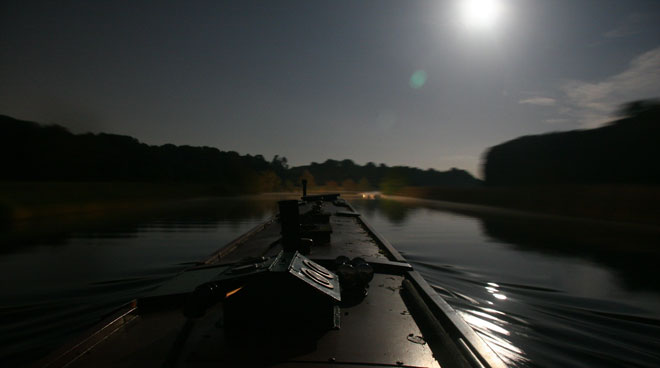
    Boating at night on inland waterways

    There are many reasons why a boater may find themselves having to boat at night.  It could be due to illness or emergency, such as a crew member becoming unwell or needing to get your boat past a short-notice stoppage.  It could be due to the timing of a tidal passage, or it could be through miscalculation of the time needed to reach a mooring, or it may simply be through choice.

    IWA supports the principle of being able to navigate at night. Boating at night is something that is allowed for in some but not all navigation authority byelaws, and for commercially operated boats it is often a necessity.  There are some places where it is prohibited, for example on the River Wey, Middle Level and Chelmer & Blackwater navigations – so it is best to check with the relevant navigation authority.  Most hire boat companies also prohibit boating at night, so if you are on a hire boat holiday in the winter you will need to make sure your schedule allows for mooring up before it gets dark.  Boat owners should check the terms and conditions of their insurance.

    There are a few things that boaters should bear in mind, especially if you’ve not been boating in the dark before.

    1.  Headlight

    Ensure your boat has a good headlight, particularly on narrow waterways where you may need it to see where you are going and to avoid damage to your own or other craft.  Bear in mind though that headlights are intended for use in tunnels and can easily dazzle oncoming boaters or towpath users.

    2.  Navigation Lights

    Whilst carrying a headlight alone is permissible for narrow boats on the narrow canal system, for larger craft and on larger waterways, rivers and freight waterways navigation lights are required.  These should consist of a white masthead light (not a headlight), a red side light on the port side and a green side light on the starboard side (neither of which should be visible from behind), along with a white stern light.

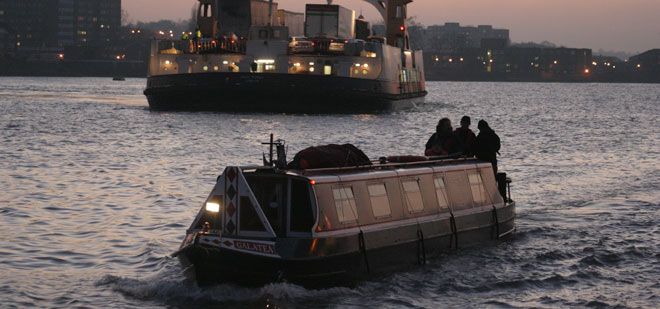
    Night boating on the River Thames. Photo by Tim Lewis.

    You should have these navigation lights fitted if you are cruising on any of these waterways, even if you do not intend to do any boating at night, as you may find you have to use them if you break down, or your plans change once you are on the waterway and you need to make a tidal passage late in the day or early in the morning, or you suddenly find visibility is reduced (e.g. due to fog) and there is nowhere safe to moor nearby.

    More detailed information, including requirements for vessels of different lengths and for different waterways, can be found on our boating pages.

    3. Passing Moored Boats

    When boating in the dark try to consider moored boats and the people who may be on board – especially if boating late into the evening, through the night or very early in the morning.  Sound travels on the water, so avoid having to shout to your crew, and slow well down past moored boats (pass even more slowly than you would during the day) to minimise disturbance.

    Passing moored boats. Photo by Paul Strudwick

    4. Have a Torch to Hand

    Make sure that your instruments are visible in the dark.  Head torches are great inventions and extremely useful when boating in the dark, especially when operating locks or mooring; however, be careful not to dazzle others by moving so that the beam shines in their eyes.  Having a hand held torch close to the steering position can also be a good idea – but bear in mind that bright lights will affect your night vision. Having a supply of spare batteries for your torches is also sensible.

    5. Navigating Your Route

    Make sure that you are familiar with your route, and have appropriate maps, guidebooks or navigation charts to hand, so that you know when to expect junctions, locks, bridges and bends and can recognise individual lit navigation marks.  Take particular care at these places and in particular take extra care if operating locks at night (where this is permitted). If you are boating single-handed give serious consideration to the risks.

    Beware of overhanging bankside vegetation, on cloudy or moonless nights in particular, and especially on rivers keep a look out for floating objects.  Depending on the surface material, towpaths or river banks may show up more than the darkness of the water in the waterway, and you can sometimes use the towpath or bank to work out which way the canal or river goes around a bend.  Night boating on rivers or larger waterways can bring other challenges and you will need to be on the look out for weir signs and navigation channels that may not be so obvious in the dark.

    6. Let Someone Know

    Make sure someone else knows where you are going, have some form of reliable communication on board (preferably marine band VHF radio on larger waterways where this is in use) and have an anchor ready for deployment in an emergency (and know how to use it!).  Even if you don’t wear a lifejacket the rest of the time, it can be a good idea if boating in the dark or in very low temperatures (immersion in very cold water is more likely to lead to life-threatening situations).  IWA advises against boating in the dark in other conditions with increased risks, e.g. floods, mist or fog, extreme ice or snow, etc.

    Photo-top: Boating at night on the River Weaver. Photo by Steve Wood

  • How to Moor a Boat

    How to Moor a Boat

    Learning how to safely moor your boat is an essential lesson to any new boater.  However a reminder for the experienced boater can also be valuable and can lessen the chance of damaging their boat, the bank or even another boat.

    Read on for an overview of how to moor your boat, what knots to use and the safety precautions to take.

    Encourage everyone to use long lines for mooring; it is good practise to reduce load and wear on rope, bollards, bank piling, mooring pegs, structure of the boat, boat bollards, and also to reduce the damage done when the water level changes more dramatically.

    The last one may be rare on the inland waterways, but any breach in a canal or change in level for emergency reasons, will result in damage to boat and/or bank (i.e. to both boat owner AND navigation authority), or of course pull your mooring pins out.

    Those who moor sensibly cause little or no damage.  Those who moor carelessly with short rope are either hanging there, damaging the boat, possibly causing the bank to give way, or drifting down-stream with rope in the water.

  • Getting to Grips With Single Handed Boating

    Getting to Grips With Single Handed Boating

    IWA supports the principle of single handed boating, but acknowledges that risks of accident are much greater if you are boating without crew, and recommends the following advice for people boating on their own.

    Planning ahead

    Single handed boaters should take responsibility for their own actions in the knowledge that the risks associated with boating on their own are greater than with a crew and they should limit those risks according to conditions.  For example, someone who frequently single hands their boat through locks in normal weather conditions may decide to postpone his or her trip due to extreme conditions such as ice or snow.

    When boating single handed it is sensible to plan ahead and to have an idea of where you intend to get to each day, especially on rivers or waterways with few places to moor.  It’s also a good idea to plan for practical things, such as ensuring that you have enough food and drinks easily to hand and extra layers of clothing or a waterproof jacket easily accessible in case the weather should change.  Some boaters prepare hot drinks in a flask, before they set off, to drink later on.

    Mooring and setting off

    A centre line (typically attached to the roof of a narrow boat or to bitts or cleats on the stern quarter for barges or cruisers) of a good length is essential for single handed boating for a number of reasons.  It is useful when mooring up, enabling you to bring the boat alongside the bank before then making it secure at each end.

    A centre line is also handy for temporarily mooring up your boat at the lock landing stage while you get the lock ready, but make sure it is tied up tightly enough or that the engine is left in forward gear to hold the boat in, so that one end of the boat won’t swing out in front of boats coming out of the lock.  A centre line can also be used for those occasions when you need to moor up very briefly to use the toilet or boil the kettle, for example, but remember that if the rope is attached to the boat roof, passing traffic may make the boat tilt significantly.
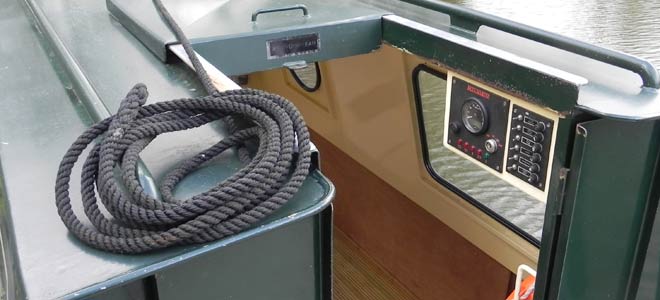
    Having the centre line coiled ready near the steering position means you can step off the boat with rope in hand. Photo by Alison Smedley

    The centre line should be long enough for the end to be coiled up and placed close to the steering position, so it can be picked up easily as you step off the boat.  Another handy tip is to position the end of the rope to the side of the cabin closest to the towpath and move it across if the towpath changes side or to have two ropes, one on each side (especially on a larger barge or cruiser), so that you can always easily step off the boat with rope in hand.  On a river or tideway with noticeable flow, it is essential never to step off the boat without a rope in hand; if the boat drifts away while you are ashore there will be no-one on board to bring in back in again!

    When you set off from a mooring, make sure you coil the mooring ropes neatly so that they are ready to use when you want to moor up again later on. It’s a good idea to have the mooring hammer and pins handy too.

    Locks

    Allow extra time – it will probably take you longer to get your boat through a lock than it would with crew, as you will have no-one available to go ahead to prepare locks.

    When operating locks single handed it’s a good idea to do things as efficiently as possible so you don’t get over tired, although you will find that there is no way to avoid a certain amount of walking backwards and forwards.   Take it steady and don’t run, as that may lead to a fall or slip.

    Experienced single handed boaters will adapt their own technique for going through locks, which will be based on their knowledge of how their boat behaves in different types of locks and in certain conditions (eg wide or narrow locks, going up or going down) and on knowledge of specific hazards with locks on a particular waterway which may result in the boat getting caught up (for example wide gaps between balance beams and planking on river locks which may catch your bow or lockside chains on which a hard-chined narrow boat may hang up).
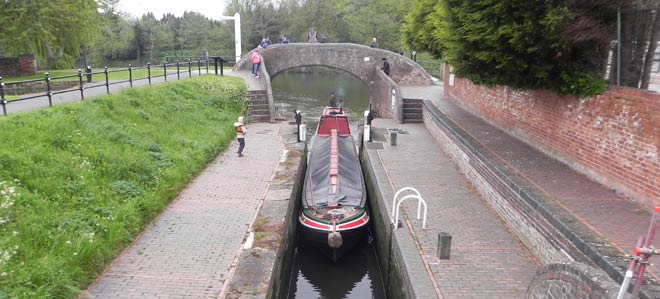
    A narrow lock with a lock ladder makes for easy work for the single handed boater.  Photo by Alison Smedley

    Most locks these days have lock ladders fitted, which makes life much easier for the single handed boater.

    Just as when locking with a crew, it is essential to keep an eye on what the boat is doing at all times and to check that it is floating freely and hasn’t got hung up anywhere.  Even in narrow locks it is always sensible to have a rope (ideally a centre line) on the lockside with you, so that you can pull the boat out of trouble if necessary and can move it to a ladder allowing you to board.

    On river navigations and canals with wide enough locks, it’s always best to share locks with other boats in order to save water.  If the other boat has plenty of crew they may be happy to operate both sides of the lock but don’t assume so and be prepared still to do your bit.

    On some larger waterways there is a requirement for marine band VHF radio (and it’s a good idea on larger waterways even where it’s not obligatory), in order to communicate with lock and bridge keepers and other vessels.  On certain larger waterways, such as parts of the tidal rivers Ouse and Trent, the byelaws prohibit single handed boating and you may be denied access to the tideway at places such as Goole if you are alone, so you will need to find some crew if your journey includes any of these stretches.

    Lift and Swing Bridges

    Moveable bridges, just like locks, should have a landing area where you can tie up the boat while you open the bridge, then return to the boat and take it through, tie up again and return on foot to close the bridge.  Some moveable bridges still have the operating controls on the offside, which can make it difficult for the single handed boater and operation usually involves having to nose the boat right up to the bridge in order to get off, so that you can get back on again once you’ve opened the bridge in order to move the boat through, and then carry out a similar procedure once you are through the bridge in order to close it again.  IWA policy is to press for proper landing stages to be provided on the offside in these cases but there are still bridges where the only option is to climb over bridge railings with rope in hand.

    Tunnels

    Before entering a tunnel it’s worth making sure that you have a torch to hand (and a spare in case the batteries fail), and a waterproof jacket, as most tunnels tend to have water dripping from the roof and there won’t be anybody in the cabin to pass out a coat to you!
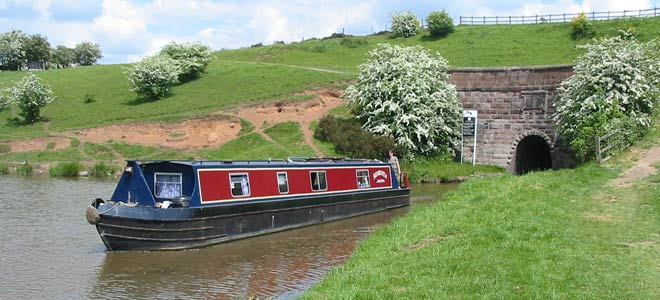
    Caldon Canal, Leek Tunnel

    Weather conditions

    Ice, snow, rain, hail and strong winds are all types of weather that can make single handed boating more difficult and when these weather conditions are extreme it is probably advisable to postpone your trip.  Don’t forget the effects of too much sun either.  If boating in hot weather or a heatwave it is advisable to wear a hat and sunscreen, make sure you have plenty of cold soft drinks to hand and be prepared to moor up for a siesta during the hottest part of the day.

    Safety considerations

    Even if you don’t wear a lifejacket all of the time, it can be a good idea if you are boating on your own in certain conditions, such as on rivers, through tunnels, in the dark or in cold weather conditions (immersion in very cold water is more likely to lead to life-threatening situations).

    On rivers and tidal waterways (and in tunnels) falling overboard when alone may be extremely hazardous, even if wearing a lifejacket.  On a boat steered with a tiller, contact between the rudder and floating debris when the boat is moving at a reasonable speed can be enough to unbalance the steerer.  Risks can be minimised by steering the boat from the safest position possible; for example on a traditional-stern or semi-trad narrow boat, stand in the hatches with the doors closed behind you, so that you can only fall inside the boat.

    Wearing stout shoes with a good grip is sensible and do take extra care when stepping on and off the boat in the rain, ice or snow, as surfaces are likely to be slippery.

    It’s good practice to keep the roof of your boat clear so that you can get on and off using the roof when locking. Lock ladders are rarely in the right place (and in the bottom of a narrow lock it is difficult to walk along the gunwales to get to the lock ladder), so you will need a way of easily getting on to the cabin roof (a small folding metal step is easily installed on the cabin side if you don’t already have one) from the steering position.
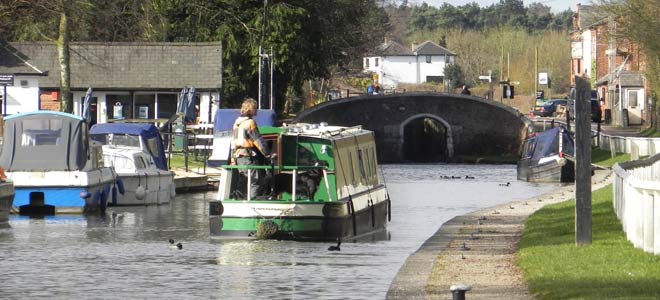
    Single handed boater at Fradley on an early spring day. Photo by Alison Smedley

    It’s a good idea to know where you are along the waterway and what feature, such as a junction, flight of locks or a tunnel, is coming up next, so you might want to make sure you have a waterway guide showing the whole of your route handy.  If you are boating on a river or tidal waterway it’s sensible to know where there are safe places to moor in an emergency.  It’s also advisable to ensure that your anchor is ready for use at all times on rivers and tidal waterways.

    These days most boaters have a mobile phone and when boating on your own this is recommended, as you may need to call for help in the case of an accident or sudden illness.  It’s a good idea to know roughly where you are along a stretch of waterway as if you can inform the emergency services of the nearest bridge name or number this can usually help them to locate you.  It can also be a good plan to make sure that family or friends are aware of your route and to arrange to make regular contact with them.

    Many of these suggestions equally apply if you are boating with a crew, so whatever trip you are planning, with or without friends and family, do stay safe.
  • Get your bike towpath-ready

    Get your bike towpath-ready

    Want to take your bike along the towpath but not sure where to start? Dedicated volunteer and cycling enthusiast Richard Worthington has put together information and advice to help get you cycling along the canals.

    Towpath

    Checking out the state of the towpath beforehand will give an idea of the sort of preparation you need. Some are just like a pavement, others a rough track or gravel path. Whilst they are generally flat (apart from where the are locks or tunnels), they can vary in width and surface along their length. A rougher track can contain ruts and potholes that could bounce you into the canal if taken at too high a speed. Very muddy towpaths can be slippery and dangerous.

    Bike

    You don’t need a serious off-road mountain bike for towpath use, anything other than racing bike should be fine.

    Courtesy

    Cyclists on a towpath need to take care if there are other people using it. Walkers, joggers, anglers and other cyclists are common (plus the occasional volunteer) and pedestrians have the right of way, so moderating your speed, giving way and using a bell are important. Read our Waterways Cycling Code.

    Tyres

    Hybrid tyres (flat in the middle, knobbly on the edges) or a thinner mountain tyre should do on most towpaths, giving a smooth ride on harder paths and enough grip on a rough one. Oversized offroad tyres are unnecessary and will probably churn up and damage the towpath, particularly if it’s been raining.

    Mudguards

    Mudguards will stop you getting covered in water and mud and can also protect the gears and brakes of your bike from getting clogged up.

    Punctures

    You can get a puncture anywhere but on a towpath they’re likely to be from thorny vegetation. There are a number of ways to help prevent them:

    • Selfsealing inner tubes contain a glue which will seal small holes for a few pounds more than a standard tube
    • Tyre liners go between the tube and tyre to add an extra layer for under £10
    • Puncture resistant tyres offer the greatest overall protection for £15 and up

    If you do get a puncture, the quickest way to fix it is to carry a spare tube and patch the punctured one when you get home. Obviously a pump is essential and the tools to do the work. Carefully check the tyre to make sure there isn’t anything still stuck in it to cause another puncture.

    Repairs

    In addition to a puncture repair kit or tube, a small cycling multitool can mean the difference between cycling and walking home. If you are going for a longer ride additional tools can be useful, but this needs considering against weight and space.

    Find out more about cycling near the waterways, including cycle routes and our Waterways Cycling Code.