Blog

  • Ten mammals to look out for around the waterways

    Ten mammals to look out for around the waterways

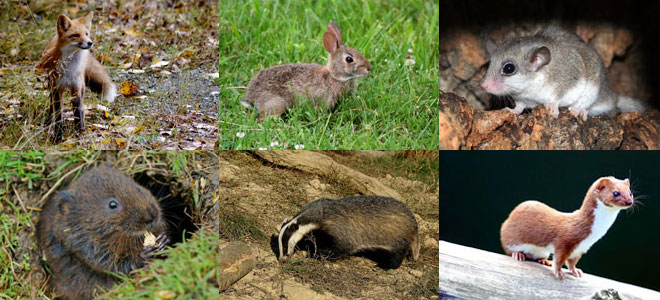
    You never know what you may come across, from the familiar sights of rabbits and foxes to a rear glimpse of badgers or otters.  Here is our guide to spotting mammals along the waterways.

    Water Vole

    Water voles are also known as water rats, but they are different animals. Water voles have rounder noses, deep brown fur, short ears and their tails, paws and ears are all covered in hair. Water voles often like to sit and eat vegetation such as waterside plants and stems in the same places. Water voles live in burrows within the banks of rivers, ditches, ponds and streams and like to be beside slow moving, calm water. They are experts in swimming and diving.

    Interesting fact: Every day a water vole will consume approximately 80% of its body weight. (Source: Nottinghamshire Wildlife Trust)
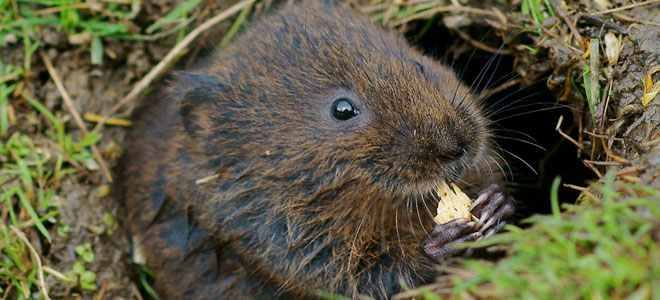
    Photo taken by Peter Trimming

    Otter

    Otters can live both on land and in water. Otters are found on river banks, lakes, streams and in some coastal areas.  They mainly eat fish but also frogs, crab and even small mammals and birds. They have features that enable them to live on the water such as a thick coat of fur which allows them to keep warm in freezing cold water, webbed feet, and they can close their ears and nose whilst swimming.

    Interesting fact: An Otter can remain under water for up to 4 minutes and can dive up to 300 feet in search of food. (Source: Otter World)
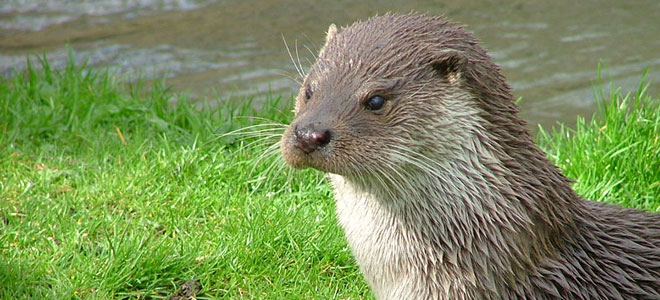
    Photo taken by Catherine Trigg

    Dormouse

    Dormice have a golden coat with a thick furry tail and large black eyes. They are nocturnal creatures and can spend up to three-quarters of their life asleep; they hibernate when food is low to conserve energy. Their diet consists of buds, hazelnuts, berries and insects. In Britain, dormice are mainly found in the southern counties.

    Interesting fact: Dormice can spend their entire lives high up in the trees without ever touching the ground. (Source: The Wildlife Trusts)

    Photo taken by H. Osadnik

    Hare

    Hares are up to 70cm long and weigh around 7kg. They have long ears with black tips, a white underbelly and tail with big eyes on either side of their head. Compared to rabbits, hares have a more upright posture and  longer limbs. They can be seen, in woodlands, hedgerows or arable land. Their diet consists of plants, crops, berries, fungi and roots. Unlike other mammals, hares do not hibernate in the winter but instead store large amounts of fat in their bodies.

    Interesting fact: A hare’s ability to run fast can put distance between themselves and danger. With running speeds of 35 miles per hour they are the fastest land mammal in the UK (Source: Nottinghamshire Wildlife Trust)

    P

    hoto taken by Bohringer Friedrich

    Badger

    Badgers live in groups in underground tunnel systems created by themselves or other badgers. These are called setts and can be made on the embankments of canals. Badgers have black faces, white markings and a light coloured underbelly. They are nocturnal creatures and their diet consists mainly of earthworms but they also like to eat insects, bluebell bulbs and elder berries. Badgers are most easily seen near their setts or searching for food at night.

    Interesting fact: Despite being nocturnal, badgers have poor eyesight but have an excellent sense of smell and acute hearing. (Source: Nottinghamshire Wildlife Trust)

    Photo taken by Peter Trimming

    Stoat

    These mammals are brown in the summer but can turn white in the winter, except for the tip of their tails which is black. They can be seen around hedgerows, paths, walls, ditches and like to stay near to an area with lots of food around. Stoats are predators eating birds, reptiles and small mammals and also take chicken eggs. Stoats mostly move around at night and can sometimes be seen in the day but be careful not to startle them as they can quickly disappear!

    Interesting fact: Stoats can kill adult rabbits that are much larger in size to themselves with a bite to the base of the skull. (Source: The Wildlife Trusts)
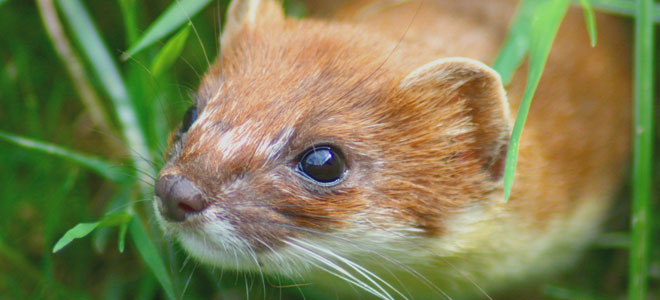
    Photo taken by Keven Law

    Wood Mouse

    Wood mice are small mammals with a light brown coat and big eyes and ears. They can be mostly found in woodland areas looking for food such as seeds from grasses, herbs and trees or buds, shoots, berries and insects. Wood mice usually live for no longer than two years because they get eaten by animals including foxes, weasels and owls.

    Interesting fact: With approximately one wood mouse for every two people in the UK, they are one of its most common small mammals. (BBC Nature)
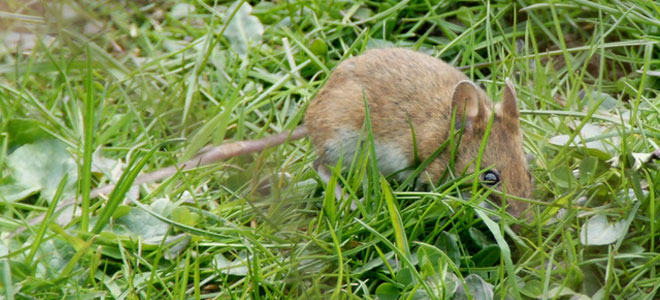
    P

    hoto taken by Mike Pennington

    Weasel

    Weasels are smaller in size to stoats and do not have a black tip on their tails. They are able to adapt to live in many places including grassland and woodlands. Having long thin bodies allows them to hunt for food such as mice, voles and shrews in their burrows underground.

    Interesting fact: A weasel has its own territory of between five and eight hectares and during the night this mammal can travel up to 2km hunting for food. (Source: Nottinghamshire Wildlife Trust)
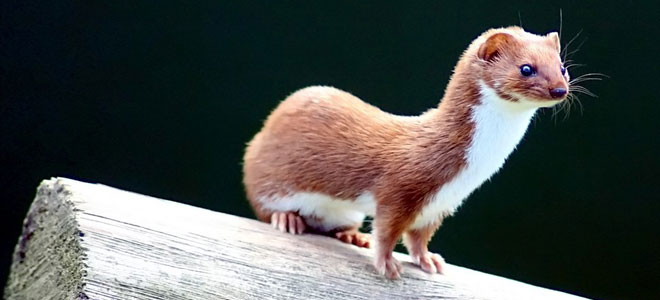
    Photo taken by Keven Law

    Fox

    Found in either the city or countryside, foxes do not hibernate in the winter months and are most likely to be seen at dawn or dusk hunting for food. They are small mammals with a reddish brown colour coat, pointed ears and a bushy tail and can produce 28 different calls. Foxes are known for hunting poultry but can eat anything they come across being omnivores. Foxes stay and live together in groups, during August to November any cubs within the group leave to find new territories.

    Interesting fact: Male foxes bark but females make a spine-chilling scream, this can be heard often in the winter when their courtship takes place. (Source: The Wildlife Trusts)
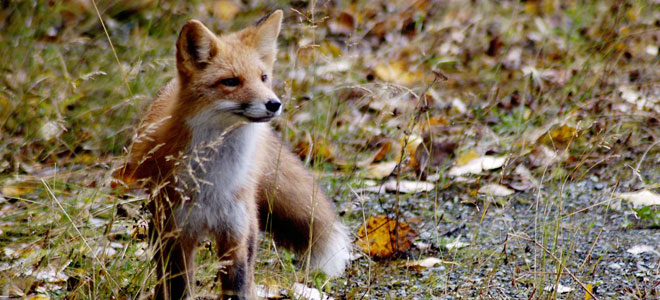
    Photo taken by Laubenstein Ronald, U.S. Fish and Wildlife Service

    Rabbit

    Rabbits are a familiar sight in Britain and can be seen in fields and woodland during the day and night, usually in large groups. Similar to hares they have long sensitive ears to alert them of possible danger and eyes on either side of their heads allowing 180 degrees of vision. Rabbits out in the wild often have grey hair and white bellies with a fluffy tail. As a warning signal to other rabbits that predators are about, rabbits thump their back legs. Their diet contains any vegetation such as grasses, tree bark, small herbs and agricultural crops.

    Interesting fact: A rabbit thumping it’s back legs sends a warning to others that one of their numerous predators is about. (Source: BBC Nature)

    Photo taken by ForestWander

    Take a look at our guide on Ten Birds to Look Out For Around the Waterways.

    Find out more about wildlife by the waterways.

    Sources
    BBC Nature
    The Wildlife Trusts
    Nottinghamshire Wildlife Trust
  • The Pros and Cons of Living Afloat

    The Pros and Cons of Living Afloat

    Thinking of embracing a life afloat but not sure what to expect? For most people it will mean a huge lifestyle change and isn’t a decision to be taken lightly. Alison Smedley, chair of IWA North Staffs and South Cheshire Branch, spent seven years living on a boat. Find out about some of the highs and lows of her experience living aboard a narrowboat.

    “Isn’t it Cold in Winter?” people used to regularly ask me, during the 7 years I spent living afloat.  “No”, I used to reply “It’s nice and snug with the stove going”.  That wasn’t the reality, of course, I used to gloss over the mornings when I would wake up shivering under the duvet with ice on the inside of the windows because the stove had gone out during the night, or because I’d arrived home too late the night before to re-light it.

    People often have an image of life afloat as being idyllic and peaceful.  It’s nothing of the sort, in my experience.  It can be fun and exciting, but it can be cold, hard work and lonely too.

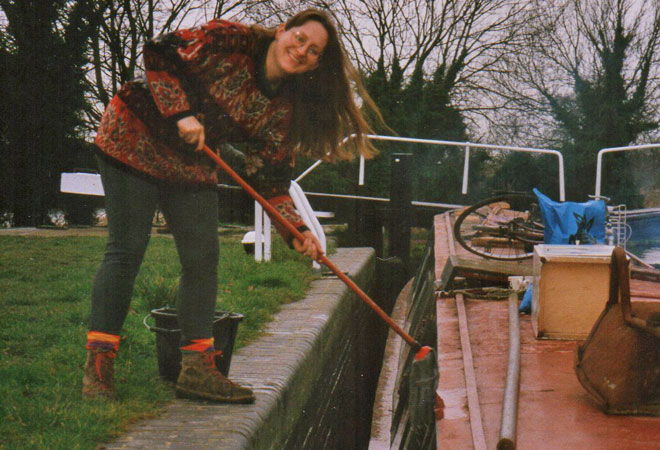
    Photo: Mopping the decks

    During much of my 7 years living on a narrow boat I travelled around a lot, and religiously moved the boat every two weeks.  For a lot of this time I was working as a secretarial “temp”, so was able to move from town to town and pick up work anywhere.

    As well as wanting to comply with the rules, moving every 2 weeks was necessary for practical reasons, being an opportunity to fill the water tank and visit a boatyard to get the toilet pumped out and occasionally fill up with diesel and get gas bottles replaced. I would often plan this for a weekend and invite friends over for a day trip or a weekend on the boat, but the rest of the time I had to do it on my own, which could be challenging and wasn’t quite so much fun in the rain.

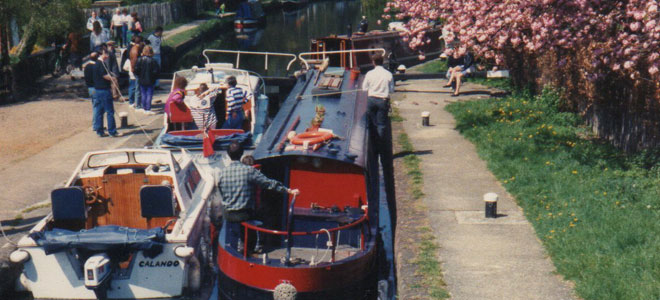
    Photo: Moving from one place to another can often make for a lovely day out with friends

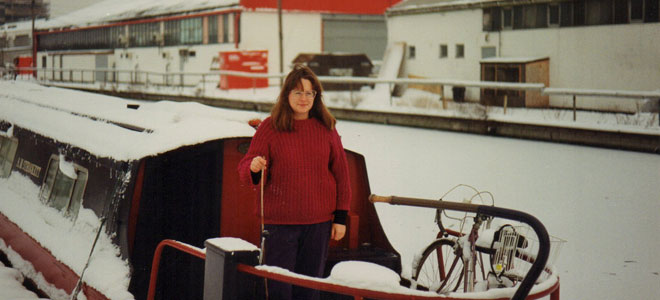
    One winter the canal froze for weeks and I couldn’t move the boat anywhere.  I managed to obtain sacks of coal and a new gas cylinder by dragging then along the towpath through the snow from the nearest boatyard, but the available water in the water tank got less and less as it froze in layers above the reducing amount that was still liquid.

    Photo: Snowed in at Uxbridge

    One peculiarity of living on a boat is that unlike bricks and mortar it doesn’t necessarily stay where you put it!  I once woke up in the middle of the night to the sound of rushing water to discover the boat had come adrift (strong winds had pulled out the mooring pins) and the boat had drifted some distance along the canal into the lower entrance of a lock, with excess water pouring over the bottom gates.  Quite a shock when I opened the front doors to a cascade of water!  Another time the boat was purposefully set adrift from the mooring rings I had tied to, and I woke up to find the boat on the other side of the canal along with 2 or 3 other boats that had been untied.

    As a female in my early twenties, my personal safety was something that other people, particularly my parents, used to worry about – walking home along a dark towpath late after a night out didn’t particularly worry me at the time, but looking back I realise that I was lucky not to have had any serious mishaps.  One time the boat was broken into and a camera and jewellery stolen – fortunately I wasn’t on board at the time.

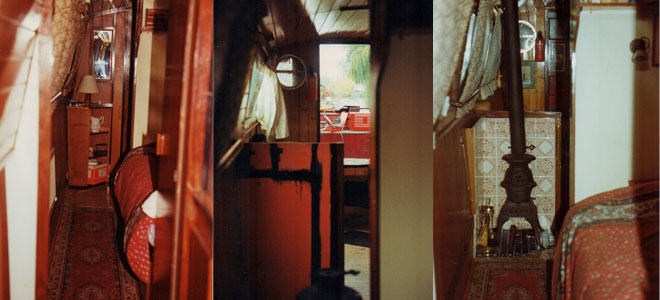
    Photo: You may decide to make modifications to your boat, these photos show a corner cupboard being replaced with a solid fuel stove.

    Although I am a fairly practical person, I don’t think I would have survived at all without a circle of friends who used to come along and help me sort out flat batteries and an engine that wouldn’t start, or help installing a wood burning stove, or helping out in dry dock.  Of course often these events turned into social occasions, and I like to think that I hosted some pretty good parties during those seven years!

    Photo: First dry docking of many – Tardebigge Dry Dock

    When people heard that I lived on a boat, they would often ask me about it as a cheaper way of living.  My response was always that you should want to live on a boat for the right reasons, because you are interested in boating and the waterways, and not just because it might seem like a cheaper option than a flat or a house.

    In my experience, barely a week would go by without some issue to deal with – a storm bringing a tree down on the boat, the engine not starting, going to moor up after moving one weekend to discover I’d left the mooring pins behind ten miles away, but the sense of satisfaction of owning and living on my own boat was something that for me made it all worthwhile.


    Photo: The pleasure of steering your own boat down the cut

    Living on a boat might seem cheap compared to living in a house, but instead of gas, water and electricity bills, and repairs to plumbing, roofs, boilers and the like, on a boat you have diesel and gas to purchase, toilet contents to get rid of (whether that is emptying it yourself or paying for a pump out), repairs and regular maintenance to the hull and superstructure, and maintenance, repair or replacement of equipment such as engines, generators, water pumps, bilge pumps, shower pumps, inverters ( there is an endless list of equipment that people can have on their boats).

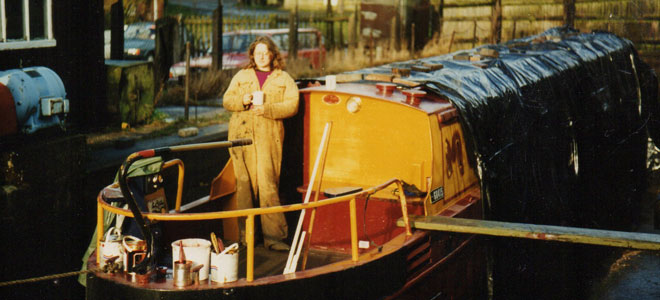
    Photo: One day you may decide a complete re-fit-out is needed! Photo: Alison decided to take out the pump out tank and replace it with a porta potti – not a pleasant job!

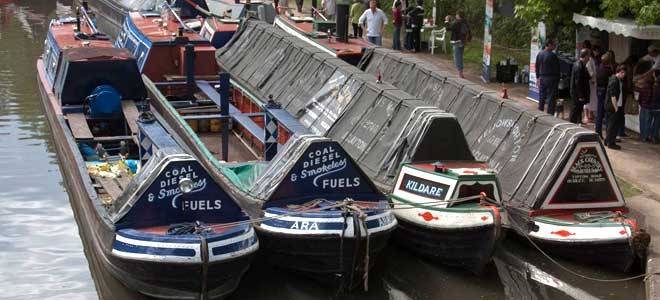
    Many people who live afloat these days rely heavily on the various trading boats who do a sterling service plying up and down our waterways selling solid fuel, gas and even offering toilet pump outs.  Although even these boaters have to fend for themselves if the canal ices over for weeks and the service boats can’t get to them.

    Photo: Some parts of the waterway system have a trading boat offering solid fuel, diesel, gas and even pump-outs

    There are many things to consider when contemplating a life afloat:

    • Licence – you will need a licence for the navigation authority for the river or canal that you plan to be based on, and visitor licences for any waterways in different navigation authority ownership that you may wish to visit.
    • Mooring – if you want to live in one place, so you can attend college or get to your place of work, for example, and not be continually moving your home around, you need to find a mooring (preferably before you take the plunge and buy a boat). Suitable moorings in popular areas such as London are scarce and can be very expensive.
    • Alternatively, on Canal & River Trust waterways  you can declare yourself as ‘continuously cruising’, which means you don’t have to pay for a mooring, but you will need to move your boat at least every 14 days (sooner if moored at a visitor mooring which specifies a shorter period).  And this doesn’t just mean moving round the bend to the next road access point.  If you have a job based in one place, or other local commitments such as school for your children, this isn’t a practical option, and you should look for a permanent mooring.
    • Insurance – in order to obtain a licence you will need to take out at least third party insurance.  However, if all your worldly goods are on board you may wish to take out full insurance on the contents too.  Boat fires and boat sinkings are both things that can and do happen.  Boats also tend to be less secure than houses and boaters often find things stolen from their roofs or decks even if the cabin hasn’t been broken into.  If the boat is more than 20 years old then most insurance companies will insist on regular hull surveys (out of the water) – a considerable expense.
    • Are you practical?  Can you fix the engine (or bilge pump, water pump, etc) when it breaks down, or will that be an additional expense?
    • Can you actually steer and manoeuvre the size of vessel you are contemplating?  Why not book yourself on an RYA Helmsman course to learn some useful skills.
    • Boat safety – boat fires and carbon monoxide poisoning occur on board boats for various reasons – you need to be aware of your own safety and not block air vents or escape routes. Every 4 years you will need to pay for a Boat Safety Examination – and heed the advice of the examiner in keeping your boat safe for you and other users of the waterway.  Boat fires happen more often than you might think, and could happen on a boat moored next to you, however safe your own boat is.
    • Water – filling up the water tank is something that you will have to do more frequently than you might think if you are living aboard, and it could be some hours boating to the nearest water point.  You’ll very quickly become conscious of the amount of water you use washing up or having a shower.
    • Heating – How is the boat heated – it’s a good idea to have two sources of heat so that one can be a backup in the event of running out of fuel or something breaking down.  Diesel and gas can be used for heating systems, and most boats also have a solid fuel stoves which can burn wood as well as solid fuel (smokeless fuel is not required by law even in a smokeless zone but is a good idea to avoid annoying local residents).  You will have to think about how you will transport solid fuel, gas and diesel if not moored at a boatyard which sells them.
    • Toilet – What type of toilet does the boat have, and is it the best type for you?  A pump out tank needs emptying less often but can only be emptied at certain places, with a cost involved.  A “cassette” style toilet has a small portable tank that you can empty yourself, at “sanitary stations” provided by the navigation authority, at no cost, but will need emptying more often.  It’s a smelly job and not for the faint hearted!  It also has the benefit of being more portable so if you can’t get the boat itself to a disposal point you can still take a full cassette there.
    • Internet access and mobile phone signal are things everyone takes for granted these days, but you will need to think about how these are going to work for you on a boat, particularly bearing in mind a steel cabin’s tendency to affect signal.  There are various solutions available and you should research them if technology of this type is important to you.

    Some additional things to consider if going down the “continuous cruiser” route:

    • Planning ahead – You will have to think about where you are going to move your boat to every time you move, and plan your progressive journey ahead. Some parts of the country, notably London and the Bath/Bristol area, are getting extremely overcrowded, making it very difficult to find a mooring when you do move.
    • Transport – If you own a car you will have to work out where you will keep it, and how you will retrieve it each time you move (a bicycle comes in very handy here).  You may also find that you will be using public transport a lot more – another added expense.
    • Electricity – These days electricity is needed for everything from lighting the boat to running the pumps so you can have a shower, and for charging your mobile phone or tablet. Where is your electricity going to come from?  You will need to either run your engine or a generator (both noisy) in order to keep your boat batteries topped up.  Wind generators and solar panels can be useful additions to top the battery up, but both rely on certain weather conditions so cannot be relied upon solely. Finding a mooring which comes with an electricity supply is the best solution to this problem, if you think you are going to spend most of your time moored up and not travelling around the system.
    • Being a good neighbour – Do be considerate to your neighbours on land or water. Excessively smoking chimneys, generators or engines running for long periods and belongings spread across the towpath will not endear you to the local community.
    • Groceries – Think of all the food (and drink!) that you consume, and then bear in mind that you are more than likely to have to carry it some distance from where you bought it.
    • Winter months – What will things be like in the winter?  Make sure you have made plans for how you are going to cope.  Not all areas benefit from the services of a coal boat regularly plying up and down selling coal, diesel and offering pump outs.  A spare portable type toilet (or extra cassette) in case you can’t get your tank pumped out, is a good idea, but bear in mind you will have to carry it along the towpath (although a wheelbarrow or trolley can come in handy here).
    • Personal security – Your personal security getting to and from the boat – will you feel safe walking along unfamiliar towpaths in the dark as you move around from place to place?  Or would you be better off with a permanent mooring in a secure boatyard or mooring site?
    • Health services – You will need to consider what you are going to do if you need medical attention – while getting access to GP surgeries, dentists and hospital appointments is possible, it will always be harder if you are just passing through an area, and may hold up your planned schedule while you have to wait to be seen or for follow up appointments.
    • Voting – You can register to vote even if you do not have a permanent mooring or home address, by registering a “declaration of local connection”.  This can be the place you were last registered, a boatyard you have used for maintenance, or somewhere you spend a lot of time. 
    • Emergencies – When moored up in the middle of anywhere its always a good idea to know your exact location so that you can advise the emergency services should they be required due to an injury, illness, accident or fire.
    • What happens when you want to move back to the land – Living on a boat should not be seen as a first step onto the housing ladder.  Unlike property, even well built and maintained boats will not appreciate in value and are likely to lose value each year.
    • Over-staying – If you are tempted to ignore the rules and over-stay in one place, you will find yourself extremely unpopular with fellow boaters, which is a pity as the camaraderie between boaters is one of the special things about living afloat.  More importantly, Canal & River Trust can and will take action against offenders and you may ultimately end up in court and/or lose your boat.

    Many of these problems are overcome if you have a permanent mooring, or if you are genuinely travelling around the waterways network.  If you are continuously cruising your electricity will be generated as you boat along, and you will frequently pass shops, water points and boatyards.  Some Navigation Authorities such as Canal & River Trust offer winter mooring permits to boats that are otherwise “continuously cruising”, which mean that you can base yourself in one place for the colder months.

    Living aboard can be a hugely enjoyable and rewarding experience for those who have a passion for boating and the waterways environment – but it’s a labour of love. It’s not an easy or particularly cheap option, so it’s important to seriously consider all the implications before making a decision.

    To find out more, do look at the living afloat section of IWA’s website

    Alternatively you can consult the Residential Boat Owners Association website

    Or see the advice given to people contemplating continuous cruising on the Canal & River Trust website (PDF).

  • Historic Boat Spotting Guide

    Historic Boat Spotting Guide

    Wood or Iron/Steel?

    The early narrow boats were all made of wood.  Iron was used from the 1830s and was much more expensive but the boats lasted much longer.  By the 1930s, steel was being used for most of the new boats being built, although there were some still being built in wood and iron, particularly on the BCN (Birmingham Canal Navigations).

    Wooden narrow boats are becoming scarce because the maintenance required has meant that many have been lost over the years.

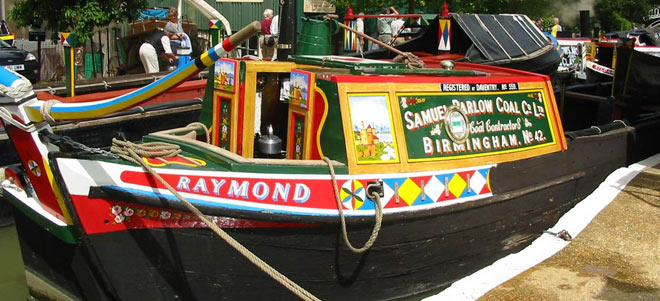
    Image: This photo shows Raymond, which was the last wooden narrow boat built, in 1958 at Braunston (photo by Tim Lewis)

    Motor or Butty?

    In the early 20th century, steam and later diesel engines started to be installed in boats, which meant the shape of the stern had to be changed to allow the new arrangement of a propeller to work.  This became known as a counter stern.  Butties (the towed second boat) meanwhile retained the overall hull design of the horse boats.

    When identifying a butty, it is useful to know that some of them are still original unpowered butties, some have been given some form of propulsion but retain their pointed stern, whilst yet others have had the butty stern cut off and a modern counter stern put on.

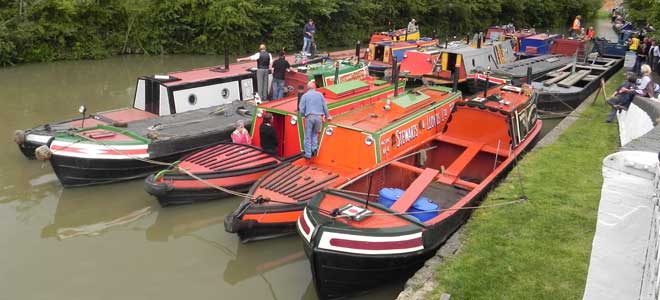
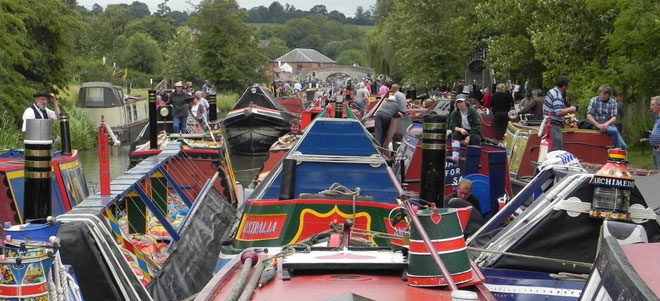
    Image: Two motor and butty pairs at IWA’s Canalway Cavalcade, Little Venice (photo by Alison Smedley)

    Rivets or Washers?

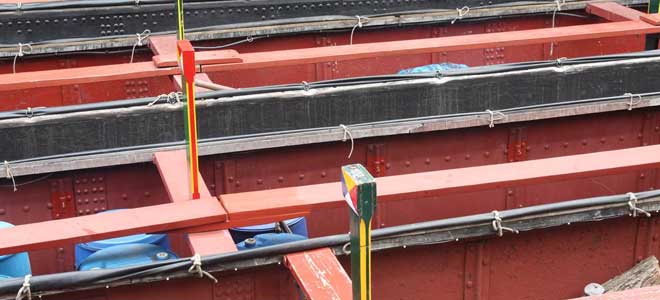
    Generally speaking, a boat with rivets is likely to be historic.  However, many modern boats are built with washers welded on the outside of the hull to look like rivets.  Some boat builders are getting very good at building replicas of working boats, so that it can be difficult to tell the difference (one clue is to look inside the well deck to see if you can see the other side of the rivets!).

    There are also some other exceptions, such as the fleet of welded wrought iron narrow boats built in 1930s for Severn & Canal Carrying Co Ltd.  There were all named after a species of tree (Oak, Elm, Fir, Pine, Beech, Alder, Willow and Ash) and were built by shipbuilders Charles Hill of Bristol.  Other exceptions include the last narrow boats built for commercial carrying, the River Class and the Admiral Class, built between 1957 and 1961, which were of welded steel construction.

    Image: Riveted hulls of working boats (photo by Alison Smedley)

    GUCCCo or FMC?

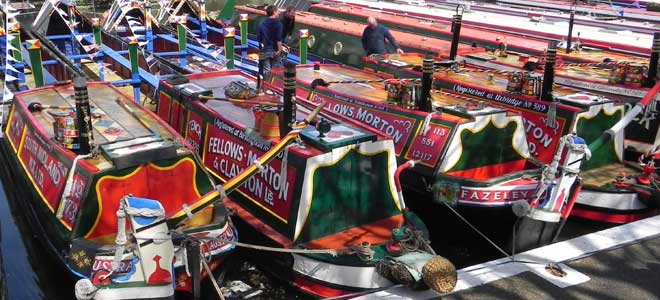
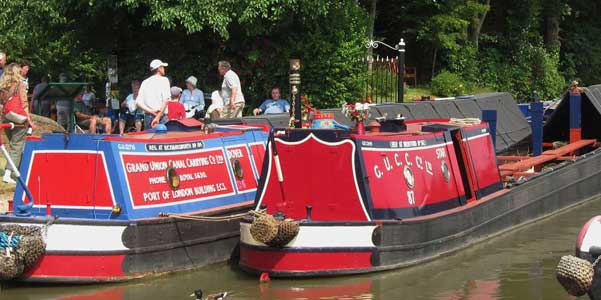
    Many of the historic working boats you see around today belonged to Fellows Morton & Clayton Limited (FMC) or the Grand Union Canal Carrying Company (GUCCCo), the two largest carrying companies.  FMC boats are known as “Joshers”, after Joshua Fellows, although in fact it was his father James who started the business in 1837.

    Image: GUCCCo and FMC pairs at the Rickmansworth Festival (photo by Tim Lewis)

    Hill Class or Fish Class?

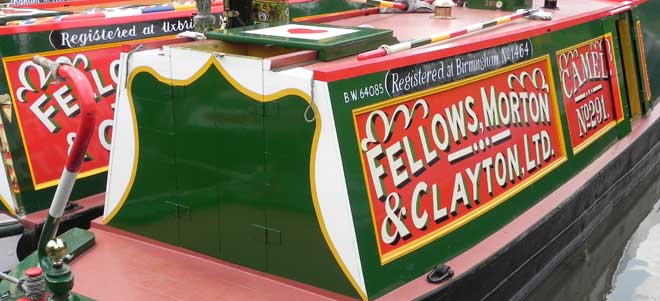
    FMC had two boatbuilding yards, at Saltley where they built iron boats and at Uxbridge where wooden boats were built.  They also had many boats built by W J Yarwoods of Northwich. There were various classes of boats, such as the 16 motor boats all named after Fish (eg Bream, Lamprey, Dory), and other series named after countries, flowers and birds. FMC’s Uxbridge yard was still producing wooden boats in the 1940s, including a series of boats named after hills (eg Clent, Clee, Chiltern)

    Image: Some FMC boats were named after animals, such as Kangaroo, Jaguar and Camel, shown here (photo by Alison Smedley)

    The George and The Mary

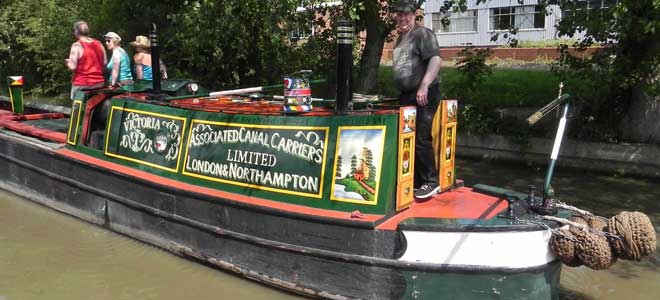
    GUCCCo is a much younger company and was a subsidiary of the Grand Union Canal Company Ltd, which had been formed in 1929 following the amalgamation of five separate canal companies.  At that stage they had just a motor and a butty George and Mary and the following year took over a small carrying company, Associated Canal Carriers.

    Further boats were acquired and then a fleet of boats, similar in design to George and Mary were ordered.  These were the Royalty Class boats:  Duke & Duchess, Edward & Alexandra, Henry & Anne, Prince & Princess, Victoria & Albert, William & Adelaide, and a number of these survive today.  They were big boats, with sides five foot deep and capable of carrying 70 tonnes a pair.

    Image: Royalty Class Victoria taking part in the historic boat parade at the Braunston Historic Boat Gathering (photo by Alison Smedley)

    Town or Star (Large or Small) / Woolwich/Northwich/Ricky

    In 1934 GUCCCo launched an ambitious expansion programme to increase the fleet to 100 pairs of boats, built by three different boat builders; WJ Yarwoods of Northwich, Harland & Woolf on the River Thames at Woolwich (both well known ship yards) and Walker Brothers of Rickmansworth. The first boats became known as the Star Class boats, all named after stars and constellations, and the later ones, which were built slightly deeper in the hold, were the Town Class boats, named after English towns and villages.  The boats built by Yarwoods and Harland & Woolf were all made of riveted steel, while the Walkers Brothers boats were wooden.  The combination of boat builder and class gave rise to nicknames such as ‘Large Woolwich’ or ‘Small Ricky’, a Large Woolwich being a Town Class boat built by Harland & Woolf, while a Small Ricky was a Star class boat built by Walker Brothers.

    In 1936 the Chairman of the GUCCCo was quoted as saying “never before in the history of canal transport has such a programme been embarked upon. The greater the number of boats in commission, the more economically and efficiently we can run our concern”.

    Image: This photo shows Star (Star Class) and Dover (Town Class) (photo by Tim Lewis)

    Other Carrying Companies

    As well as GUCCCo and FMC, there have been many smaller carrying companies throughout the history of the inland waterways, from Pickfords to Willow Wren.  There are too many to talk about here, but we’ve mentioned a few of them below.

    Young Sam or Old Sam?

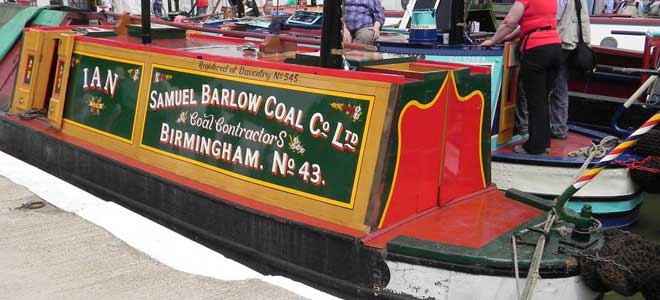
    Samuel Barlow was born in 1847 as the son of a canal boatman, who in 1867 set himself up as an owner boatman carrying coal from the Tamworth pits.  SE Barlows was a separate company set up in 1919 by Samuel Edwin Barlow, grandson of the original Samuel Barlow.  To distinguish between the two fleets, boatmen referred to boats of the original company as ‘Old Sam’s’ and the SE Barlow fleet as ‘Young Sam’s’.  The two companies worked well together, often on the same contracts.  Barlows boats still around today include Daphne, Ian and Beatty.

    Image: Ian, a Samuel Barlow’s motor (photo by Alison Smedley)

    Thomas Clayton of Oldbury Ltd

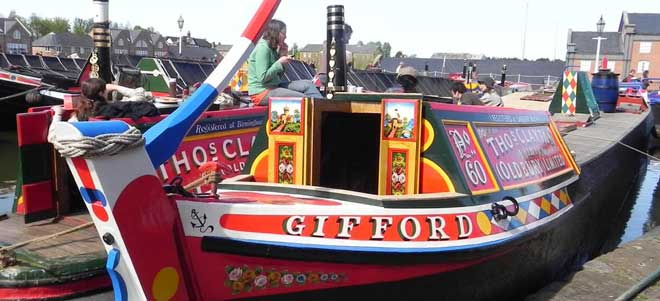
    Thomas Clayton (a member of the same family as the FMC Claytons) operated a fleet of wooden narrow boats built specially for carrying liquid cargoes such as tar, crude oil and creosote.  The boats (originally horse boats and later motors and butties) were built by a number of different builders, and were maintained at Clayton’s own dock at Oldbury.  Due to the preservative nature of much of the cargo, several of these boats still survive and they are recognisable by their long flat deck with small loading hatches.  Dane and Pearl are both examples of horse boats that were converted to motor boats.  Claytons boats that are still around today include Spey, Stour and Towy.
    Image: Gifford, the only Clayton’s horse boat to survive in an unconverted condition, restored and maintained by the Boat Museum Society at Ellesmere Port (photo by Alison Smedley)
    WH Cowburn & Cowpar Ltd

    This company’s origins began in 1877 when William Henry Cowburn went into partnership with a Mr Parkinson with premises at Potato Wharf beside the Bridgewater Canal at Castlefield Basin.  From the 1890s they supplied Courtauld’s Textile Mills with chemicals for cotton manufacturing and by 1914 they were responsible for the supply of much of Courtaulds raw materials to their sites in Coventry and Wolverhampton.

    The main cargo was carbon disulphide, but other products included acids, solvents, acetone and oils carried in drums or glass carboys. The hazardous nature of carbon disulphide led to the introduction of pairs of cylindrical steel tanks being fitted to some of the boats between 1935 and 1936.  When the tanks were put in, all boats were equipped with a flood valve in the fore end port side to enable the boat to be sunk quickly in the event of fire.

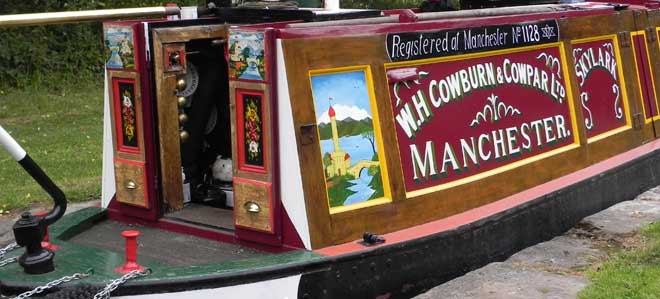
    The only Cowburn & Cowpar boats that still exist today are the eight motor boats built for the company between in 1933 and 1936 by WJ Yarwoods.  They are all named after birds beginning with S:  Swan, Swift, Swallow, Stork, Skylark, Seagull, Snipe and Starling.  Originally they were all fitted with a Gardner 4VT which is a hot bulb semi-diesel engine, and three of the boats still have these distinctive engines today.

    Image: Cowburn & Cowpar motor boat Skylark

    Railway Boat or Station Boat?

    The London Midland & Scottish Railway (LMS), when it was formed in 1923, inherited a considerable canal network and fleet of boats. Many of the boats were wooden and no longer exist, but in 1928 WJ Yarwoods were commissioned to build a fleet of riveted iron day boats, for use on the 22 railway interchange basins of the Birmingham Canal Navigations. Ajax, Mecca and Manchuria are examples of these ‘Railway Boats’, still around today, all since converted to motor boats with counter sterns.

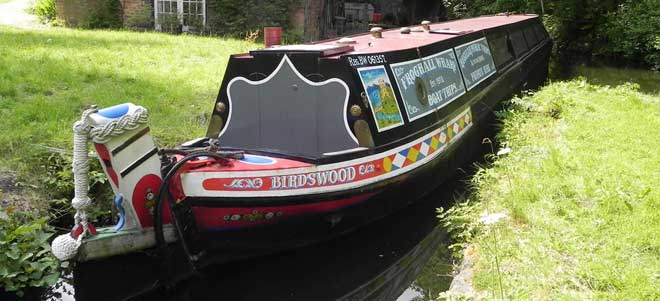
    After nationalisation most of the boats were sold, but 12 of the Yarwoods boats were converted to long distance boats. They were re-named after railway stations, in an alphabetical order:  Alsager, Birdswood, Crewe, Ditton, Exeter, Ford, Grantham, Hereford, Irlam, Jesmond, Kidsgrove, Lincoln and are known as ‘Station Boats’.

    Image: Birdswood, recently restored and now operating as a trip boat on the Cromford Canal, after many years on the Caldon Canal (photo by Alison Smedley)

    Bantock or GWR?

    ‘Bantocks’ are boats built by Thomas Bantock & Sons, a company that both built boats and operated them as agents for the Great Western Railway (GWR), who also had transhipment yards on the BCN.  Some boats were owned by GWR and some by Bantocks but they used a combined fleet numbering scheme.  The company also built boats for other carriers including LMS. Early Bantock boats are distinguishable by having wooden footings (the bottom part of the hull sides) in addition to the wooden bottom. Later Bantocks were all iron and many of these survive and are considered to have more pleasing lines than many of the other BCN built boats.

    Image: GWR 15 – built by Bantocks for Great Western Railway

    BCN Boats – day boats and tugs

    Around the canals of the Birmingham Canal Navigations there were once thousands of wooden and iron day boats.  Day boats were used for local traffic and were either open boats with no cabin, or had a small day cabin with a stove and a bench seat.  Many were pulled by horses or even mules, but later tugs were built and these could pull trains of several day boats.  There were numerous companies operating on the BCN, including:

    • Stewarts & Lloyds Ltd – who owned the steel works at Coombeswood on the Dudley No 2 canal – their tugs are still around today include Pacific and Bittell.
    • Leonard Leigh Ltd, whose wooden tugs include James Loader and Christopher James.  During the second world war, Leonard Leigh Ltd won a contract with the Ministry of War to supply coal and so they commissioned 6 new riveted iron tugs to help fulfil the orders, all being named after Fighter Aeroplanes, including Spitfire, Typhoon, Tempest and Hurricane.  
    • T&S Elements – based at Oldbury – boats still around today include Ben (unusual on the BCN for having been built as a full length motor) and Princess Anne (which started life as a GUCCCo motor).

    There were hundreds of boatyards across the BCN all building wooden day boats, and dozens of others making iron day boats and tugs.  BCN day boats are often referred to as ‘Joeys’, although there are those that consider that a ‘Joey’ was specifically a wooden day boat built by Joe Worsey. Worseys had three wooden boat building yards on the BCN, at Toll End Dock, on the Icknield Port Loop, and at Bloxwich Road, Walsall.

    Photo – BCN Tugs at the annual Braunston Historic Boat Gathering

    See previous feature on the evolution of the narrow boat.

  • The Evolution of the Narrow Boat

    The Evolution of the Narrow Boat

    Until the second half of the 18th century there was no standardisation of inland waterway craft and boat size varied around the country on the different river navigations.

    The concept of a boat approximately 7ft wide by about 70 ft long is attributed to James Brindley, who was one of the most influential canal engineers. Brindley reached an agreement with the Proprietors of the Trent & Mersey Canal Company to build the locks on their canal to take boats of that size. The dimensions, which were considerably narrower than craft using the rivers that the canal would link to, were perhaps due to the need to tunnel under Harecastle Hill.  This then became the standard size of lock on the rest of the Midlands canals built subsequently.

    Wooden Horse Drawn Boats

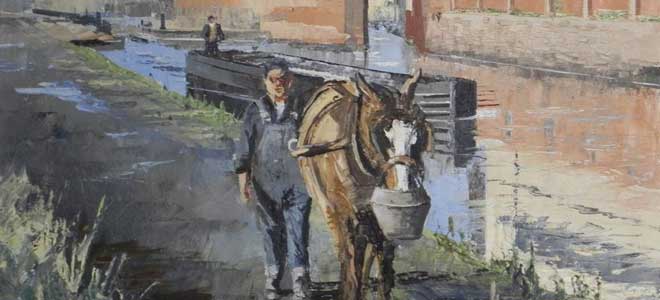
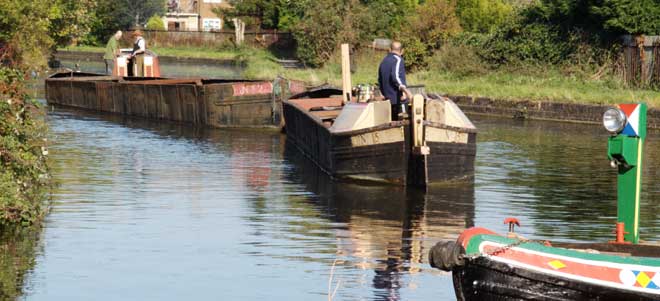
    From the late 18th through to the early 20th centuries there were hundreds of companies building and operating narrow boats for the transport of goods around the waterways system, some long distance and some just for local traffic.  Originally they would all have been horse drawn.  There were thousands of these boats, mostly wooden and mostly all long gone.  Many of them would have been day boats used for short journeys, such as shown here on the BCN (Birmingham Canal Navigations).
    (Photo – oil painting by Harley Crossley)

    Boatmen’s Families

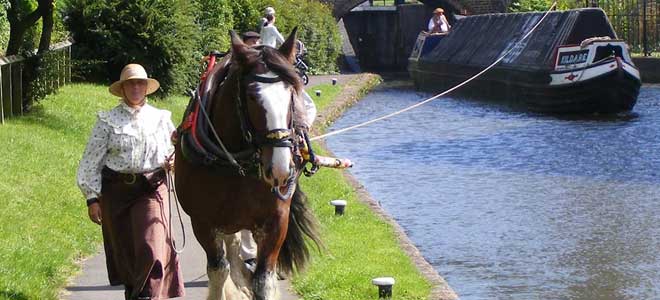
    Initially, the long distance boats typically saw the men work on the boats and their families stay on the land.  Early carrying companies typically employed a man to steer the boat and a boy to lead the horse. As time went on, however, and economic situations changed, particularly with the competition from the railways, it became unviable to keep a house on the land with the wages paid to a boatman, and so the long distance boatmen’s families moved on to the boats to work as unpaid crew.
    (Photo – horseboating – ‘Kildare’)

    Butties

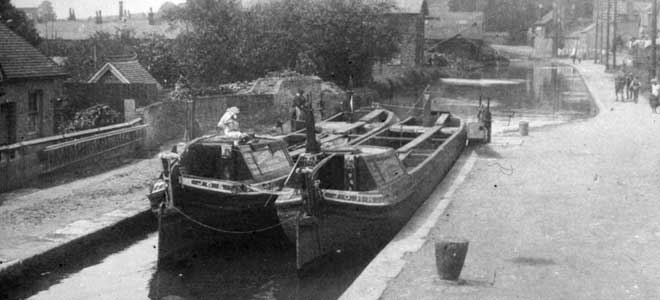
    Even horse drawn boats were sometimes worked in pairs, the towed boat being known as a butty (possibly from the word buddy meaning friend).  This gave two cabins of living accommodation for what were often quite large families, as well as twice the cargo carrying capacity.
    (Photo – pair of horse boats at Berkhamsted)
    Number Ones

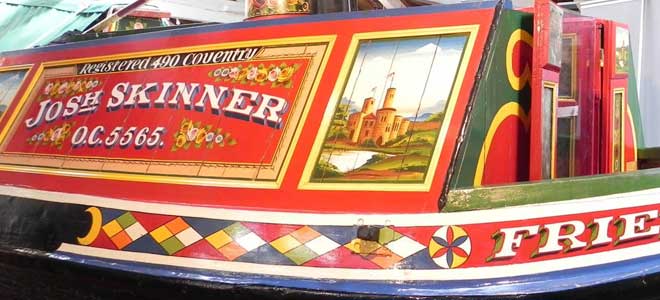
    Number Ones were independent self employed boatmen who owned their own boat. Joe Skinner on narrow boat ‘Friendship’ was one (‘Friendship’ is now an indoor exhibit at Ellesmere Port Boat Museum).
    (Photo – narrow boat ‘Friendship’)

    Introduction of Steam Engines

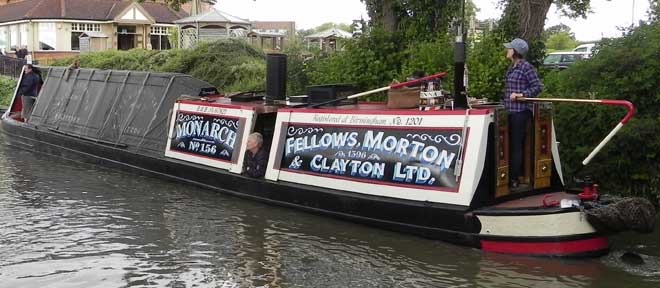
    Towards the end of the 19th century some companies began to introduce boats powered by steam engines.   Fellows Morton & Clayton Ltd (FMC), who operated a large fleet of horse drawn boats, introduced steam powered boats from 1886, some of them being converted from horse boats.  These steamers were mostly used on long distance runs between London, Braunston, Birmingham, Leicester and Nottingham.  They worked ‘fly’, non-stop day and night to a strict timetable.
    (Photo – FMC Steamer ‘Monarch’)

    Experiments with gas and diesel Engines

    The steamers were very successful for FMC, but they did have their disadvantages – a large amount of the cargo space was taken up with the engine, boiler and coal required for the journey, and the high number of crew required.  A steamer pair required a crew of seven men (four on the steamer and three on the butty).
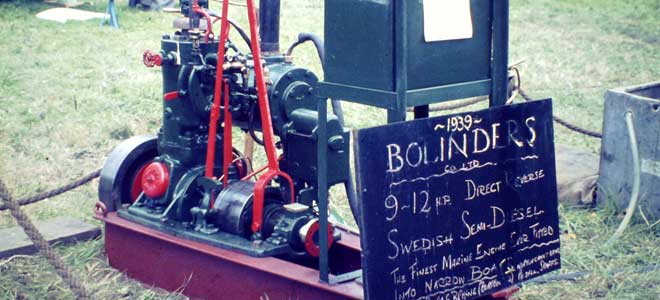
    From 1906 FMC experimented with various gas engines, and in 1912 fitted their first Bolinder (a Swedish engine) to narrow boat ‘Linda’.

    The early Bolinder installations had no reverse gear, although this didn’t worry the boatmen, for of course horses don’t have reverse gear either!  The arrangement worked well and all further boats were fitted with Bolinders (the later ones did run in reverse).  The steamers were all converted and by 1927 they all had Bolinders too.  Many FMC boats still have their Bolinder engines today.
    (Photo – Bolinder engine)

    Carrying Companies

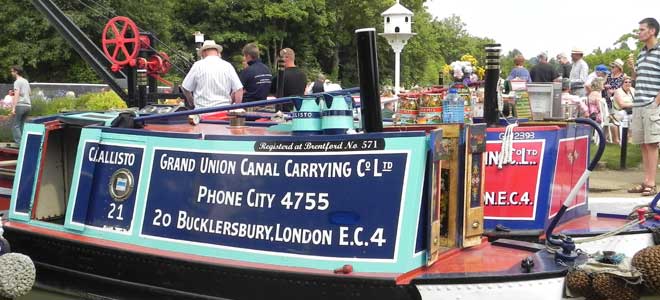
    As well as FMC there were many other smaller companies, and by the 1930s the other large carrying company was the Grand Union Canal Carrying Company Ltd (GUCCCo), which was a subsidiary of the Grand Union Canal Company Ltd.  In 1934 the company launched an ambitious expansion programme to increase their fleet to over 100 pairs of boats.  Many of these boats are still around today.
    (Photo – two GUCCCo motor boats)

    Nationalisation of the Waterways

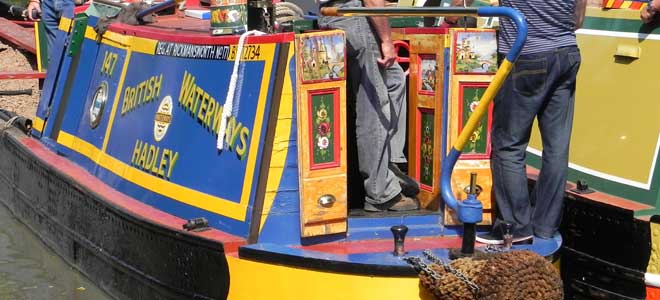
    In 1948 the waterways were nationalised, which included GUCCCo as a subsidiary.  Most of the boats were transferred to the British Transport Commission, which 20 years later was to become the British Waterways Board.  GUCCCo at that time had 126 motor boats and 130 butties.  FMC boats also joined the fleet, following voluntary liquidation.  This gave the British Transport Commission a total of 368 boats, probably the largest fleet of narrow boats that ever existed.
    (Photo – ‘Hadley’ in British Waterways livery)
    Decline of the Waterways

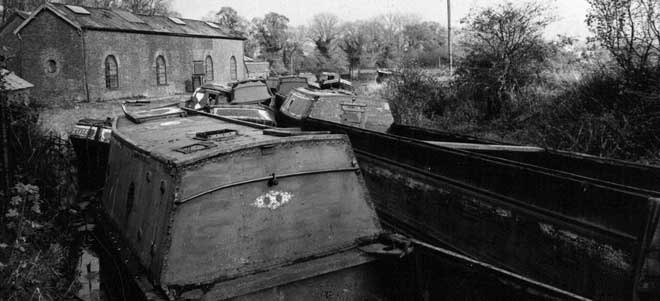
    Unfortunately the canals were suffering from a lack of maintenance during the war, and traffic had declined to an all time low. Despite some attempts at revival, by the 1960s a lot of the boats were surplus to requirements.  In 1963 The British Transport Commission became the British Waterways Board, and one of their early decisions was to discontinue most of its narrow boat carrying operations.  This followed a bad winter where boats were iced up for months and much cargo was transferred to the roads.  Many boats were abandoned in a few designated places, including Braunston reservoir, Harefield Flash, Norton Canes and the Wendover Arm.
    (Photo – Abandoned boats on the Wendover Arm)
    Pleasure Boating

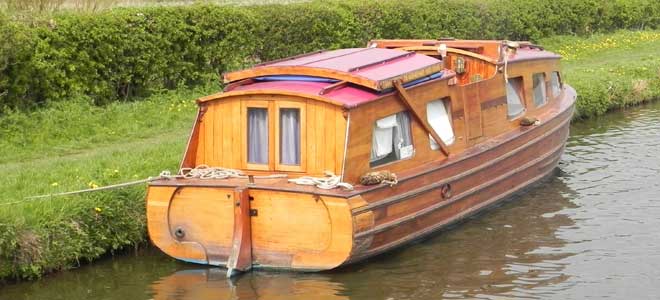
    Canals were late in being used for pleasure boating on a serious scale due to their continued use for commercial traffic until the middle of the 20th century.  Many early pleasure boats were converted ex working narrow boats. Ken Keay and Harris Brothers of Bumblehole were boat building yards that diversified into building pleasure boats.   Although fibreglass cabin cruisers began to be popular on the canals from the 1950s, by the 1970s many boatbuilders had sprung up building purpose built steel narrow beamed boats for hire companies or private use.
    (photo – an early purpose built narrow beam pleasure boat)

    Modern Narrowboats

    The term ‘narrowboat’ (one word) has become widely accepted to describe modern purpose built steel craft of a beam to fit on the narrow canal system.  It is generally more accurate to refer to historic working boats as ‘narrow boats’ (two words).

    These days a wide variety of narrow boats can be found on the waterways – from preserved historic working boats, purpose built hire boats, hotel boats, camping boats, and privately owned boats of every kind from scruffy to the immaculate floating ‘country cottage’ with all mod cons.
    (Photo – these days anyone who wants to can go boating on an historic working boat – by going on an hotel boat or a camping boat)
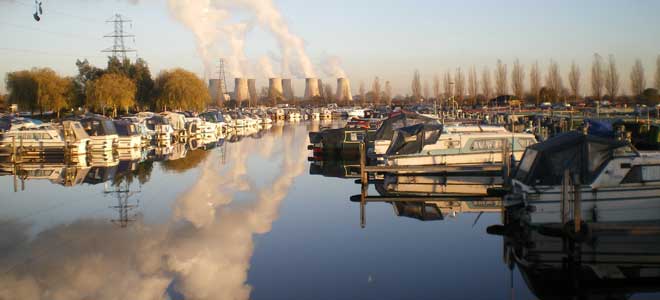
    Keep an eye out for forthcoming features including a narrow boat spotting guide and interesting features of historic narrow boats.

  • Finding a Permanent Mooring for your Boat

    Finding a Permanent Mooring for your Boat

    Owning your own boat can be hugely rewarding, with the freedom to travel the UK’s waterways at your own pace, closeness to nature and sharing your love of the waterways by entertaining friends with day trips.

    Some initial things to consider include the costs, types of boat, getting a boat licence and boat maintenance.  Unless you intend to continuously cruise the network throughout the year, you need to give some serious thought to finding a permanent mooring for your boat.  Generally finding the right boat at the right price is fairly straightforward, but finding somewhere to berth it can be a little more tricky. It is therefore a good idea to find a permanent mooring before buying your boat.

    Choosing a Waterway

    Firstly you’ll need to know what area and on which waterway you would like your boat to be based. If you intend to live on your boat, this might be close to your place of employment, family or friends. Otherwise, you might choose to moor your boat on the other side of the country from where you live. Things to consider would include the size of the boat you intend to buy – you’ll need to check whether it will fit through the locks on the waterways you intend to use! Do you like to eat out or enjoy a swift pint? If so you’ll want to check out nearby pubs and restaurants.

    Once you’ve got an idea about where you’d like to moor your boat, you can start to look at what moorings are available in the area. You may already have a very clear idea, but if not, you can take a look at our waterways route map or see the individual waterways pages.

    Online vs Offline Moorings

    Permanent moorings can be found within marinas or basins (offline) or along the main line of a canal or river (online).

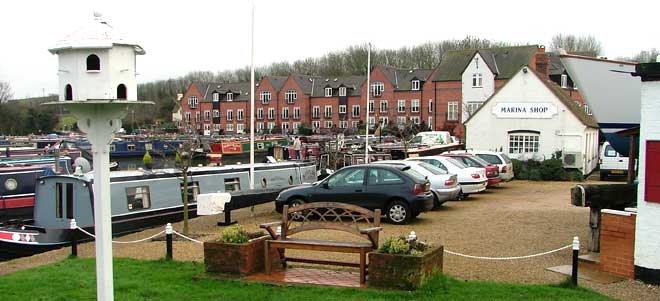
    Marinas are usually large purpose made water spaces but moorings can also be found at boatyards and the wharves, arms and loops left from the commercial days of the waterways.

    Offline moorings are generally run by businesses, and can be more expensive than online moorings. However, you are more likely to benefit from facilities such as water, toilets, sanitary disposal, showers, a diesel pump, electricity, coal, gas and Wi-Fi. Some marinas also have boatyards and chandlery shops on site and there may even be some basic security against vandalism and other crime. Marinas and basins often have transport links and car parking, which is something to consider if you need to travel. Apart from the cost, possible downsides include the fact that some marinas may have a waiting list for their berths.  Some marinas will have residential moorings, and a few marinas may offer a ‘caretaker’ (residential) berth, but these are rare.
    Image: Braunston Marina

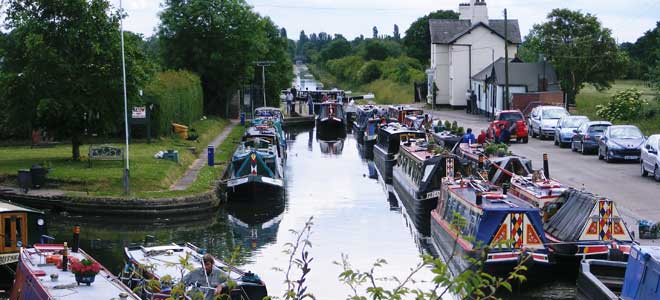
    Online moorings along the main line of a canal are usually run by the navigation authority, or in some cases local farmers who set up moorings along their land, and tend to cost less than offline moorings because there aren’t as many, or any, facilities. Apart from the cost, advantages of online moorings include being closer to nature, heritage and often beautiful scenery.

    Some moorings are available along the towpath side but these lack privacy and any degree of security. Those on the non-towpath (off-side) are preferable and will have some security depending on the access, fencing and gating arrangements.

    You could buy or lease a length of land alongside the waterways but remember that this does not necessarily mean that you have rights to moor a boat there. There may be planning restrictions and on canals you will still have to pay the navigation authority for mooring. These can be referred to as ‘end of garden moorings’ or ‘farmers’ field moorings’.  On rivers the situation is different as riparian owners generally have the right to moor alongside their land if they own their side of the land under the river. Remember that rivers go up and down, so you will need suitable mooring arrangements to allow for this and you may not be able to get to your boat in flood conditions.  In either case, you should consult with the navigation authority first before committing to a mooring.
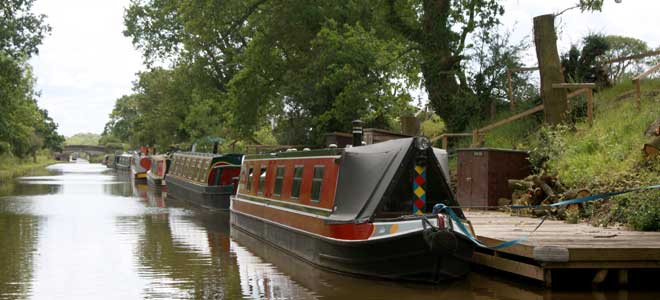
    Image: Online moorings, Shropshire Union Canal
    Boat Clubs

    Boat club moorings may be online or offline. These clubs often have club-houses and host social events. Many clubs require their members often pitch in with maintenance of the site, which saves money.
    Image: Longwood Boat Club, Rushall Canal (photo by Angela Acott)
    Residential Moorings

    If you intend to live on your boat, there are additional things to consider. For a start, unless you intend to continuously cruise the waterways you’ll need a suitable mooring.  Most residential moorings require planning approval, so you should always take advice to ensure your proposed residential mooring is legitimate. Some residential mooring operators require boats to be away from the mooring for a certain time each year or require you to have an address elsewhere.  In some cases you may be required to pay Council Tax, but Housing Benefits could contribute towards the mooring fees.

    You’ll also need to think about the facilities that will be available in winter, for example if you’re moored online and the canal freezes, how would you go about emptying sanitary facilities or getting fuel and water? Take a look at our features on the pros and cons of living afloat and ten things I wish I knew before living on a canal boat for more information.

    Finally, it’s useful to be aware that many residential berths are based on short term mooring agreements, which can easily be terminated by your landlord – it is important to read and understand the ‘small print’ of your mooring agreement.

    Next Steps

    Once you’ve got an idea about where you might want to moor, you can refer to our individual waterway pages to find details of navigation authorities, boat clubs and marinas to get in touch and find out about the availability of long term moorings.

    Some navigation authority websites provide information on finding residential and permanent moorings on their waterways:

    Other links

  • 10 birds to look out for around the waterways

    10 birds to look out for around the waterways

    Moorhens

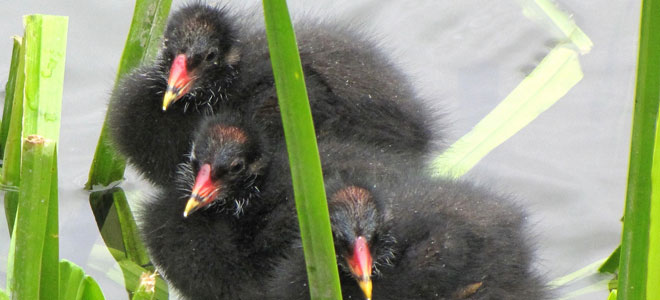
    Moorhens are also called marsh hens or river chickens. They are small black feathered birds with a red pointed beak and are found near marshes, ponds and streams. Moorhens can live in cities as well as the countryside. To help them with swimming and walking on slippery surfaces they have webbed toes. A moorhen’s diet consists of insects, water-spiders, plants and larger animals such as lizards.

    Photo of Moorhen Chicks by Jans Canon

    Mandarin Ducks

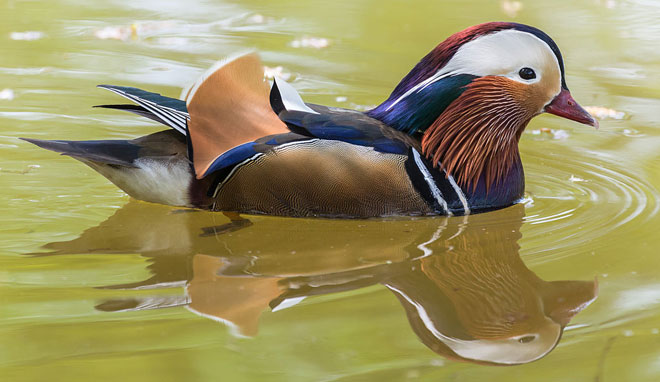
    Male Mandarin ducks have a red bill with orange feathers on their cheeks and sides and a purple breast with two white vertical bars. Female Mandarin ducks are different in how they look to male ducks they have grey heads with a white stripe behind the eye and a brown back. These ducks are shy and like to be beside lakes with overhanging trees and bushes. Mandarin ducks eat insects, vegetation and seeds.

    Photo of a Male Mandarin Duck by David Iliff


    Kingfishers

    Kingfishers have large heads, a long sharp bill, short legs and a short tail. They have brightly coloured feathers with some kingfishers having feathers sticking upwards from their heads. Their nests are in tree hollows or holes in the ground beside a river bank or lake. Kingfishers are known for hunting and eating fish but some kingfishers also eat crustaceans, frogs, insects, spiders, reptiles and mammals. Even though these birds have bright colourful feathers it is rear to spot one along the waterways!

    Photo of a Kingfisher by Thoth,God of Knowledge (Flickr name)

    Mallards

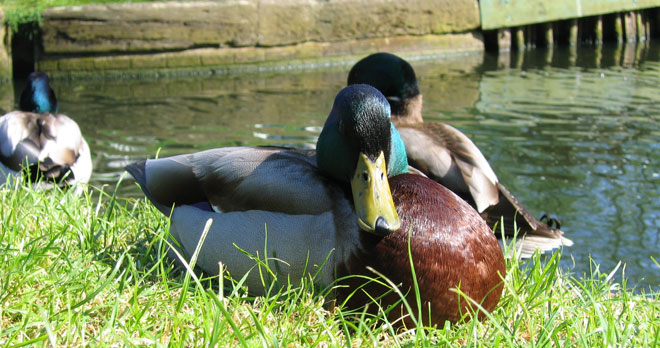
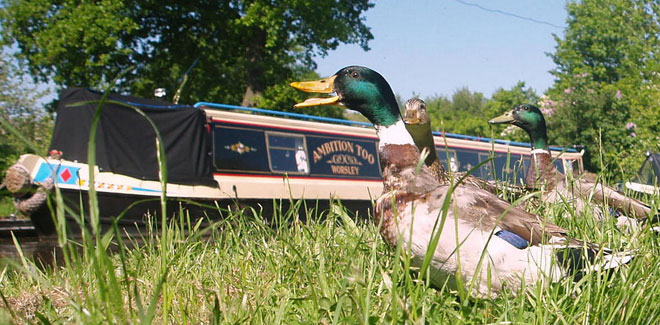
    Mallards are large, sociable ducks that live in rural or urban wetland habitats. Male birds have a green head and grey on their wings and belly and female birds have brown specks on their feathers. Mallards eat water plants, seeds, acorns, berries and insects. At this time of year there is likely to be lots of ducklings about!

    Photo of Mallard Ducks next to PaperMill LockChelmer and Blackwater Navigation


    Reed Bunting

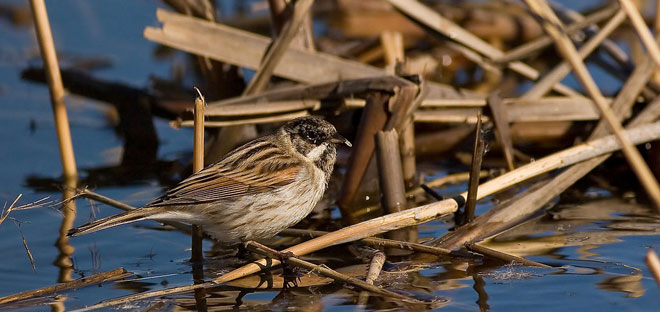
    Reed Bunting birds have large heads and thick necks and are medium in size. Male birds have a black head and white collar and when singing they are usually perched on a bush or reed. Their habitats are in dense vegetation and the nests are built by female birds with reeds and grass. These birds are found in wet vegetation and on farmland. They like to feed on seeds and insects.

    Photo of a Female Reed Bunting Bird by Thermos


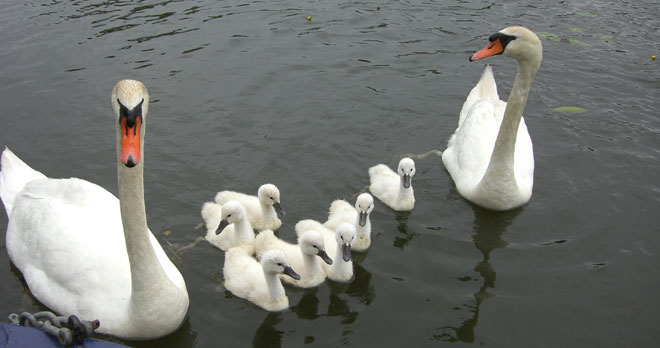
    Mute Swans

    The Mute Swan is a very large, white heavy flying bird. They have long S-shaped necks and orange bills with black at the base. Mute swans can be seen anywhere where there is a shallow lake or river even in urban parks. Swans eat seaweed and aquatic plants whilst on the water or seeds, berries, insects and plants when they are on land.

    Photo of a Swan Family by Chris Clegg

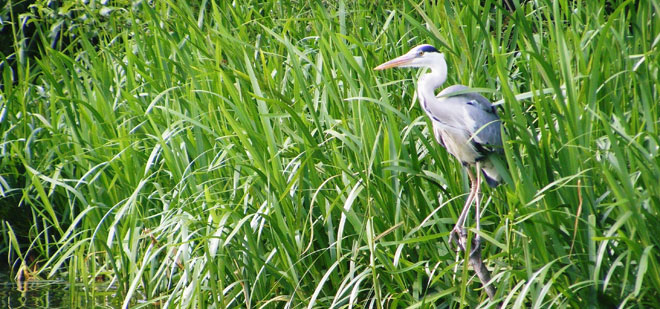
    Grey Herons

    Grey herons are long-legged birds that primarily feed on fish.  They are non-swimming birds and can be seen by lakes, rivers, swamps, ponds and the sea. Herons hunt on their prey by sitting still on the edge of the water before using their long beaks to catch food from the water or the ground. The diet includes a range of aquatic animals, including fish, reptiles, amphibians, crustaceans, molluscs and aquatic insects.

    Photo of a Grey Heron by Angela Acott


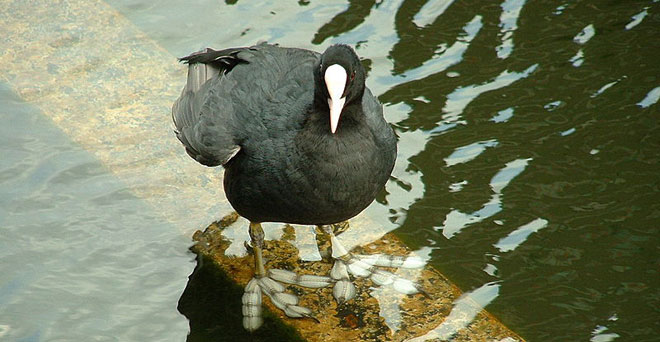
    Coots

    Coots have black feathers with white bills and white on top of their bills. These birds can be seen on freshwater lakes, gravel pits, reservoirs, rivers and urban park lakes. They build their nests in shallow water sheltered by vegetation and sometimes out in the open. Coots like to feed on aquatic plants and small animals such as snails and larvae.


    Photo of a Coot by Marcus Rowland

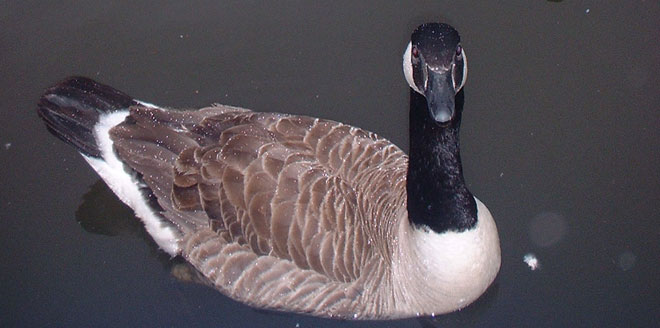
    Canada Geese

    Geese are large, noisy birds and can be seen in grassland areas and parks with lakes. Their diet consists of grass, roots, cereal leaves and spilled grain. The Canada goose has a large population in the UK. They have a black head and neck with white patches around the throat.

    Photo of a Canada Goose


    Great Crested Grebes

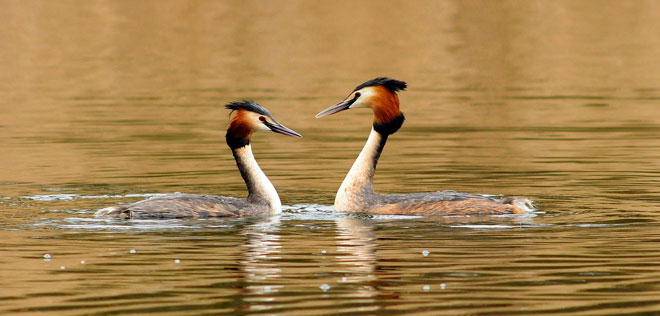
    Great Crested Grebes are small birds with pointed bills, round bodies and small tails. They can be seen at lakes, gravel pits, canals and slow moving rivers where there is lots of vegetation. They are excellent swimmers and divers but cannot walk on dry land. Their habitats are floating nests built near vegetation in the water. Great Crested Grebes eat insects, crustaceans and small fish.

    Photo of Great Crested Grebes by Liam Richardson

    Find out more about wildlife by the waterways.

  • Get your bike towpath-ready

    Get your bike towpath-ready

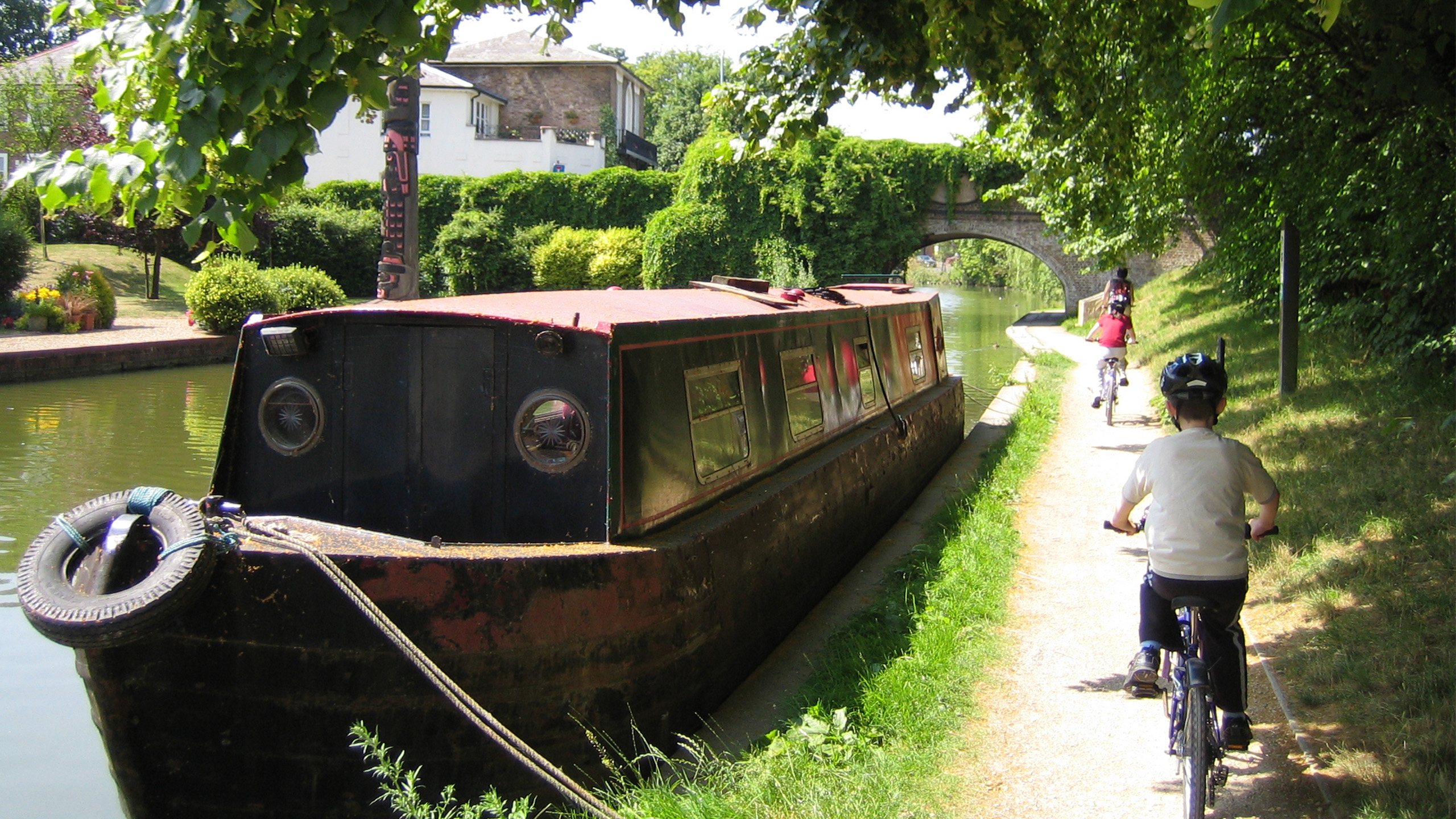
    Want to take your bike along the towpath but not sure where to start? Dedicated volunteer and cycling enthusiast Richard Worthington has put together information and advice to help get you cycling along the canals.

    Towpath

    Checking out the state of the towpath beforehand will give an idea of the sort of preparation you need. Some are just like a pavement, others a rough track or gravel path. Whilst they are generally flat (apart from where the are locks or tunnels), they can vary in width and surface along their length. A rougher track can contain ruts and potholes that could bounce you into the canal if taken at too high a speed. Very muddy towpaths can be slippery and dangerous.

    Bike

    You don’t need a serious off-road mountain bike for towpath use, anything other than racing bike should be fine.

    Courtesy

    Cyclists on a towpath need to take care if there are other people using it. Walkers, joggers, anglers and other cyclists are common (plus the occasional volunteer) and pedestrians have the right of way, so moderating your speed, giving way and using a bell are important. Read our Waterways Cycling Code.

    Tyres

    Hybrid tyres (flat in the middle, knobbly on the edges) or a thinner mountain tyre should do on most towpaths, giving a smooth ride on harder paths and enough grip on a rough one. Oversized offroad tyres are unnecessary and will probably churn up and damage the towpath, particularly if it’s been raining.

    Mudguards

    Mudguards will stop you getting covered in water and mud and can also protect the gears and brakes of your bike from getting clogged up.

    Punctures

    You can get a puncture anywhere but on a towpath they’re likely to be from thorny vegetation. There are a number of ways to help prevent them:

    • Selfsealing inner tubes contain a glue which will seal small holes for a few pounds more than a standard tube
    • Tyre liners go between the tube and tyre to add an extra layer for under £10
    • Puncture resistant tyres offer the greatest overall protection for £15 and up

    If you do get a puncture, the quickest way to fix it is to carry a spare tube and patch the punctured one when you get home. Obviously a pump is essential and the tools to do the work. Carefully check the tyre to make sure there isn’t anything still stuck in it to cause another puncture.

    Repairs

    In addition to a puncture repair kit or tube, a small cycling multitool can mean the difference between cycling and walking home. If you are going for a longer ride additional tools can be useful, but this needs considering against weight and space.

    Find out more about cycling near the waterways, including cycle routes and our Waterways Cycling Code.