Blog

  • Waterway investment crucial for visitors and safety

    Waterway investment crucial for visitors and safety

    The vital importance of the waterways to the Government’s aspirations for economic prosperity and the population’s physical and mental health was highlighted by three navigation authorities at the most recent meeting of the All Party Parliamentary Group for the Waterways.

    Canal & River Trust, the Broads Authority and the Avon Navigation Trust all reported dramatic increases in visitors to their waterways during 2020, with the restrictions imposed as a result of the Covid-19 pandemic bringing many people to their local waterways for the first time. Visits to towpaths and riverside paths increased, along with the number of people using canoes and stand up paddleboards.

    The navigation authorities also noted the impact of climate change and the role of waterways as a critical aspect of national infrastructure, particularly as a response to extreme weather events such as flooding. They urged the Government to take a long-term view to make waterways more resilient to future environmental pressures, as well as ensure funding for current ‘high-risk’ aspects of waterways infrastructure.

    Underfunding continues to be the biggest threat facing our inland waterways. All three speakers stressed the importance of future funding to ensure ongoing access by the whole population to safely managed waterways. IWA will continue to push the government to make sure waterways are properly funded, by raising awareness of the issues and providing a platform for navigation authorities.

    Find out more about how we lobby government through the APPG for the waterways.

  • 2020 – our year in photos

    2020 – our year in photos

    This has been an incredibly tough year for many people. The continued support of our members, volunteers and donors means a lot to us. Thank you.
    To round off the year, we wanted to share some of the things we’ve achieved with your help. Read on to see 2020, our year in photos.

    January – Parliamentary lobbying

    Paul Rodgers, IWA National Chairman meeting Environment Agency's Alice Mayne
    Paul Rodgers, IWA National Chairman meeting Environment Agency’s Alice Mayne at a Parliamentary Reception January 2020

    More than 65% of constituencies in England, Scotland and Wales are home to a navigable waterway or restoration project. Around 25% of these constituencies elected a new MP in the 2019 general election.   All waterway MPs were presented with a briefing titled “The Future of the Inland Waterways”. At a gathering in the Houses of Parliament we explained the issues currently facing our waterways. Parliamentary campaigning is a key strand of our work and one of our principal concerns is the ongoing need for adequate funding of the publicly owned waterways operated by Canal & River Trust and the Environment Agency.

    February – local campaigning

    Frankton Locks on the Montgomery Canal

    IWA Shrewsbury District & North Wales Branch campaigned successfully to extend the opening times of Frankton Locks. Following a 10-month campaign by branch volunteers, Canal & River Trust agreed to improve opening hours for the summer of 2020. This action, in response to pressure from the branch, will improve boater access to the Montgomery Canal.

    March – defra seeks IWA’s viewpoint

    Waterway businesses have been badly affected by the impacts of Covid-19

    Defra sought our opinions on the impact of Covid. We were clear that the effects on the waterways and their users were far-reaching. Our key concerns include boaters’ health and access to facilities, the affordability of moorings and licence fees and the impact on waterway businesses. Ongoing we are worried about the ability of navigation authorities to deal with emergency repairs due to the effects on their income.  

    April – watch IWa tv

    IWA TV Laptop graphic

    May – fanfare for our unique waterways heritage

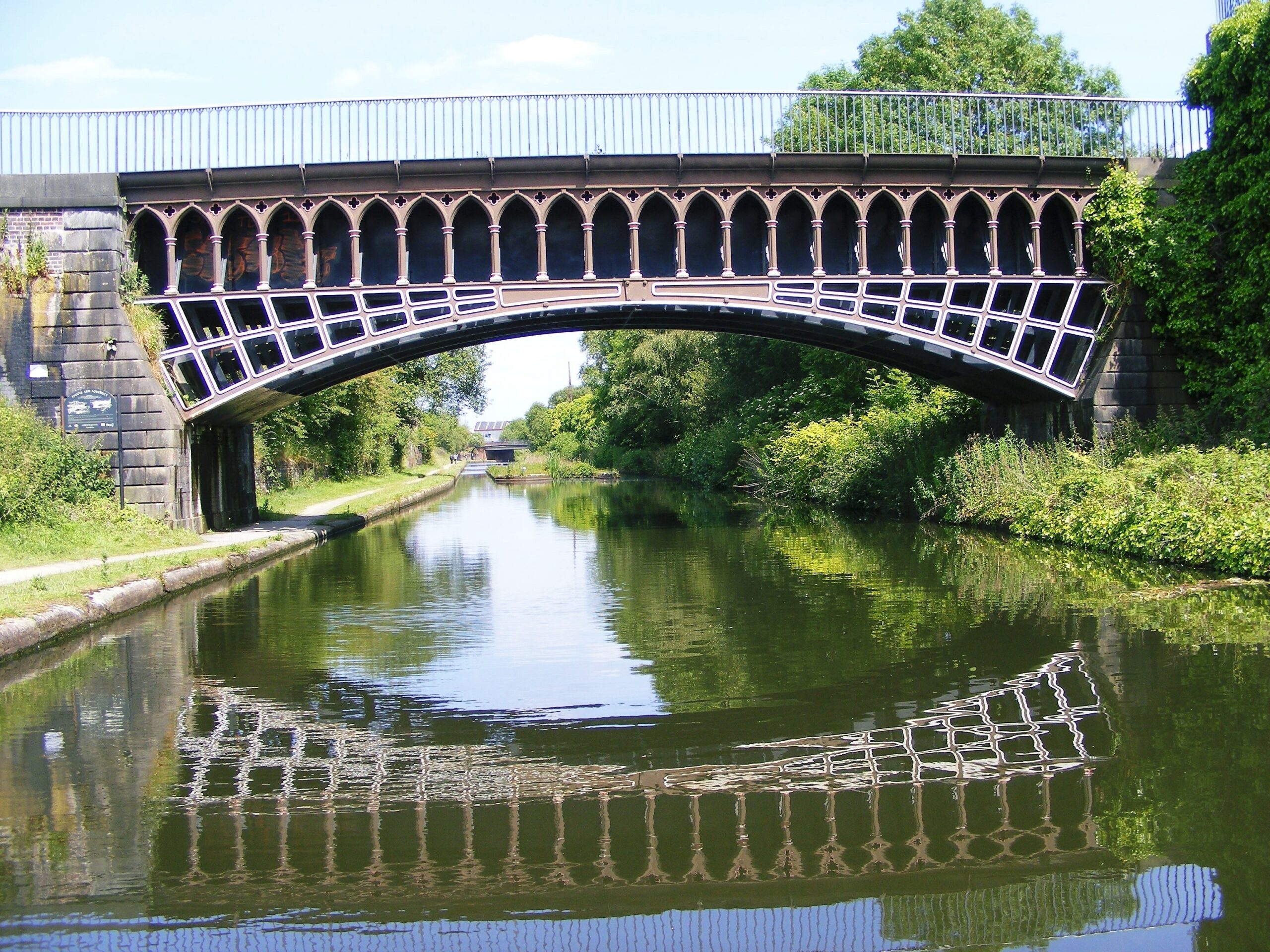
    Heritage Bridge 77, Congleton on the Macclesfield Canal by Martin Allaway
    Bridge 77, Congleton on the Macclesfield Canal by Martin Allaway

    We published our report calling for better protection for the country’s unique Waterways Heritage. Sadly, this same month, the Government announced that the West Midlands Strategic Rail Freight Interchange had been given the go ahead. This project will cause lasting damage to the heritage, amenity and tourism value of the Staffordshire & Worcestershire Canal.

    June – hs2, a continuing campaign

    Boats moored on the Ashby Canal
    Proposals for Phase 2b have blighted the restorations of the Ashby Canal for many years Photographer: Angela Acott

    IWA responded to a Call for Evidence by the National Infrastructure Commission for a Rail Needs Assessment for the Midlands and the North. IWA’s HS2 recommendations, if followed, would reduce impacts on the Trent & Mersey Canal and remove them altogether from the Coventry, Ashby, Soar, Trent, Erewash, Nottingham, Chesterfield, Sheffield & South Yorkshire and Aire & Calder waterways. Read more about our on-going HS2 campaign.

    July – a new waterway infrastructure

    Wey & Arun Canal Trust Canal centre and trip boats 2019. Photo by Dave Verrall.

    The All Party Parliamentary Group for the waterways focused their attentions on waterway restoration. Waterway Recovery Group Chairman, Mike Palmer, described IWA’s vision of a fully joined up network. When considered together, waterway restorations form a national infrastructure project that includes hundreds of miles of canals and towpaths. Once restored to navigation the canals will make a massive contribution towards solving many of the issues that Government has stated it wishes to address as part of its post Covid recovery plan.

    August – A TALE OF Love

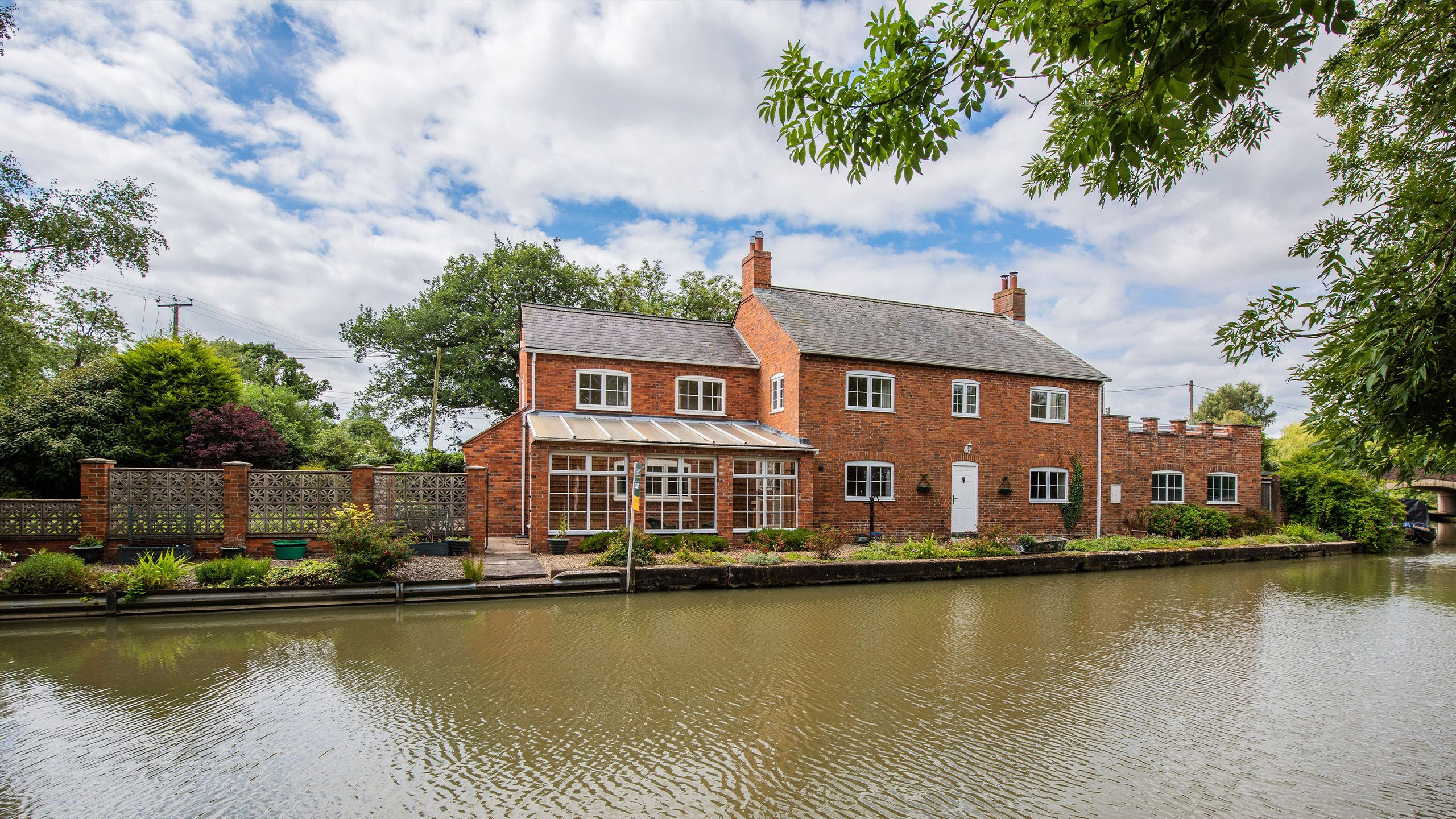
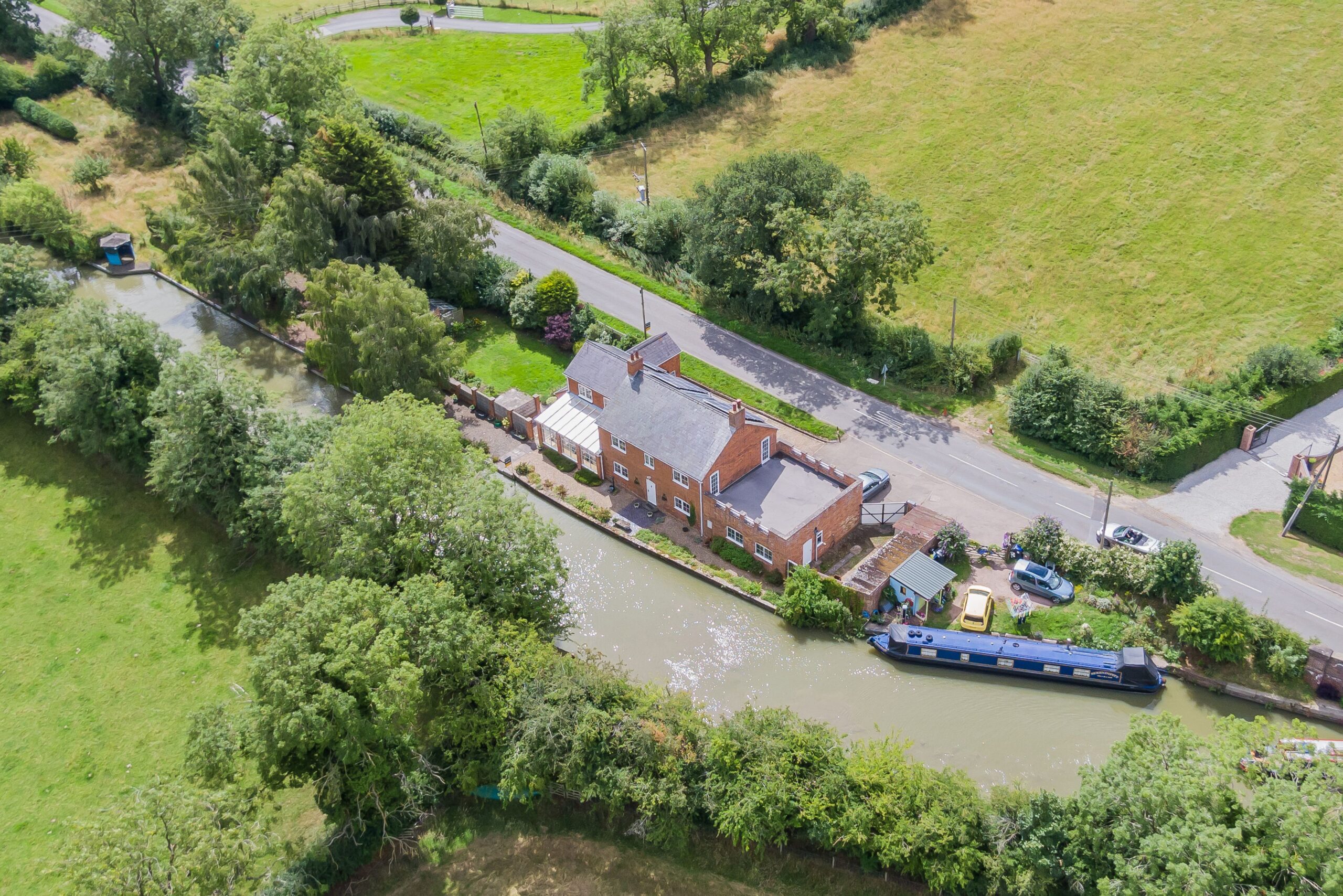
    The Boat House at Yelvertoft is both a tale of love and a generous gift. The house is a property left to IWA in the will of Mary Jackson for which we are incredibly grateful. It was advertised for let following refurbishment and will provide an income to the charity for many years to come.

    September – a sustainable future for our waterways

    In September we published a new Vision for Sustainable Boating. The report includes suggestions across four core areas to ensure our waterways help bring about zero carbon emissions by 2050.

    October – keeping our canals and rivers clean

    Rubbish in workboat on the Grand Union Canal

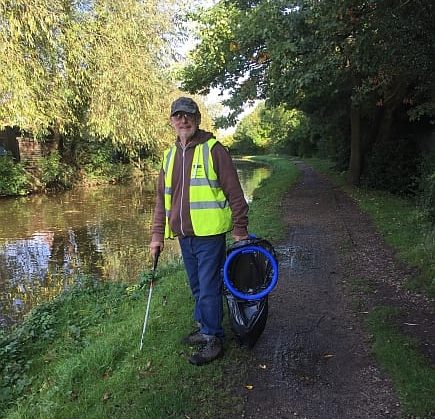
    In October, 4 tonnes of rubbish were removed from the Grand Union Canal in Milton Keynes by volunteers from IWA’s Milton Keynes branch. Whilst this has been a difficult year for IWA, our branch volunteers across the country have been able to get out to remove debris, plastics, supermarket trolleys and bicycles from our canals and rivers.

    November – waterways in progress

    Langport project at Cocklemoor – looking west. Photo by Mike Slade

    Following receipt of £250,000 in grants and other funding, the river frontage at Langport has been opened out. IWA’s West Country Branch team has been pushing for this project right from the very start. IWA volunteers spotted the potential for the river front regeneration, encouraging the community to get behind the initiative and persuading partner organisations and Langport Town Council to get on board.

    December – supporting restorations at a local level

    Tree planting team, Wendover Arm
    Tree planting team, Wendover Arm

    IWA’s Chiltern Branch volunteers spent the day with supporters of the Wendover Arm Trust planting trees. On the day, John Brice (2nd from the left in the picture), was presented with the John Heap Salver. The award was given in recognition of his fundraising skills. Over 25 years he has raised more than ÂŁ50,000 for the Association. Some of these funds will be used to build a slipway on the Wendover Arm at Aston Clinton which can be used by children at the local outdoor centre to get afloat in canoes.

  • Walking London’s Towpaths

    Walking London’s Towpaths

    IWA Towpath Walks guide Charlie Forman gives his perspective.

    I’ve been with Towpath Walks for five years, although the scheme itself has been running for much longer than that, since 1977. I joined as a newly qualified guide, realising it would be a golden opportunity to have a ready-made audience of walkers expecting a professional service, as well as to indulge my love of the waterways and social history.

    I’m very much fascinated by what makes places work, and canals were a critical part of the infrastructure of our cities. Understanding how they operated and supplied the city and the people who worked on them was my way in, rather than being interested in the boats themselves.

    I don’t go on the canals that often, but I do walk alongside them regularly. I’m a volunteer at the London Canal Museum too, so a lot of the expertise from there has filtered through and helps when guiding the walks. I think I’ve got more interested in some of the boating and warehousing details as a result.

    London locals

    Our groups contain quite a mix of people. There are a few dedicated members of IWA who come along, and you have to be careful that you get your facts right! They sometimes know more than I do. And a lot of people are London locals who are just keen to explore their own city. They’re a great audience to have. You also get a number of tourists.

    The canals are effectively a linear path cutting through the middle of our city, so for the tourist it’s an amazing way to see the capital without the noise and pollution of walking the streets. Obviously the towpaths themselves can also get quite busy, but it’s certainly a very different perspective they offer. Thanks to the quality of our guiding, I think all our customers leave feeling satisfied they’ve gained an insight into London that they would never otherwise have had.

    Challenges

    Because they’re based on a towpath, our walks aren’t difficult to follow, but they can be quite hard to manage because there isn’t a lot of space.

    Sunny weekends can be particularly problematic – a combination of lots of other people out enjoying the canal, and big groups on our walking tours. The two together can be challenging. Throw cyclists into the mix and it can become even more problematic. I don’t want to demonise cyclists (I can’t, because I am one myself), but a bit more courtesy and common sense from some of them would certainly help. Most, fortunately, are very respectful.

    King’s Cross to Camden and Little Venice to Camden along the Regent’s Canal are probably our two most popular walks, but you often get surprises. It’s hard to predict. You can do the same walk twice and on one occasion get five people and the next time 25 or even 30, despite the weather conditions being apparently no different.

    Other walks that can pull in a big crowd are West India Docks and the Olympic Park. The way the Olympic Park has developed is very much intertwined with the history of the waterways that are running through it, so that’s always a good story to tell.

    Personal favourite LONDON WALK

    As a guide, one of the walks I enjoy most is Kings Cross to Camden. You can chart more of the history of the canal in that walk than in any other. It’s all there. The great success of the planning of the area has been the preservation of some of the old goods yards and infrastructure, which you can highlight as something that connects the canal with its past.

    Of course, there are also disputes about how successful the whole development is, but I personally think it’s one of the areas that has been done best. The restored gas holders, for example, and the nature reserve. You’ve got everything in one spot, almost.

    It’s a great walk and I always enjoy it. At the moment we offer somewhere between 15 and 20 different walking routes. Some are a bit difficult to get to so aren’t run very often. We’re always looking for new places.

    The walks are relatively flat so can be excellent for people whose mobility isn’t good. Not all the access points to towpaths have ramps (some require getting up or down quite steep stairs) and sometimes the surface can be rough. Having said that, I’ve guided people who aren’t strong walkers and have still managed to finish pretty much on time. And I’ve done walks with people using mobility scooters, which is perfectly manageable if you can plan ahead.

    Weather woes

    Our service is a partnership with London Walks, which has a year-round programme and under normal circumstances, gives us a guaranteed slot every other Sunday afternoon.

    The quid pro quo is that we always have to be available, whether it’s a lovely day in June or a snowstorm at the beginning of January. We’re there come rain or shine and, in one case, fog. On that particular occasion, in the Lee Valley, I could basically only offer an audio commentary. I had to describe what people would have seen had there not been such adverse conditions. Thankfully they all got into the spirit of it. The fog was so thick that when I went home at the end of the walk I got lost twice myself! We never cancel. What I say to people on a really bad day is that I’m going to carry on doing this walk until there’s no one left to listen to me.

    Something for everyone

    There is something in the walks for everybody, from primary school children right up to people who have memories of the canals as working, industrial waterways. It’s one of the things that make the walks come alive and keep them fresh for me every time.

    Another thing is that the canals are changing quite fast, so you have to stay alert to that. Part of their story is this change, and how we’ve managed to save the canals over the last 40 years from potentially being infilled and built over with new office blocks, specifically around City Basin.

    Finally, it’s important to recognise that another motivation for all of us guides is the fundraising aspect. If you’ve got 25 people per walk, you’re probably going to pick up the best part of £200 or more. That’s quite a significant contribution to IWA. Add all that together over the years and it’s a terrific sum we’ve raised – over £48,000,

    Join the team

    Towpath Walks is looking for volunteer guides to join the existing team at the IWA Towpath Walks Society, in London. The society, in partnership with London Walks, carries out a regular series of guided walks along London’s canals.

    The walks last just over two hours and take place on two Sunday afternoons each month starting at a tube or DLR station. They’re a great way to introduce people to the waterways, and to raise money for IWA.

    All that is needed is an interest in waterways, an enjoyment of sharing your knowledge with others and a love of walking. A full briefing will be provided for the series and each individual walk. You will be part of a team so you can do as many or as few walks as you like.

    There are a set of walking routes already planned and being carried out, so there is little preparation to be done. However, if you would like to add more walks to our programme then this may be possible. If you would like to help, please contact londonwalks@waterways.org.uk

  • Protecting waterways along the HS2 Western Leg

    Protecting waterways along the HS2 Western Leg

    The HS2 Phase 2b Western Leg Design Refinement proposals affect the Middlewich Branch of the Shropshire Union Canal in the Wimboldsley area north of Crewe. Plans would also impact the Ashton Canal and Rochdale Canal in Manchester.

    We are working to protect all waterway routes from the project, regardless of their current navigation status, as well as from disruption during construction. As compensation for environmental and heritage damage, we are also campaigning for improvements to waterways as part of the works. We have previously proposed a review of the whole route of the Western Leg to integrate it with Northern Powerhouse Rail. The route needs to take better account of subsidence risks; the landscape, noise and heritage impacts on the Trent & Mersey Canal in the Dane valley north of Middlewich; and noise and visual impacts on the Middlewich Branch of the Shropshire Union Canal.

    Shropshire Union Canal, Middlewich Branch

    A rolling stock depot over about 4 km around Wimboldsley will affect the historic environment of the Middlewich Branch. This is in addition to three viaduct crossings of the canal between Park Farm and Yew Tree Farm. Users of the canal will be subject to construction and operational noise impacts of the depot. We want to see additional planted bunding in the plans, to help provide visual and noise screening in this area.

    Three viaduct crossings are proposed along the Middlewich Branch in the latest plans. These will impact on woodland habitats as well as the tranquility and character of the area. The viaducts will also impact on the setting of the historic canal bridge, Hughes Bridge 25, which is Grade II Listed. We successfully lobbied for a balancing pond near Park Farm to be removed to allow for more screen planting of the railway, but more changes are needed. Adverse visual and noise impacts need to be mitigated by sympathetic design of the viaducts and provision of noise barriers. To protect waterway businesses, We are also pushing for any stoppages during construction to be minimised. Stoppages should be avoided completely between March and October. In addition, the moorings, which will be lost under the viaducts should be compensated.

    The new Clive Green Lane Overbridge will be near the historic canal bridge, Clive Green Bridge 24. We want to see a design, which respects the architectural tradition of Shropshire Union Canal bridges. They should also provide a minimum 3m air draught clearance over the canal. We also want to see access to the canal towpath for pedestrians and cyclists from Clive Green Lane as part of the works.

    Ashton Canal & Rochdale Canal

    Proposed changes to increase the size of Manchester Piccadilly High Speed Station will bring it closer to the Ashton Canal. The main construction compound, road closures and works in the surrounding area will further affect the Ashton Canal and the Rochdale Canal.

    We want to see canal users included in noise assessments. We will continue to campaign for substantial noise fencing here to protect users and waterway habitats.

    Find out more about our HS2 campaign.

  • IWA’s call for more electric charging points gains support from MPs and Lords

    IWA’s call for more electric charging points gains support from MPs and Lords

    Our vision for sustainable boating outlines how developments in more environmentally friendly propulsion can help the inland waterways meet the UK’s zero carbon commitments.  The All Party Parliamentary Group (APPG) for the Waterways learned more about the subject of sustainable propulsion on 10th November. MPs and Lords were joined at the meeting by IWA, boating organisations, navigation authorities and other stakeholders, to hear the latest thinking.  A lively discussion followed four expert presentations and concluded when Michael Fabricant MP, Chair of the Group, committed to write to the Chancellor on behalf of the APPGW.  His letter (see below) focuses on 3 key issues: 

    • the need to invest in infrastructure to deliver more electric charging points across the system;
    • a proposed boat engine scrappage scheme to encourage conversion of existing boats;  and
    • a move towards greater distribution and use of biofuels. This step is favoured, over the current proposal by HMRC and HM Treasury to move from red diesel to white for inland waterways craft.

    the Presentations

    First off, Bowman Bradley, chair of IWA’s Sustainable Propulsion Group, presented IWA’s viewpoint.  He pointed out that policy makers will need to develop a legislative framework to meet the sector’s vision.  For instance, Government would need to invest in a recharging infrastructure, to include electric charging points, hydrogen technologies as well as provide more support for biofuels.

    Second up, Jonathan Collins of Cadent Gas highlighted the growing importance and developments of hydrogen-based technologies in reducing emissions from the residential, transport and maritime sector.  Philip Whiffin from the University of Warwick demonstrated that the low energy and low power requirements of the majority of canal-based pleasure craft, made battery-based solutions feasible and cost effective as replacements for traditional hydrocarbon-based engines.   Finally, the Group also heard about a scheme led by Oxfordshire County Council.  Marine engine manufacturers, electric vehicle and infrastructure providers and other user and stakeholder groups are working together on a feasibility study to install electric charging points on the Oxford Canal.  

  • Navigating Canal Tunnels Safely

    Navigating Canal Tunnels Safely

    TUNNELS – THE BASICS

    Due to the history of the canal network that we have today, most currently navigable canal tunnels fall within Canal & River Trust’s jurisdiction.  There are exceptions however, such as on the Grand Western Canal, the Monmouthshire Canal and on waterways in Scotland.

    Canal tunnels vary in length and width. Some can be very short, such as Dunsley on the Staffordshire & Worcestershire Canal which is just 23 metres.  Alternatively they can be very long indeed such as Standedge and Dudley tunnels, at 5000 metres and 2900 metres respectively, where special arrangements are in place to allow passage. Some longer canal tunnels have one-way working systems, where passing two boats isn’t possible.  On the other hand, some, where they are wide enough, allow two way passage at any time.

    Lifejackets (personal flotation devices)

    We strongly recommend the wearing of lifejackets or buoyancy aids when travelling through tunnels, in any type of boat. All users of unpowered boats should wear a lifejacket. The skippers of powered craft are strongly advised to do so, particularly if travelling through single handed.

    If a person falls in the water whilst travelling through a tunnel, the darkness will be disorientating in addition to the shock from the cold water. Tunnels also give added issues surrounding access and rescue. A buoyancy aid will help keep you keep yourself afloat. A properly fitted life jacket is designed to turn your body over and keep your face clear of the water, even if you are unconscious or injured.

    SINGLE AND TWO WAY WORKING THROUGH TUNNELS

    Single way working

    In some tunnels you are unlikely to encounter an oncoming boat unless one of you has ignored the lights or signs!  Examples include Foulridge on the Leeds & Liverpool Canal, which has a traffic light system, or Preston Brook and Saltersford tunnels on the Trent & Mersey Canal, which have timed periods for boats entering at either end.  On waterways where wide beam boats are more common, for example in London, one-way working needs to be in place.  This is true even if the tunnels are wide enough for two narrowboats to pass each other, as the boat coming the other way may be wider than 7ft.

    Two way working

    Many canal tunnels permit two way unrestricted passage, allowing narrowboats to pass in the tunnel.  Signage at the tunnel entrance will indicate whether two way passage is allowed, or whether there are time restrictions on entering.  When the tunnel is short and straight enough to see all the way through you simply need to wait for the tunnel to be clear.
    Note: Passage by boats wider than 7 feet through tunnels which normally have two way working, needs to be arranged in advance with the navigation authority. With the increase of wide beam boats, particularly on the Grand Union Canal, there is an increase in cases of the tunnel being closed to other traffic to allow an authorised passage. The number of incidents of meeting wide beam boats in tunnels where permission has not been obtained is also on the increase.

    ADVICE TO SKIPPERS OF POWERED CRAFT

    All boaters should take great care and keep a good lookout when navigating tunnels.  Beware catching up the boat in front of you, and make sure to look out for any unpowered craft that may be using the tunnel.
    A boat’s tunnel light should not be aimed straight ahead but slightly up to illuminate the roof so as to not blind the steerer of on-coming boats.
    Users of powered boats should carefully read the noticeboard at the tunnel entrance for any specific instructions, and to find out whether unpowered craft are allowed to enter.
    Except where two-way working is the general practice, wait until the tunnel is clear of other boats before entering.  Alternatively abide by the instructions of traffic lights or time restrictions.

    Whitehouse Tunnel, Llangollen Canal

    Before entering a tunnel:

    • Switch on your headlight and also some internal lights. Make sure that additional lighting in the form of a waterproof torch is available for the person steering.
    • Check that there is no boat already in the tunnel coming towards you if it is too narrow for two boats to pass.
    • Ensure nobody is on the roof or sides of the boat.
    • Put on waterproofs as tunnel roofs are often wet with dripping water
    • Put on your lifejacket (recommended), especially if you are boating alone.

    ADVICE FOR SMALL UNPOWERED CRAFT USING TUNNELS

    When planning your journey:

    • Check the list on CRT’s website when planning your route to find out which tunnels you are allowed through:
    • If tunnels that allow passage by unpowered craft are included in your route, arrange for others to join you on your trip so that you do not go through alone.
    • Make sure you have a forward facing strong white light of a minimum of 80 lumens (which can be a head torch) and that you have spare batteries for it.
    • Don’t forget your buoyancy aid/lifejacket and whistle.
    • Consider fitting reflective strips to clothing and paddles to help your visibility whilst travelling through a tunnel

    On the day:

    • Do not enter any canal tunnel unless signage explicitly says that unpowered craft are allowed.
    • Do not enter the tunnel if you can see any oncoming boats in the tunnel, even if two way working is allowed. Stay clear of the tunnel entrance if it is not clear to enter.
    • Do not ignore traffic lights or timed passages – where these exist they apply to all craft, powered and unpowered.
    • Turn on your headlight/headtorch
    • Ensure that you are wearing your lifejacket/buoyancy aid and that you have your whistle to hand.
    • Enter the tunnel as part of a group of two or more.
    • Proceed directly through the tunnel, no loitering or turning around
    • If you do meet a powered boat going the other way, keep to the right side of the tunnel and be prepared for turbulence as the larger boat passes.
    • Avoid dazzling steerers of oncoming boats by not pointing your head torch directly at them.

    Permissions for small unpowered craft to use tunnels

    Canal & River Trust allows small unpowered boats to use some of their shorter tunnels and a list can be found on their website.
    In general, CRT allow passage of tunnels by small unpowered craft if the tunnel is less than 400 metres long and there are good sight lines through the tunnel. Longer tunnels up to 650 metres long are included in the list if a single way traffic system is in place. Passage of other tunnels can be requested by groups for managed events which would involve closing the tunnel to other traffic for the duration of the event. Boats being towed are excluded from these requirement.
    Canoeists and people in other small unpowered boats are reminded that they need to heed the instructions of the traffic lights or time restrictions in order to avoid coming face to face with an oncoming boat.

    OUR RECOMMENDATIONS TO NAVIGATION AUTHORITIES REGARDING TUNNELS

    We recommend navigation authorities ensure that clear signage exists at all tunnel entrances, and suggests that two sets of signage is desirable.  The signage should be:

    1. Positioned for the steerers of powered boats – well back from the tunnel entrance so that the information on the sign can be taken in before getting too close to the tunnel, and in large enough lettering to be seen clearly).
    2. Signage specifically for users of smaller unpowered craft can be closer to the tunnel entrance but should be positioned lower down so as to be visible by someone closer to water level
    • Both sets of signage need to be kept clean and clear of vegetation.
    • All tunnels should have chains fitted along the sides of the tunnel to allow people to hold on to and pull themselves out if necessary.
    Signage on entering Foulr

    We suggest that Canal & River Trust’s current criteria for access to tunnels by unpowered craft should be maintained (ie passage allowed if the tunnel is less than 400 metres long and there are good sight lines through the tunnel, longer tunnels should only be included in the list if a single way traffic system is in place). Passage of longer tunnels should continue to be prohibited other than by special request for managed events which would involve closing the tunnel to other traffic for the duration of the event.  We encourage other navigation authorities to adopt similar criteria and signage for tunnels.

  • IWA Volunteer Awards 2020

    IWA Volunteer Awards 2020

    The Award winners were:

    CYRIL STYRING TROPHY

    IWA’s premier award is given to an individual IWA member who has, in the opinion of the trustees, made an outstanding contribution to furthering the Association’s campaigns.

    The trophy recipient in 2020 is John Pomfret.

    John joined IWA in 1969 and was active in the North East Region in the early 1970s. Later in the 1970s he joined the Inland Shipping Committee for the North East and was soon invited to attend Inland Shipping Group meetings, becoming its chairman in 1988 and retaining that role for four years. In 1992 he took over the role of chairman of IWA’s former Conservation Committee. John has been a member of IWA’s Navigation Committee providing expertise on environmental and inland shipping issues almost continuously for over thirty years. His knowledge of VHF radio usage and potential problems arising between commercial and private boaters has been invaluable to the Association.

    John was elected to IWA’s Trustee Board in September 2000 and has since spent over 14 years as a Trustee and Regional Chair. He is currently a member of IWA’s Northampton Branch committee and a member of the Board of Essex Waterways Ltd. His intimate knowledge of a very wide range of inland waterways, especially those less frequently travelled has also been an important resource for the Association. He is the author of IWA’s Waterways Directory, which currently lists over 650 individual waterways and is an asset which more than 1000 people have downloaded from the website. It is also printed on the back of IWA’s unique IMRAY map of the Waterways of Great Britain.

    John’s formal qualifications and experience as an ecologist provided a valuable support for the Association regarding both navigational and the environmental matters. John was able to offer expertise and up to date knowledge regarding current and changing legislation. He was appointed by Government and served for the maximum term permissible on Defra’s Inland Waterways Amenity Advisory Council (latterly IWAC), but when his term of office expired his services were considered so valuable he was brought back as an advisor until the Council’s demise.

    He authored a number of IWAC’s publications, including Britain’s Inland Waterways: Balancing the needs of navigation and aquatic wildlife, considered the standard work on the subject.

    Audrey finished the tribute by saying “John’s dedicated work for the Inland Waterways Association over forty years, make him a most worthy recipient of the Cyril Styring Trophy.”

    JOHN HEAP SALVER

    The Salver is awarded to an IWA member who, in the opinion of the trustees, has made an outstanding contribution to raising funds for the Association.

    John Brice of IWA Chiltern Branch was named as the recipient, having been involved with his branch for at least 25 years and raised over £50,000 during this time. Fundraising activities have included annual lock‐wind weekends, day trips and boat cruises as well as branch jumble sales at Rickmansworth Festival. John was the Festival Waterspace Manager for many years and his focus on raising money through the event led to the branch one year raising in excess of £1200.

    Funds raised by the branch have enabled the installation of benches on the Grand Union canal and are being put towards the construction of a new slipway on the Wendover Arm.

    Dave Chapman, who nominated John Brice said: “John is one of those unique individuals who has ideas, can raise funds off the back of those ideas and then can see through the projects which have been made possible because of the money he has raised. The John Heap Salver would be a very appropriate recognition of the great service he has given IWA over a very long period!”

    CHRISTOPHER POWER PRIZE

    This prize is awarded to a person, society or trust who has made the most significant contribution to the restoration of an inland waterway.

    The winner – Athina Beckett – was nominated by Chris Durham of IWA Milton Keynes Branch for her dedicated and enthusiastic contribution to the ongoing restoration of the Grand Union’s Buckingham Branch.

    Athina joined Buckingham Canal Society in 1993 as a volunteer and as is so often the way, further roles soon followed. In 1997 she took on the job of work party leader, a role she continues to hold today, and has been particularly successful at encouraging corporate volunteering involvement with the restoration project. Athina is a Trustee of the Society and an ex – Chair of Trustees and through the years has been a volunteer with Waterway Recovery Group’s BITM group, getting hands-on involved across the country at a large number of restoration sites. Audrey said “I am delighted we have been able to recognise the work and success of such an extraordinary woman.” Athina receives the Christopher Power Prize and Buckingham Canal Society receives a cheque in the sum of ÂŁ1000.

    Richard Bird Medals

    Received by volunteers nominated by their colleagues for the significant benefits they have brought to IWA over a sustained period.

    David Venn: David caught the boating bug in 1989 after a hireboat holiday which led him to say to his wife “let’s get rid of the caravan and get a boat instead”. David has been a member of IWA for the best part of 25 years and on retiring to East Anglia became Chair of IWA Peterborough Branch where he kept up an almost constant pressure on Environment Agency to not only make sure that the Old Bedford River is navigable but also to make a symbolic point by leading campaign cruises along Horseways Channel to Welches Dam so that boats almost meet either side of the stanked off lock.

    Throughout his years of involvement David also gave his expertise as an ex-fireman to advise the national festival teams on health and safety at events. The awards panel found “It would be hard to think of anybody more deserving of recognition and reward for the long term support of, and contributions to, IWA.”

    Robin Bishop: Robin is Secretary of IWA West London Branch, a role he has carried out for many years, and is described by his colleague Roger Hazelgrove as “always first to volunteer to promote the work of IWA and of the branch at events and festivals where he is also pretty skilled at selling IWA merchandise.” Robin is well known across the waterways through his involvement with the Friends of Raymond, helping to take Raymond and Nutfield to waterways festivals and talking to visitors about the boat. He is dedicated to improving the canals and can often be found waterside on work parties repainting, clearing vegetation and other activities.

    Adrian Sturgess: Adrian began volunteering with Waterway Recovery Group in 2005 and is now one of their most highly skilled excavator operators. He has volunteered on over 70 Waterway Recovery Group Canal Camps, training weekends and other WRG nationally organised events as well as at countless WRG regional group weekend digs.

    However whilst Adrian has spent much of his time inside an excavator on site, carefully grading a slope or excavating a lock chamber, it is his time spent teaching over 200 new plant operators which means he thoroughly deserves to be recognised with a Richard Bird Medal. Presented with his award by Rick Barnes, IWA Deputy Chair, Adrian was described as “one of WRG’s main ‘go to’ plant instructors, and one of WRG’s unsung heroes, always happy to get his hands dirty in true WRG style!”

    Jack Wootton: Jack joined IWA in 1979 and became Treasurer of IWA East Yorkshire Branch committee in 1993. For the next 27 years Jack remained in post, carrying out the role admirably and has now decided to take a very well-earned retirement. As well as being a dedicated supporter and valued committee member, Jack organised the all-important annual branch outings, giving supporters the opportunity to visit other waterways around the country by car and by boat and has been instrumental in the organisation of branch cruises. Helen Whitehouse, IWA Trustee described Jack’s contribution to IWA as “outstanding”.

    Colin Bird: Colin joined IWA in October 1972 and joined IWA Chiltern Branch committee in 1995. Almost immediately he focused on organising trips, the first of which was to the Kennet & Avon which was so successful that they developed into annual weekends away. He has also utilised his comprehensive knowledge of not only UK waterways, but also his experiences holiday boating in Europe, to bring an interesting array of speakers to branch monthly social meetings and he has taken them online very successfully during the lockdown. Dave Chapman, IWA trustee and Chair of IWA Chiltern Branch said “Colin is the very essence of what makes IWA so good and is the reason why the branch has such a reputation for its excellent speaker programme.”

    IWA’s Branch Achievement Award

    Given annually to the Branch that has made the greatest progress in promoting the Association’s aims and objectives during the past year.

    IWA West Country Branch is a unique combination of campaigning and practical hands-on waterside volunteer work. They bring the theme of one IWA to reality by assembling expertise from across the Association – engineers, planners and heritage advisors, WRG Forestry and WRG BITM volunteers – to advance the branch campaigning objectives. The branch also uses the advice of IWA experts to secure the greatest advantage when facing up to the giants that are Canal & River Trust and Environment Agency. The committee recognises the value of partnership and has forged excellent relationships with local planning and government authorities and both Bridgwater Town Council and Sedgemoor District Council count IWA West Country branch as their allies.

    Their work is covered by local radio, TV and press and the team makes the most of social media too to raise awareness and whip up a storm when they have to.

    Branch chair Ray Alexander and work party organiser Mike Slade have a motto: “There is no I in team” and the work of their branch committee; Maurice Pinner, Julian Gibson, Chris Jewell and Michael Aldridge was said by Sarah O’Grady, IWA’s Chief Executive to be “a lesson to us all in what you can achieve with a small team with big aspirations and good direction”.

  • A tale of love and a generous gift

    A tale of love and a generous gift

    The Boat House at Yelvertoft, a property that is known to many users of the Grand Union Canal in Northamptonshire as it sits right at the water’s edge, was left to the Association in the will of Mary Jackson. Mary passed away in 2018 having shared the property with her husband Michael, who died in 1995. Michael’s brother, Ian, is the former chair of IWA Warwickshire Branch and he showed us round the property last year.

    Ian told a tale of the wonderful love between Michael and Mary and their shared passion for boating as well as for IWA. Their beautiful home was originally constructed as a pub with stables, and it dated from around the same time as when the canal was built. The land to the east of the pub acted as a coal yard for a number of years, before becoming a houseboat mooring for a local doctor. In the 1980s the house’s owners had secured permission to construct a small marina in the large paddock and they even took the first steps towards seeing this business idea come to fruition. However, their plans were put on ice and the house was offered for sale. It was then that Michael and Mary came to see the property and fell in love with its waterside location.

    Improvements over the years

    Over the ensuing years Mary and Michael demolished the stables and made gradual improvements to the main property while retaining the footprint of the original pub, with a very large reception room and smaller, private sitting area (a former snug?). The rebuilding of the house included raising floor heights and installing insulation, and the addition of a conservatory and solar panels made it more comfortable and practical for modern family living.

    Mary wanted the property to remain as a home after her death so that the passion she shared for the waterways with her husband could live on through the house. Her wish was that the property’s canalside location should be utilised as fully as possible for boating and the enjoyment of the waterways – two things dear to both their hearts. Ian says his family are keen for IWA to “obtain maximum benefit from the property”, and the Association is incredibly grateful to the Jackson family for their generous gift.

    Rental proposition

    A small team of volunteers and staff was brought together in 2019 to work out how to make the most of the property as a rental proposition, while remaining true to Mary’s will and the couple’s passion for the waterways. A builder was appointed following the approval of specifications drawn up by the group. The bathrooms have now been upgraded and a new kitchen installed to suit the requirements of a 21st-century family.

    Once complete, the five-bedroom house will be an attractive prospect for renters. Outside, the paddock could be used for grazing or horse care, and the moorings that run alongside represent a further potential income stream for IWA.

    After meeting with Ian and viewing the property, we took a stroll along the towpath opposite the Boat House and found a bench with a dedication to Michael. It’s a lovely spot to sit, ponder the view and reflect on the gift left to IWA, which will bring long-lasting benefits.

    With thanks to Ian Jackson for the tour of the property and to IWA volunteers Mike Dyer and Chris Howes for seeing this legacy project through to the point of rental.

    Passing on property

    If you would like to talk to a member of IWA’s staff team about the potential for leaving a gift in your will or request a Legacy pack, please call us on 01494 783453 or email legacy@waterways.org.uk.

  • Stop the loss of waterways heritage

    Stop the loss of waterways heritage

    Our on-going campaign to protect waterways heritage has been bolstered by the launch of the first part of a two-part report which aims to highlight the significance of waterways heritage across the UK.

    The report focuses on the need for better protection of waterways heritage assets but also calls on navigation authorities, councils, planning authorities, developers and builders to consider waterways heritage in any future development plans for local waterways and adjoining land.

    Britain’s waterways form a vast, open-air network of working canals and rivers, connecting city and countryside, alive with boats and enjoyed by millions. As a heritage asset it is unsurpassed in scale and accessibility. It tells the story of Britain’s industrial past as well as being important to its future. Sadly, many of the unique and diverse heritage features that make the waterways so special are not protected. Vast numbers have already disappeared and those that remain are at great risk of being lost.

    Our report highlights our concerns and calls for a greater level of protection for waterways heritage features, over and above the 2,800 larger structures that are already listed through the Historic England register. These include 70 scheduled ancient monuments and five UNESCO world heritage sites. We don’t want the waterways to become a museum. What we are asking for is that our waterway history is protected and included in development plans rather than being overlooked or removed.

    Part two of this report will be released in the summer and will go into more detail about the value of waterways heritage using a series of in-depth case studies alongside other resources for use by our Branch Heritage Officers.

  • New Biodiversity Net Gain guidance launched

    New Biodiversity Net Gain guidance launched

    A shift from ‘infrastructure versus nature’, to an approach where infrastructure is designed, built and maintained in ways that benefit our environment, has led to the publication of a new guidance note by IWA. Written by IWA’s Restoration Hub team,  Introducing Biodiversity Net Gain to Waterway Restorations is designed to support waterway restoration projects with future development opportunities.

    Managing impacts on biodiversity has long been part of infrastructure development. However, declarations on the joint climate and biodiversity crisis by private and public sector organisations escalated during 2019, placing biodiversity loss, and the need to address it, at the centre of political and public discussions. Biodiversity Net Gain (BNG) looks to be the answer.

    The concept is simple as the approach leaves biodiversity in a measurably better state than before. BNG will fundamentally change the way we approach Waterway Restoration in the future. Where previously biodiversity and the environment would have been an afterthought or a nice ‘added extra’, BNG will require developers and construction organisations to put biodiversity at the heart of all activities from project inception to the aftercare.

    Mike Palmer, IWA Trustee says “Biodiversity Net Gain is an opportunity in waiting for Waterway Restoration and canals in general. BNG will give us the tools to really demonstrate the positive impact waterway restoration can offer to the environment and will allow us to talk to larger organisations looking to make their own improvements locally.”

    To find out more about how Biodiversity Net Gain will affect Waterway Restoration, download our guidance below.

  • Spotlight on… Eastern Region Waterways

    Spotlight on… Eastern Region Waterways

    Sitting in my narrowboat, in the middle of January, with the rain pounding on the roof and the swollen waters of the River Great Ouse rushing past, last summer’s water shortages are only a distant memory. This may seem an odd time to be thinking about water resource management, but it isn’t.

    There are two parts to water resource management: getting rid of excess water (flood management), and guaranteeing a sufficient year-round supply of clean water to meet demand. For many years these activities have both taken place but perhaps despite, rather than in accord with, the other.

    Here in the Eastern Region, those of us who boat on the rivers Nene or Great Ouse know how quickly the water rises after what appears to be quite a modest amount of rain. Much of the surrounding ground is clay, and rain runs straight off it and into the rivers.

    Last year, during two heavy rainfall events the Environment Agency disposed of a total of 100 million cubic metres of water (approaching twice the volume of water in the Manchester Ship Canal) by pumping out to the Wash. This was at a time when the underlying water levels in the region remained very low.

    Shortage of water for navigation affected the Grand Union Canal between Braunston and Stoke Bruerne during the summer of 2019, and locks were closed overnight. I remember the  frustration of waiting in steady drizzle for Canal & River Trust to reopen the Buckby Flight one morning. There was a certain irony that the locks were shut to save water despite the seemingly abundant quantities descending on me from above.

    Water Resources East

    What is clearly needed is an approach to water management which balances and reconciles the two apparently contradictory requirements of getting rid of water, and of finding it.

    To tackle this problem across the country, five regional planning groups working as part of EA’s national framework have been set up. Water Resources East has been instructed to take a holistic approach for the Eastern Region.

    WRE (which covers 31,000km² from the Humber in the north to Basildon in the south, and Northampton in the west to the East Anglian coast) is predicted to face a gap between supply and demand of 750 mega litres per day if it carries on managing water resources in the same way as before. This is the equivalent of 40 Olympic-sized swimming pools-full daily. WRE is focused on recognising the impact that climate change and population growth will continue to have on Eastern England’s finite water supply, combined with the need to enhance the environment in this region.

    In the region

    The Eastern Region is home to some of the UK’s most exciting businesses, beautiful natural sites, fertile agricultural land and prestigious academic institutions. Three of the UK’s five fastest-growing cities, the Thames Gateway, and the M11, A11 and M1 growth corridors are all in the Eastern Region – making a significant contribution to growth nationally.

    However, the East of England has other characteristics that make it uniquely vulnerable to water shortage and severe weather events. Part of the land mass is below sea level and a huge proportion of the area is used for agricultural production; due to relatively low rainfall it’s also the driest region in the UK despite it having one of the longest coastlines of any region. With the increasing risk of drought and a likely surge in demand for food, energy and services, there is a real risk that a lack of water could limit growth and development in the area.

    Boston to Peterborough Wetland Corridor

    Open water transfer

    WRE’s immediate task is to guarantee an adequate water supply for East Anglia. The River Trent provides a supply of water in excess of the requirements of the areas along its banks, and the plan is to move water from the Trent down to a new reservoir to be constructed somewhere broadly in the region of Holbeach. Most of this can be done through existing waterways, but extra connections are required.

    The water companies have traditionally moved water in closed pipes, rather than by open channel. However, in the 1960s the Great Ouse Cut Off Channel partly included open water transfer. The eastern (Denver) end of the cut off channel acts as a wildlife corridor, but is sadly closed to leisure activities, including boating. The southern part of the channel disappears into a tunnel and only serves to deliver drinking water to Essex. IWA argues that moving water from the River Trent to this new reservoir using existing rivers and dykes should produce as wide a range of benefits as possible. EA and Lincolnshire County Council support this argument.

    Benefits

    Many people enjoy spending time on or near the water, and the Government is actively promoting the benefits of walking, cycling, nature preservation, fishing, canoeing, paddleboarding etc. What we’ve all known for years is now official – boating is good for your health!

    If the proposed water transfer link to the River Trent is made navigable it brings the aspirations of the Fens Waterways Link significantly closer. With EA and LCC, IWA has formed the Boston to Peterborough Wetland Corridor to ensure that the connection be open water. Even Defra is in favour.

    The partnership has commissioned a Business Case Study to identify and quantify the many benefits (including economic and wellbeing) of bringing surplus water into the region by open channel. This is a very real project with a concise timeline. Reservoir concept design should be completed by the end of March 2021. The project should be ‘shovel ready’ by 2025 and completed by 2030.

    Wetland corridor

    This neatly dovetails with the aspirations of the Boston to Peterborough Wetland Corridor. Completion of the proposed reservoir should facilitate an open-water channel as far south down the River Welland as Peakirk, which is a couple of miles north of Peterborough. To connect to the River Nene below Peterborough will require approximately 12 miles of new waterway. There are two potential routes, either along the Car Dyke or the Cats Water Drain. Both of these pass through flat, agricultural land and wouldn’t pose significant engineering challenges.

    The River Trent provides a year-round supply of surplus water; however, WRE is not the only area to be ‘eyeing it up’ as a source. During times of high rainfall so much water outflows down the River Nene that EA reverses the locks – opening the top and bottom lock gates at the same time to increase flow. If only some of this extra water could be stored and recycled for use during dry months. Hopefully one day the potential of doing this will encourage the development of the remaining ‘missing link’ between Peakirk and the River Nene.

    Boston and Peterborough are geographically only 30 miles apart, but at present navigating between them by boat requires either a challenging Wash crossing or a torturous 250-mile, 135lock, 15-day trip, restricted to boats less than 7ft wide. When the Boston to Peterborough Wetland Corridor comes to fruition, it will only require a couple of days’ leisurely cruising.

    Find out more

    Read about the Boston to Peterborough Wetland Corridor campaign.

  • Greening our waterways

    Greening our waterways

    The overwhelming proportion of craft currently navigating our inland waterways are propelled by fossil fuels, mainly diesel but in many cases petrol. While their overall contribution to UK carbon emissions is small, it will inevitably come under scrutiny in the near future and, in any case, we also have a social responsibility to ‘do our bit’. While there are many steps boaters can take right now to reduce carbon emissions from their craft, such as not running engines at locks, the thrust of this feature is to paint a picture of what sustainable propulsion on our canals and rivers might look like in the coming decades. Technology will inevitably develop, possibly in ways we do not envisage, but IWA’s focus is on technologies that are currently available or close to being available rather than ‘blue sky’ thinking.

    There are many stakeholders in the inland waterways world, from boaters, navigation authorities, boat-builders and marinas, to hire companies, chandlers, marine surveyors, BSS inspectors and more. Most will be required to make a significant (to them) investment if we are to resolve the issue. It is hoped that our vision for the future, if ultimately validated, will allow these groups to move forward with a degree of confidence.

    When we talk about the boats themselves, we’re mainly referring to steel, diesel-powered canal craft, both narrow and wide-beam. The reason for this is the large number in the existing fleet and within the IWA membership, as well as the similarities of the basic design. However, the principles established will be applicable in some cases to other types of craft, including river boats, but not all.

    This is not a technical feature, but is assembled from my technical knowledge (limited), the useful discussions that have taken place over the last month or two with IWA colleagues, and some feedback from the ‘trade’. Hopefully it will prompt others with specialist knowledge or bright ideas to do further work to underline or amend the vision. The problems are largely economic and logistical rather than technical.

    Diesel-electric propulsion

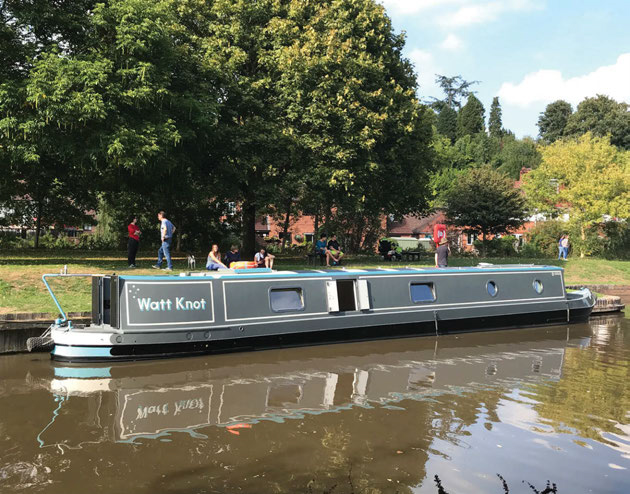
    Photo: Leading the way: Ortomarine’s ‘Watt Knot’ boasts diesel-electric propulsion with a 775Ah 48V battery bank and eight 160W semi-flexible solar panels fixed flush to the roof.

    New-build boats

    It seems extremely likely that the canal boat of the future will be driven by an electric motor. The technology exists and is mature. Quite a few boats have been built over the years with electric motors and they work. Motor vehicle technology will lead development.

    As with road vehicles, the problem is how to carry the energy around. Hydrocarbon liquids are a very efficient and effective method of transporting energy. There are two current solutions, both of which are being actively developed for road and rail vehicles:

    1) Batteries:

    There are very few issues installing a battery bank in a narrowboat. Weight is not a problem and space is more readily available than in a car. Power requirements are well within the range of the current technology and less than most road cars. The main drawback of batteries is range and recharge times. Both will improve. Batteries can be recharged using a shore connection, by onboard photovoltaic cells or small wind turbines. PV cells and wind turbines, given the current state of development, will not be able to provide all the energy required. However, PV cells are developing rapidly. Batteries can also be charged by hydrogen fuel cells, see below.

    Batteries are, of course, only ‘green’ if the electricity used to charge them is ‘green’, which at the moment is only partly true. This is a national problem and will not be addressed here. There are also environmental issues around the manufacture, recycling and disposal of batteries.

    2) Hydrogen:

    Hydrogen is an efficient method of transporting energy but not as good as hydrocarbon liquids. The hydrogen is converted into electricity in a fuel cell. The technology is well developed (and will develop further) and the size of existing cells is within that required to propel a narrowboat. Hydrogen, while potentially dangerous, can be engineered, in my opinion, to be no more hazardous than a petrol system. It will never be as intrinsically safe as a diesel system. Yet, California has 10,000 hydrogen cars and they are commercially available worldwide. Germany has hydrogen trains and they will be on the UK rail system too in a year or so. I assume they will be allowed in tunnels! Hydrogen engineering is well understood and mature.

    Currently hydrogen is not ‘green’ as it is mainly manufactured from hydrocarbon liquids and gases. This could be made ‘semi-green’ with CO2 capture. It can also be manufactured from ‘green’ electricity if available in sufficient quantity. Again, this is a national problem not confined to the waterways.

    IWA’s current vision for new-build narrowboats of the future

    • Powered by an electric motor.
    • Equipped with a battery bank large enough for canal cruising at normal speed.
    • Equipped with a hydrogen tank and a fuel cell powerful enough for canal cruising at normal speed.
    • Both would be used when high power (stopping, starting, manoeuvring) is required.
    • Battery charging by shore connection, onboard PV cells or the fuel cell.
    • The combination of battery and hydrogen fuel cell gives flexibility and reduces the cost of the total installation because of the reduced size of the fuel cell.
    • The cost would currently be higher than a diesel set-up, but this would come down with time.
    • Batteries would be adequate for short trips.
    • The hydrogen system would give range and fast refuelling capability.
    • An electronic management system would be required, but this technology is available.

    French electric hire boats and charging

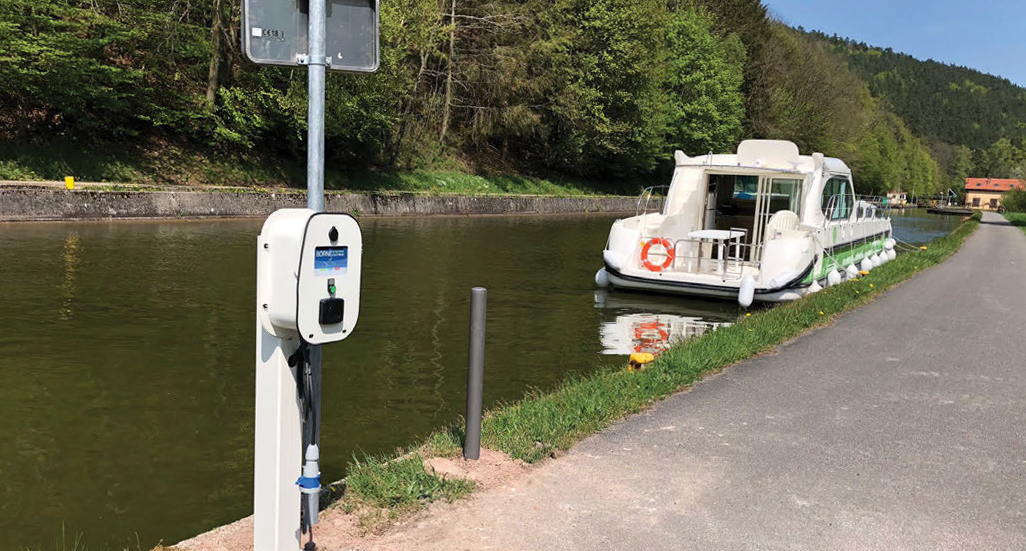
    Photo: ‘Tout vert’ and it only takes two hours to charge! France is well ahead of the UK network with electric hire-boats and newly installed charging infrastructure on some waterways.

    Existing craft

    Boats last a long time, as do their diesel engines. Owners, especially those with few engine hours a year, will be reluctant to convert from diesel to electric drive unless required by legislation, which is unlikely. It therefore follows that most of the existing diesel fleet will be with us for many years to come.

    Given that we don’t wish these boats to be made obsolete by legislation or owners being forced into expensive conversions, we need to find a way of significantly reducing the environmental impact of the existing diesel engine.

    One possibility is to use biodiesel. While not entirely ‘green’ (its manufacture requires use of a small quantity of hydrocarbon) it is a significant improvement on mineral diesel. Using biodiesel at 100% concentration has a number of disadvantages and problems. On our inland waterways, however, we can probably mitigate most:

    1) Biodiesel is manufactured from vegetable oil, and almost any vegetable oil can be used. The most common is palm oil, which gives a biodiesel that thickens in temperatures such as we experience during UK winters. This isn’t a problem when used at low percentages in mineral diesel, as in current road diesel, but it does cause issues at 100%, particularly when fuel lies unused in tanks for a significant period. Fortunately, proprietary biodiesels (using a blend of oils) are now being produced which can resist northern European winter temperatures.

    2) Pure biodiesel burns at a slower rate than mineral diesel and hence high revving, turbo-charged road diesels can struggle on 100% biodiesel. This is not a problem when blended at low percentages into mineral diesel. Most, if not all, canal-boat engines are low-revving and not turbo-charged, and so we would not expect this to be a problem for the majority of craft.

    3) The rubber seals and similar components of some canal-craft engines, mainly in fuel systems, may not be fully resistant to 100% biodiesel. This can be corrected – at a cost. Work would need to be done to identify and convert these engines, but it is believed that most modern ones are biodiesel resistant.

    4) Biodiesel is currently, and perhaps inherently, more expensive than mineral diesel.

    5) Biodiesel is manufactured from vegetable oils, and its production normally uses land which could otherwise be given over to food. In most cases, the oil itself is a foodstuff. For this reason biodiesel has not become the universal solution to road vehicles emissions. Inland waterway use, however, would be relatively small in comparison to cars etc, and so could be acceptable.

    Refuelling and recharging

    Assuming existing boats can be converted to biodiesel, the current refuelling infrastructure could be used.

    Future builds, however, will require more investment, whether we are considering an electric recharging infrastructure or a hydrogen refuelling one. At the moment we’re in a catch-22 situation:
    commercial operators will not invest until the boats to use it exist, and private owners won’t buy the boats until the infrastructure is available. It is unlikely that Government will stump up the cash, as is happening, to some extent, with road transport.

    An electric charging infrastructure does, of course, exist in most marinas and this will be adequate for slow charging of boats moored for significant periods. It would require upgrading for faster charging. This could be adequate for most ‘hybrid’ (hydrogen/electric) boats as envisaged earlier. It is difficult to imagine every visitor mooring on the system being equipped with charging points.

    Hydrogen refuelling stations are more problematic. None exists on the system as far as we know. They will also need a distribution system, probably tankers, to service them. They will be more costly than red diesel pumps and tanks, but the technology is available. Work is currently being done to develop hydrogen infrastructure in the UK, both for road/rail transport and for domestic use, but this is some way off. The natural gas industry is actively looking at using the gas grid to distribute hydrogen for domestic use. This may ultimately develop into a partial solution.

    It may also be possible to develop a network of hydrogen refuelling stations around hire-fleet bases, if enough hire companies could be persuaded to use hydrogen boats. Hire-boats are typically refuelled at base, sent out for one or two weeks and refuelled at the same base on their return. Hire-boats are also replaced at relatively frequent intervals, compared with private boats. This combination could make installing a hydrogen refuelling station at a hire-base reasonably economical, with a hydrogen fleet being available in a short period of time.

    If sufficient bases could be ‘converted’ this would provide a basic network for private boaters to use and hence encourage the uptake of hydrogen boats, eventually leading to further development of the hydrogen refuelling infrastructure. This would only apply to the central part of the system, however, where hire bases are common, and leave a problem for outlying waterways, at least initially.

    Have your say

    This article is not intended to be a final solution to the problem of sustainable boating on our inland waterways. It tries to paint a picture of where we might go and is intended to stimulate discussion, development and the generation of new ideas. Some may disagree with parts of it.

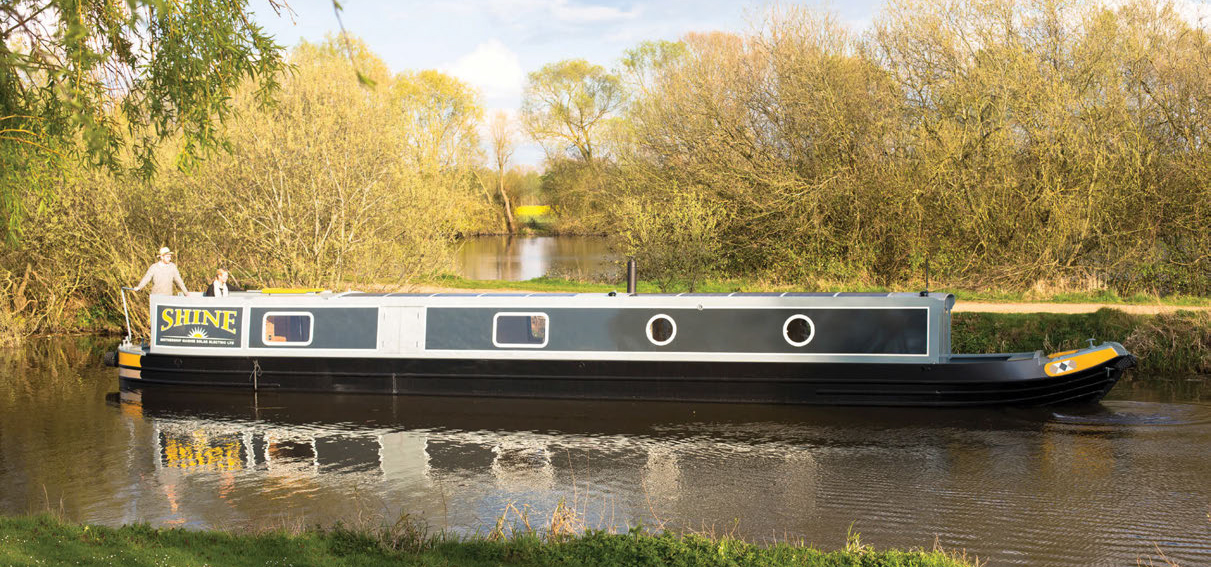
    Photo top: Mothership Marine’s 57ft semi-trad stern with 10kW electric drive and 2kW of solar panels was launched last year. It’s not entirely electric – a 7kW ‘range-extending’ generator is also on board – but it’s not bad!

  • Staying safe afloat in a flood

    Staying safe afloat in a flood

    Mooring matters

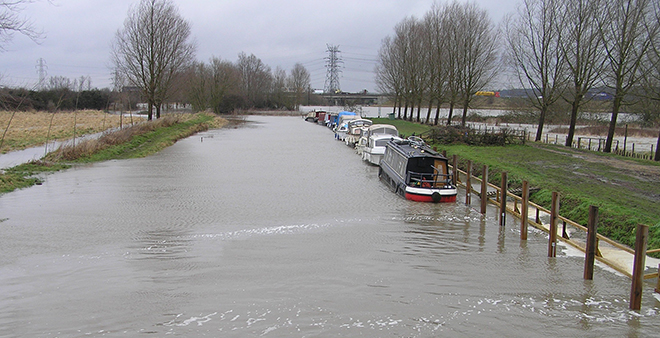
    Choosing a secure spot is easier said than done, however, especially when a river is already in flood. Try to avoid shallow banks or steep falls as this increases the chances of your boat listing when the water comes down or, if you have the opportunity, moor in a lock as it provides some protection from floodwaters.

    River Canal Rescue also urges boaters to take into account the flow of water: “Will it push or pull the boat and could it cause problems with other mooring points? Several boats sunk in recent floods because they were subject to water level changes which left them at an angle with outlets allowing water in.”

    Clean out drainage holes

    Drainage holes on the stern deck can easily become blocked with leaves and other debris over time, and become corroded. The risk here is that water may leak into the engine compartment and the alternators and starter motors, compromising charging and even starting the boat. If you’ve only got a manual bilge pump the entire engine room could fill with water. Clean out drainage holes regularly to reduce the chances.

    Ease off the ropes

    Fluctuating water levels will mean any boat tied too tightly is in real danger of listing. This could potentially sink the craft if outlets are submerged and water allowed to ingress. Keep your mooring ropes slack to stay safe.

    It’s also worth ensuring your ropes run to points that can be accessed even in a flood situation, so they can be adjusted to the conditions. If it’s especially windy, check ropes for chafing too.

    Battle of the bilge

    There are three words which could spell the difference between a boat sinking and staying afloat: automatic float switch. If you have a manual bilge pump fitted, and it works – you’ve checked! – it’s no good on unattended craft without a switch.

    Meanwhile, bear in mind that all pumps are reliant on batteries being in good condition and well charged. RCR advises: “Most batteries with a good charge can operate a pump for one week to 10 days with a bilge pump continuously running. To charge the battery, frequently run the engine for a minimum of one to two hours. It’s also worth finding out how long your battery will last on continuous use so if there is heavy rain, you can gauge how often to visit the boat.”

    Wind factor

    Strong flows and difficult river conditions aren’t your only concern in adverse weather – wind can cause havoc underway too. Check the direction it’s coming from before attempting any manoeuvres – it’s all too easy to lose control.

    Stay up-to-date

    Canal & River Trust issues stoppage or restriction notices when flood locks are brought into operation or when a navigation is closed due to flood conditions. You can sign up to receive emails advising of these per particular waterway, or you can check this information at any time on CRT’s website: canalrivertrust.org. uk/notices.

    Meanwhile, the Environment Agency issues Strong Stream Advice whenever flows reach a level that could be hazardous to boaters on its navigations. When Strong Stream Advice is in force, red flags, signs and warning lights at various lock sites are activated.

    Up-to-date information on any strong stream warnings in force on Environment Agency navigations can be obtained by telephoning EA’s Floodline Information Service on 0845 988 1188. EA operates a messaging system to inform boaters by telephone message, text or email, to advise when Strong Stream Advice has been issued or cancelled. You can sign up for these on EA’s website for Anglian waterways (gov.uk/ guidance/anglian-waterways-river-conditionsclosures-and-restrictions) and the River Thames (riverconditions.environment-agency.gov.uk).

    Point plank

    RCR managing director, Stephanie Horton, has a great tip to help prevent a boat drifting onto land when water levels rise: “Position a boarding plank between the boat and the river/ canalside edge and fix it into position on the side of your boat.” This basically acts as a stop.

    She also advises using the engine to keep the craft from getting grounded. However, she warns, “be mindful that as the propeller is at its lowest point, it can easily be damaged if the boat does drift. These options are not advisable other than in emergencies.”

    If your boat does drift onto land, it can be tempting to try and push it back into the water yourself. Timing is everything here – and so is your health and safety. Don’t attempt this potentially dangerous manoeuvre rashly, especially if you’re unable to see under the water.

  • First Silver Propeller Challenge finishers

    First Silver Propeller Challenge finishers

    The intrepid couple who were the first across the finish line were a husband and wife team, Michael and Jo Morehouse, who have been video blogging as Minimal List about their experiences via a YouTube channel and keeping fans updated on social media.

    The Silver Propeller Challenge aims to encourage boaters to visit 20 or more lesser-explored waterways across the UK and it was with a visit to Standedge Tunnel that Micheal and Jo finally made it to their 20th location.

    The couple have been boating the network since May 2017 and found out about the IWA Silver Propeller Challenge after its launch in early 2018. They realised they had already ticked off eight or nine of the destinations and made the decision to go for it and visit as many as they could. Their social media followers grew, with their YouTube channel now having over 10,800 subscribers and well over 1,000 on both Twitter and Instagram. It was this interaction that drove them forward as they knew they were encouraging other people to visit these rarely visited destinations.

    As Michael says, “We appreciate the IWA’s cruise-it-or-lose-it ethos and wanted to highlight some of the gems of these out of the way places. There were some canals where there was no love lost, but others were definitely worth the struggle, including the Ashby Canal and the end of the Montgomery.”

    Michael and Jo Morehouse joined us for an online talk to tell us about their adventures. Watch the recording on our YouTube channel.

  • Survey calls for basic facilities

    Survey calls for basic facilities

    The survey, which ran on our website during the second half of last year, asked boaters to identify areas on the UK’s waterways where facilities are missing or are in poor condition.

    Hundreds of comments were received about the facilities provided by nine different navigation authorities.  We will follow up the results with each authority individually, with Canal & River Trust, the Environment Agency and the Middle Level Commissioners all saying that they will welcome the findings.  Canal & River Trust has also said that IWA’s Gaptracker facilities survey results will contribute to their facilities review.

    An overwhelming 84% of the responses were about water points, rubbish disposal or portable toilet emptying, indicating a strong demand for those basic facilities.

    The report identifies a number of recommendations which we will be asking navigation authorities to adopt, including the general principle that the three basic facilities of drinking water, portable toilet emptying and rubbish disposal should continue to be provided by navigation authorities, without any additional cost to licence holders, at frequencies within 5 hours boating time.

    Read the full GapTracker report giving more detail about the findings of the survey.

  • IWA’s Voice is Heard in Ely

    IWA’s Voice is Heard in Ely

    Whilst IWA would have preferred the land to remain in the ownership of EA, for future navigation income and legacy, the purchase by East Cambridgeshire District Council means that the land will remain in public ownership and as such IWA welcomes the announcement.

    IWA hopes that this will bring a more secure future to the three waterway-related businesses based at the site:  Bridge Boatyard, which has been operating for over 40 years and which is now the only holiday boat hire company on the River Great Ouse, hotel barge Water Nimf and The Boat Yard boat restoration business.

    The three plots of land, amounting to over 300 metres of river frontage in total, had been offered for sale by private auction last summer.  IWA considered that this was extremely short-sighted given that the businesses and moorings at this location bring in an income to EA as the navigation authority, and wrote to EA, the Waterway Minister, MPs and local councillors to raise concerns.  As a result of the number of representations received, EA confirmed to IWA several weeks after the closing date for bids that it was reviewing the situation.

    Bridge Boatyard brings between 2000 and 2500 people on to the river each year on their hire boats, the loss of which would have had a serious effect on the tourism and leisure use of the river and consequently on the economy of Ely and other towns and villages along the river through loss of visitor spend.

    After an uncertain few months for the businesses based at the site, the announcement this week in a letter from EA to IWA, stating that the land would remain in public ownership through its sale to the council, is welcome.

    IWA Eastern Region Chairman, Chris Howes, said “East Cambridgeshire District Council is to be congratulated on its acquisition and stepping in to keep the waterside businesses going.  We understand that the Council has ambitions for the regeneration of this part of the City of Ely and hope that in developing this area the current navigation and leisure activities will be preserved and encouraged.”

  • Montgomery Canal: Enhancing heritage & habitats

    Montgomery Canal: Enhancing heritage & habitats

    After becoming derelict in the 1930s, restoration began on the waterway in 1969. Now, about 50% of the canal’s 35 miles have been returned to navigation and the towpath has also been brought back into use. Most of the canal is a Site of Special Scientific Interest and in Wales it is a Special Area of Conservation. However, thanks to a 2005 conservation management strategy, these precious habitats continue to be protected, even as the waterway welcomes increasing boat and visitor numbers. Restoration to date has included the creation of off-line nature reserves to safeguard wildlife and rare water plants when sections of the canal are reopened to traffic. These have become an attraction in
    their own right.

    Meanwhile, the built heritage – an integral part of the restoration – has also been rejuvenated. Currently 25 of the canal’s 28 locks have been restored and many of its bridges, aqueducts, warehouses and other structures have been conserved although more remains to be done.

  • Hollingwood Hub, Chesterfield Canal: Creating community spaces

    Hollingwood Hub, Chesterfield Canal: Creating community spaces

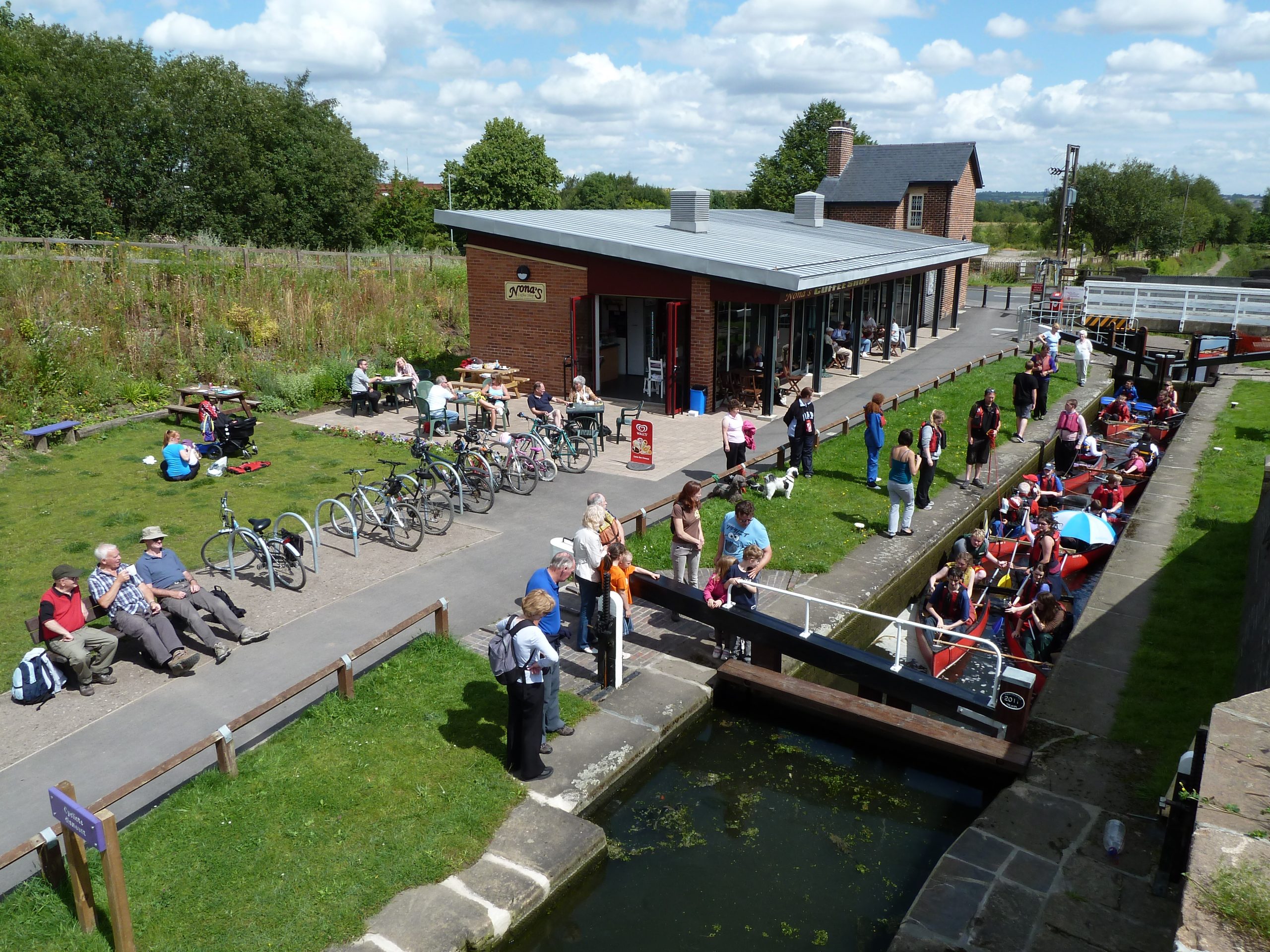
    Formerly a lock house, it was converted in 2010/11 thanks to a government grant of £385,000 under the Community Assets Programme and now boasts a coffee shop, a meeting and education room, a play and picnic area, shower and toilets. It also serves as an archive and office base for the Chesterfield Canal Trust. With many local facilities closed due to financial cuts, the Hub has filled a much-needed gap in the area. Its flexible space lends itself to a wide variety of different uses. The meeting room is used by schools, crèches and playgroups. It is available from early morning until late evening so social events, training courses and night school classes are also easily accommodated.

    The Hollingwood Hub site is owned by Derbyshire County Council, who supervised the renovation and construction, and it is run by the Chesterfield Canal Trust. It is conveniently located on the Chesterfield Canal towpath (which also forms part of the Trans Pennine Trail), attracting some 55,000 walkers and 30,000 cyclists each year, as well as anglers and canoeists. Many of them call at the Hub for coffee, for information about the canal or for volunteering opportunities. Meanwhile, the garden is being developed by local volunteers and school children. Benches, picnic tables and cycle racks have already made this an inviting area for all.

  • Shire Cruisers, Rochdale Canal: Driving tourism

    Shire Cruisers, Rochdale Canal: Driving tourism

    Obstacles included two motorways and countless road blockages. So how did it ever get completed?

    The answer lies with far-sighted local authorities, who wanted their communities to benefit from the restoration. Local hire boat fleet, Shire Cruisers, played a part in bringing life to the waterway.

    Getting boats regularly using this isolated stretch of water, brought with it the economic benefits associated with tourism but also turned it into a ‘working waterway’. This helped make the case for further restoration.

    When Nigel and Susan Stevens bought Shire Cruisers in 1980, their boats could only go one way, on the Calder & Hebble Navigation. They were excited by the expansion prospects presented by the Rochdale restoration. By 1985 this had advanced to six isolated but navigable miles around Hebden Bridge. They put a boat here, and short breaks were so popular that a second boat was added.

    One of many make-or-break moments was the public enquiry for the Manchester ring road (M60) – because of the established boat hire operation, the inspector saw the potential of the canal and ruled that the ministry must provide for navigation. This changed the prospects of the canal with funders now believing they were backing a winner.

    Seeing the waterway in action made all the difference. Funding agencies could be confident that their investment would benefit the local community.

    In 2001, the Huddersfield Narrow was reopened, which completed the South Pennine Ring, bringing even more holidaymakers to the area, all ready to spend their money supporting growing local businesses.

  • Ebley Mill, Cotswold Canals: A catalyst for transformation

    Ebley Mill, Cotswold Canals: A catalyst for transformation

    Stroud District Council was one of the first to fully capitalise on the economic benefit of a restoration project. In late 2008 they took on leadership of a Heritage Lottery funded project to restore a six-mile section of the Cotswold Canals. The decision was taken against a backdrop of recession and difficult financial and engineering challenges, but with huge community
    support.

    Through the Phase 1A Stonehouse to Thrupp regeneration project, they have seen over ÂŁ115m of private investment. This has transformed the area.

    Formerly used as a car park, the canal here has been excavated to become a navigable channel once again, complete with a tripboat. The Ebley Mill building itself was previously converted into offices by Stroud District Council. Other parts of the complex now have new uses too and luxury houses face onto the canal, developers having been lured by the waterfront potential.

    In all, some 550 new houses have been built, 62 hectares of brownfield land recycled and over 770 jobs created.

    After the success of Ebley Mill, Stroud District Council is keen to repeat it at a site further along the canal. The ÂŁ3m infrastructure works at Brimscombe Port will provide 200 new homes, business units, community facilities and a canal marina in the Stroud Valley.

  • Using VHF Radio

    Using VHF Radio

    Guidelines on the use of VHF radio by inland pleasure craft on UK freight waterways, including advice on navigation lights, sound signals and navigational safety.

    Download guidelines on the use of VHF Radio (PDF 616KB), prepared by John Pomfret.

    Summary:

    Marine-band VHF radio provides a means for vessel crew to communicate with other vessels and shore station (e.g. ports, locks, bridges and marinas) on operational, navigation and safety matters.

    As well as providing an effective means of calling for help in an emergency, use of marine-band VHF radio can inform you of the presence of large vessels and their intentions, as well as providing a means to call for locks to be prepared or moveable bridges to be swung or raised in advance of your arrival.

    Simply listening to the appropriate radio channel will provide a picture of vessel traffic, which may enable you to avoid meeting a large vessel in an awkward location, for example.

    Availability of radio-communication and establishment of vessel traffic services (VTS) in some areas has contributed to the penetration inland of larger vessels than hitherto, presenting an increased hazard to small pleasure craft.

    Marine-band VHF radio has become widely used on larger waterways, replacing flag signals and to some extent sound signals, so that if your vessels is not so equipped, you may be exposing yourself to unnecessary risks.

    Marine-band VHF radio is obligatory on vessels navigating many tidal waterways, including parts of the Ouse, Humber, Trent, Witham and Thames.

    Portable marine radio sets are now relatively inexpensive and the ship portable radio licence is free. Users will also need to attend a one day course, available in all parts of the country, to obtain the required operator’s certificate.

    IWA strongly recommends that boaters carry marine band VHF radio on all major tidal waterways and on other waterways where locks and bridges are equipped with VHF radio.

    Vessels navigating at night or in conditions of reduced visibility must carry full navigation lights except for narrow canal craft, which only need to carry a single light at the bow on narrow canals and some other waterways.  However, even narrow boats must carry full navigation lights on all tidal waterways and on many of the larger non-tidal waterways.

    Boaters should also familiarise themselves with local signage before venturing onto a large waterway; some waterways use local signs not found elsewhere.

  • Crayfish in canals and rivers

    Crayfish in canals and rivers

    Photo Credit : NNSS Image – Trevor Renals

    What is the difference between a signal crayfish and a native crayfish?

    The signal crayfish is lobster-like in appearance and reaches a maximum size of 16-18cm.

    Its claws have red undersides with a small turquoise/white blotch on the upper surface at the claw hinge. The upper surface of this species is usually brown to greenish-brown, while the lower surface is often a contrasting bright orange or red. The signal crayfish has a distinctly smooth ridge running along the middle of the rostrum (the foremost projection of the carapace).

    Photo: Bright red underside of claws

    In comparison, the native white-clawed crayfish is much smaller (under 12cm), with a brown to olive pitted body.  The underside of the claws are usually a dirty-white colour – never red.

    The white-clawed crayfish was once a widespread and common species in English and Welsh rivers, but has suffered a decline of 50 – 80% across its European range in the last ten years and is classified as ‘endangered’ on the IUCN red list of threatened species and is at risk of global extinction.

    Why are there two types of crayfish in britain’s canals and rivers?

    In the 1970s, the British government introduced the signal crayfish (Pacifastacus leniusculus) from North America to UK waters. The crayfish plague had ravaged native crayfish populations in Europe and it was seen as an attractive commercial species for export to the lucrative Scandinavian market. Unfortunately, they are a carrier of crayfish plague and it is likely they passed it to the native white-clawed crayfish (Austropotamobius pallipes) in the UK.

    Signal crayfish soon escaped from commercial fisheries and began to outcompete the native white-clawed crayfish for habitat and food. They have decimated the native crayfish populations. Signal crayfish cause further problems by burrowing into river and canal banks causing erosion, bank collapse and sediment pollution. In addition, the signal crayfish is a voracious predator. It feeds on a variety of fish, frogs and invertebrates, as well as plants, and even eating its own species.

    Where are signal crayfish in Britain?

    The signal crayfish is well established in England and Wales, especially in the south-east of England. They are not as prevalent in Scotland but several well-established populations have been recorded.

    Signal crayfish are able to disperse up and downstream, cross most natural and artificial barriers and travel over land to reach water bodies nearby. Dispersal distances of over 300m in 2 days, and several hundred metres over land in one night have been recorded. Dispersal has been aided by human transfer and release of individuals, although this is now illegal.

    The signal crayfish occurs both in still and slow-flowing freshwater environments, including rivers, streams, lakes, reservoirs and canals. They are also able to tolerate slightly salty water.

    It takes shelter under rocks and boulders, within tree roots or in burrows and cavities within banks. In the winter, adult signal crayfish shelter in burrows and enter a state of torpor. These burrows are formed of many inter-connecting tunnels, and can be up to two metres deep.

    The signal crayfish has a relatively high reproductive potential, with the female of this species laying between 200 and 400 eggs in the autumn. The female then carries the eggs around under her tail through the winter until the spring, when the eggs hatch. Once hatched, the young remain attached to the female’s tail until they are released in May or June. Signal crayfish reach sexual maturity at about 2 or 3 years old, and can live for up to 20 years.

    What are the problems with crayfish in british waterways?

    1. Environmental impact

    Signal crayfish’s extensive burrows can destabilise banks, causing erosion and bank collapse, increasing flood risk and the silt load in the water. Their burrows displace threatened riverside species such as Britain’s water vole (Arvicola amphibius).

    Native crayfish are becoming extinct through the spread of crayfish plague and competition for resources. Signal crayfish are bigger, grow faster, reproduce more quickly and are more tolerant of a wider range of conditions than the native white-clawed crayfish.

    They feed on fish and amphibian eggs, tadpoles, juvenile fish, aquatic invertebrates, detritus and aquatic vegetation and where present reduce populations of native species and affect food webs.

    2. Economic Impact

    Signal crayfish burrowing can cause erosion of riverbanks. Burrows can be up to 2m deep, with many inter-connecting tunnels that weaken the bank. This can contribute to problems with flooding, livestock safety and stability of structures built on the banks.

    Crayfish also take refuges from salmonid fish and predate fish eggs, which could reduce the value of commercial fisheries.

    3. Crayfish Plague (Aphanomyces astaci)

    This fungus-like disease is fatal to the endangered white-clawed crayfish. It spreads by waterborne spores released from infected crayfish.

    The spores of crayfish plague can survive for up to two weeks in damp conditions, but can be killed by drying or disinfecting. Introducing new signal crayfish is usually the source of new outbreaks, however spores are also carried between waterways on wet fishing equipment, boots and boats.

    CAn I catch crayfish in a canal or river?

    You must not trap non-native crayfish without written consent from the Environment Agency (EA) in England or Natural Resources Wales in Wales. You also need permission from the landowner and any relevant angling clubs. Native crayfish are a protected species – you can only trap them for scientific purposes and not to eat or sell.

    Find out more about Permission to trap crayfish

    What can I do to stop the spread of signal crayfish?

    The best defence against further spread of signal crayfish is biosecurity. If you use the waterway, you need to follow the Check; Clean; Dry guidelines.

    Anglers:

    • Dry or disinfect any boots or equipment before moving between waterways.
    • Avoid fishing different waterways on the same day.
    • The use of crayfish as bait is illegal in any form.

    Boaters:

    • Check the boat exterior for young.
    • If removing boat from waterway, check the bilge and interior for any obvious crayfish and flush the engine cooling system through with fresh water from a piped supply

    Canoeists:

    • Drain the boat as usual and check the interior for any obvious crayfish
    • If possible flush the boat out with fresh water from a piped supply

    Under the Wildife and Countryside Act 1981 (as amended), it is an offence to release, or allow to escape, any non-native species into the wild in the UK except under licence. If you catch a signal crayfish, bring it ashore or into the boat for humane destruction.

    Practising good biosecurity practice by everyone who uses or works in or around water (including fishermen, boaters and contractors), will prevent the transfer of animals or eggs between waters.

    Find out more about how you can help stop the spread of invasive aquatic species at the GB Non-Native Species Sectariat (NNSS) website.

    More information

    Predators: In the UK, the signal crayfish is known to be predated by otters (Lutra lutra), American mink (Mustela vison) and predatory fish such as Atlantic salmon (Salmo salar) and European eels (Anguilla anguilla).

    Trapping: Trapping trials have concluded that although numbers may be reduced during the short-term, traps may favour the capture of larger individuals. An unintended consequence of selective harvesting is the increased growth and earlier maturation of juvenile crayfish, which can cause the population to increase. It is not, therefore a sustainable long-term solution.

  • A Cruise Through the History of Canal Tunnels

    A Cruise Through the History of Canal Tunnels

    IWA Navigation Committee’s Sue O’Hare guides us through the oldest, longest, widest and brightest tunnels on the canals.  Read on to find out about the tunnel that contained a canal and railway side by side and the tunnel that is now the site of Europe’s largest bat colony.

    Tunnels are a fascinating part of canal cruising, a separate world seen only by boaters and wildlife. But just how much do we know about them?

    When is a tunnel not a tunnel?

    A tunnel is defined by the Oxford English Dictionary as “an artificial underground passage, especially one built through a hill or under a building, road, or river”. So how does the 25-yard Dunsley Tunnel on the Staffordshire & Worcestershire Canal qualify as a tunnel, when modern motorway bridges such as the culvert under the M5 on the Droitwich Canal do not? Is it perhaps because the Dunsley Tunnel goes through the ground as opposed to a man-made structure? Then why is Deansgate Tunnel carrying the Rochdale Canal underneath Deansgate in Manchester a tunnel?

    Following in the footsteps of the Persians

    In the 1st millennium BC the Persian people developed a system of qanāts, gently sloping tunnels to transport water from underground sources for irrigation and domestic use. The idea spread throughout the Middle East and North Africa and qanāts are still in use today.

    The first canal tunnel

    The first navigable canal tunnel was the Malpas Tunnel, built in 1679 to enable the Canal du Midi to pass under the hill d’EnsĂŠrune in the department of HĂŠrault in the south of France. The chief engineer Pierre-Paul Riquet was able to overcome the challenge of tunnelling through brittle sandstone by lining the tunnel with stone vaulting, creating a wide and high 180-yard tunnel. The hill was already the site of a tunnel dug in the Middle Ages to drain the Étang de Montady, and this is said to have provided inspiration for Riquet.

    Mines and tunnels

    It was almost 100 years later that the first navigable tunnels were built in the UK, first in connection with mines and then on canals built for other purposes. The link with mining was obvious: miners were the only people with digging skills, and mines needed both transport and drainage.
    Wet Earth Colliery in Clifton to the north west of Manchester was the location for the earliest water-carrying tunnels, engineered by James Brindley to drain the mine. Brindley designed a complex scheme involving a weir on the River Irwell to create a head of water, which was carried under the river into the mine through an inverted siphon sinking to a depth of 53 feet. It then turned a waterwheel which drove an underground beam pump. The system was completed in 1756 and was so successful that the basic components continued in use for 170 years. The remains can still be seen in what is now Clifton Country Park.

    When Francis Egerton became the 3rd Duke of Bridgewater and hired John Gilbert as factor for his estates, they realised the need to improve the productivity of the mines to meet the increasing demand for coal in Manchester. Inspired by Brindley’s work at Clifton, they hired him as surveyor. The first part of their solution was to build the Bridgewater Canal from Worsley to Salford to provide better transport for coal. The other part was to extend the canal underground at Worsley Delph, an old sandstone quarry. This work was started around 1760 and created a multi-functional ‘Navigable Level’ which could drain the mines, provide an integrated transport system, and provide a water supply for the canal. An underground canal network was developed as new coal seams were discovered. Special boats nicknamed ‘starvationers’ were used, 4½ feet wide with protruding ribs inside. By the time coal transport along the Navigable Levels ended in 1887, there were about 47 miles of underground canal on four different levels, connected by a water powered inclined plane and lifts. The system continued to be used for drainage with regular inspections by boat until it was finally closed in 1968.

    In a similar way limestone was transported out of the quarries at Dudley along branches dug from the Dudley Tunnel on the Dudley No. 1 Canal, and coal at Harecastle on the Trent and Mersey. Ironically it was mining, one of the original reasons and enablers for tunnels, which led to the downfall of many tunnels through subsidence. Unlike its neighbour the Lapal Tunnel, the Dudley Tunnel survived subsidence, only to be closed through disuse. Through a huge effort by the Dudley Canal Trust it was reopened and is now the second-longest surviving tunnel. It is a particularly intriguing place to visit, with its basins open to the air, its limestone caverns and its network of side tunnels. While it is open to navigation, it is very low and no engines are permitted, so most visitors take an electric trip boat operated by the Trust.

    Tunnel Mania

    As canals spread so too did tunnels. The Trent and Mersey Canal is well known as a pioneer, boasting perhaps the first of all navigable tunnels to be opened on the main system at Armitage in 1770 – though this no longer exists as a tunnel, having been opened out in the 1970s after subsidence caused by coal mining. The southern section of the Staffordshire and Worcestershire Canal with its short tunnels opened in the same year.
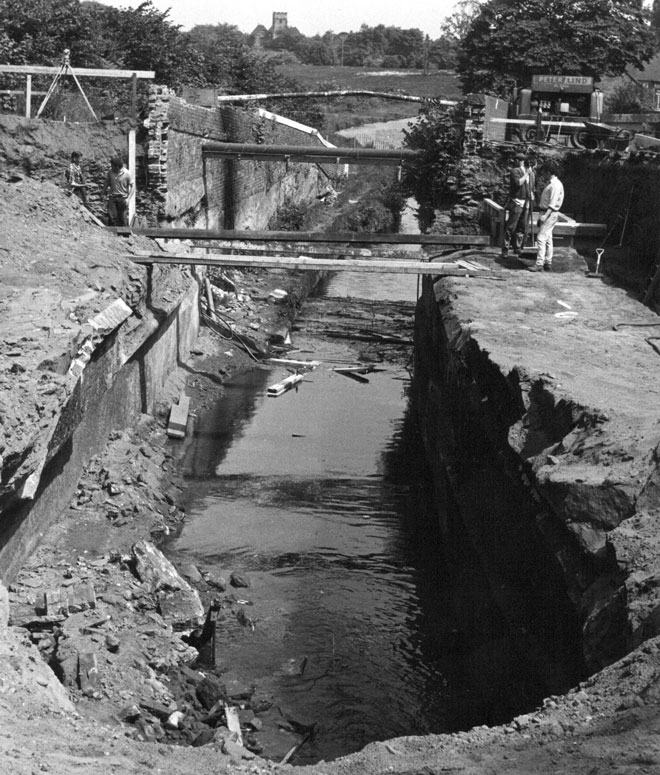
    Photo: Armitage Tunnel during removal of the tunnel roof in 1971. Photo by Harry Arnold, Waterways Images.

    The three tunnels on the northern Trent and Mersey at Preston Brook, Saltersford and Barnton were among the earliest tunnels of substantial length, and are well known for their lack of straightness. Brindley’s first tunnel at Harecastle on the same canal is often thought of as an early leader for length at 2,880 yards, although his Norwood Tunnel on the Chesterfield Canal predated Harecastle as well as being the longest canal tunnel in Britain when it was opened in May 1775. Subsidence from nearby mining caused sections to sink and it eventually collapsed completely after heavy rain in 1907. The western end was filled in to enable the M1 to be built, although the eastern end is still in remarkably good condition and CRT invited members of the public to explore it during the 10-yearly inspection in 2016. The Chesterfield Canal Trust continues to develop options for replacing the tunnel in order to re-open the whole of the 46 miles of the canal, facilitated by the recent confirmation of a new route for the West Midlands to Leeds HS2 line around Norwood, running over the line of the Chesterfield Canal restoration on an embankment. The Chesterfield Canal Trust supported by IWA and CRT has proposed that the embankment be replaced by a viaduct, so that the canal could be restored on an east-west alignment giving fantastic views out to the west. The tunnel could be opened out again as a tribute to Brindley’s original work, and it might be possible to use the old canal line and reservoirs to drain the HS2 track and keep the restored canal locks topped up – and James Brindley would have the last laugh!
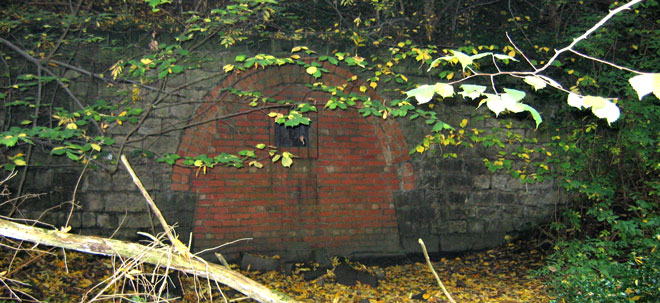
    Photo: Norwood tunnel portal on the Chesterfield Canal line.

    On the Cromford Canal in Derbyshire, the Butterley Tunnel of 1794 was at the time the third longest. It included an underground wharf where narrowboats were loaded with coal. Vertical shafts above the wharf enabled goods to be transported between the canal and the Butterley Company’s works on the hill above the tunnel, using a system of ‘tram boxes’ which were containers used on the Little Eaton tramway as well as carts on roads, narrowboats on the Chesterfield Canal and barges on the Derby Canal. Mining-related subsidence again claimed this tunnel.

    In Shropshire a network of ‘tub boat’ canals was built to transport coal, limestone and ironstone from mines and quarries to blast furnaces producing cast iron and wrought iron. The tub boats were built of wrought iron and were rectangular, about 20 feet long and 6 feet wide, and were pulled in trains of up to 20. The 970-yard Berwick Tunnel was opened in 1797 and was the first of any length to be built with a towpath. The tunnel was not straight and it was not possible to see the far end, so a byelaw was introduced giving right of way to whichever boat reached the centre mark first while the other boat had to reverse out of the tunnel before trying again. The tunnel remains, although both ends have been bricked up.

    As tunnels became more widespread, so they began to develop from the early narrow, mine-like structures. First towpaths spread, then came wide tunnels such as Sapperton Tunnel on the Thames and Severn Canal, Wast Hill on the Worcester & Birmingham Canal, Foulridge on the Leeds & Liverpool Canal, and Braunston and Blisworth on the Grand Union Canal. ‘Second generation’ tunnels were built to augment the capacity of the existing ones: firstly Telford’s tunnel alongside Brindley’s at Harecastle, and finally the last tunnel to be dug in the canal age, Netherton Tunnel which was opened in 1858. With its twin towpaths, gas lighting throughout and navigable width of 17 feet, Netherton was intended to alleviate the pressure on the narrow Dudley Tunnel and duly became one of the busiest routes in the Birmingham area.
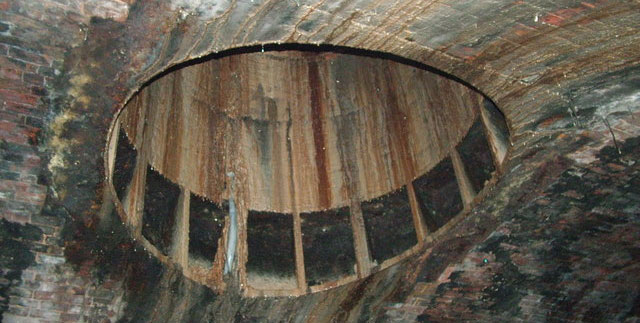
    Photo: Air shaft in Netherton Tunnel. Photo by Peter Evans.

    In most cases the method of construction was by digging vertical shafts down to the required level from above and then working sideways from the shafts, using them to remove the spoil. Some of the shafts would often be left for ventilation. The ‘cut and cover’ method was used In a few cases where ground conditions were particularly difficult, notably Foulridge Tunnel.

    The most well-known technique of propelling boats through tunnels is legging, whereby boatmen lay on boards across the boat and walked along the tunnel walls or roof. A range of other methods was used, including poles or shafts, chains or rails, towpaths in a few tunnels, and later steam or electric tugs. An unusual system was devised by Thomas Brewin for the long, narrow Lapal Tunnel on the Dudley No 2 Canal. A pump and stop locks at each end were used to create a current to push boats through in either direction, halving the transit time from 4 hours to 2 hours. The system proved effective and continued in use from 1841 until shortly before the tunnel was closed in 1917 after a collapse.

    Facts and Figures

    At the time of publication in 1976 of the definitive John Gagg’s Book of Canal Tunnels there were 46 tunnels still in use, 5 tunnels that had been opened out, and over 40 disused tunnels including the four longest ever built. Interestingly there were also two on now-abandoned canals that had never been used. The Salisbury and Southampton Canal was planned to connect with the River Itchen through a tunnel at Southampton, but despite John Rennie being called in the works were never finished. The 1,250-yard Southnet Tunnel on the Leominster Canal was completed but collapsed in 1795 before the canal was opened the following year, and was never repaired.

    Like the earliest canal tunnel, the longest and largest canal tunnel built to date is in France. The Rove Tunnel was opened in 1927 on the Canal de Marseille au RhĂ´ne, connecting Marseille to the River RhĂ´ne. It is almost 7,800 yards long, 72 feet wide and 27 feet high, with a water depth of 13 feet. After a partial collapse it was closed in 1963.

    Restoration

    Happily the situation since John Gagg wrote has improved, with the reopening of two significant tunnels. Standedge Tunnel on the Huddersfield Narrow Canal is the longest canal tunnel built in the UK at 5,698 yards, having taken 17 years and over £120,000 to construct. It is also the highest above sea level (644 feet) and the deepest underground (more than 600 feet in places). It was officially closed along with the rest of the canal in 1944, although Robert Aickman, Tom Rolt and senior IWA members famously made a difficult passage through it on ‘Ailsa Craig’ in 1948. After a £5 million project it reopened in May 2001 as part of the restoration of the entire canal. For the first few years no internal combustion engines were allowed and visiting narrowboats were towed through in convoys by an electric tug which also acted as an observation boat for the crews. Despite the provision of rubber sheets to cover boats, they were liable to be damaged in transit, and when one of the tugs needed substantial repairs British Waterways carried out a trial run for self-steer operation. Since 2009 boats have been allowed to travel through the tunnel under their own power. Numbers are limited, advance booking is needed, and a CRT chaperone travels on the boat with a service vehicle following through a parallel disused railway tunnel.
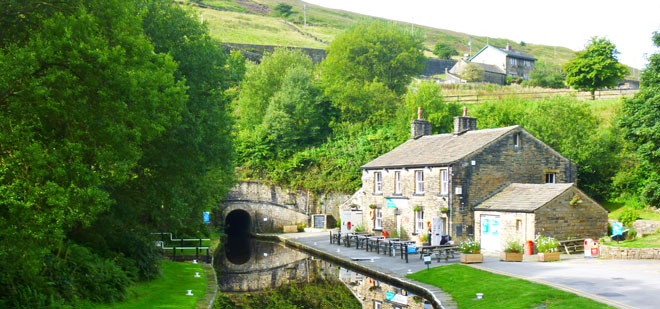
    Photo: Standedge Tunnel on the Huddersfield Canal. Photo by Bob Haigh.

    In addition the 696-yard Falkirk Tunnel on the Union Canal in Scotland was restored as part of the Millennium Link, a project to restore the Union Canal and Forth and Clyde Canal which joined them by means of a new short tunnel at Roughcastle and the Falkirk Wheel boat lift.
    There are plans to restore or bypass other tunnels including the 3,817-yard Sapperton Tunnel on the Thames and Severn Canal. Passage through this tunnel is described vividly by C. S Forester in his 1953 historical novel Hornblower and the Atropos, when Captain Horatio Hornblower helps with the legging. Meanwhile the Lichfield & Hatherton Canals Restoration Trust is progressing an ambitious fundraising programme led by David Suchet, to build new tunnels under the new Lichfield Southern Bypass as well as the Cross-City railway line from Lichfield to Birmingham.

    New Uses for Old Tunnels

    There are several examples of unexpected new uses for both operational and derelict tunnels.

    Greywell Tunnel on the Basingstoke Canal was closed in 1932 after a roof fall. It became a well-used home for bats and is now the site of Europe’s largest bat colony, with as estimated 12,500 bats of at least five species.
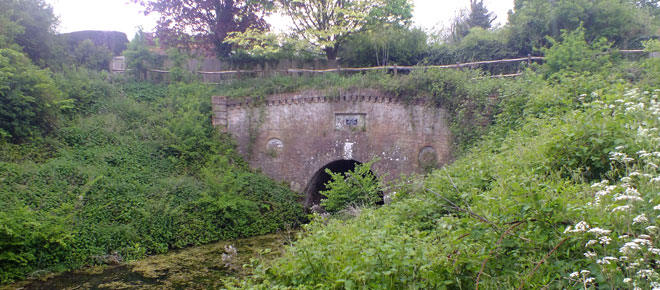
    Photo: Eastern Portal of Greywell Tunnel. Photo by John O’Hare

    Perhaps surprisingly, the second longest tunnel after Standedge was Strood Tunnel on the Thames and Medway Canal in Kent. The canal was envisaged as a short (7-mile) passage between the Rivers Thames and Medway for both naval and commercial craft, avoiding the much longer journey around the Hoo Peninsula. The major engineering challenge was the chalk ridge of the North Downs, which was met with a tunnel of notable dimensions. Strood Tunnel was 4,012-yards long, completely straight, and the widest of all UK tunnels at 30 feet including a 6-feet wide towpath. Owing to the solidity of the chalk, no lining was needed, and as a result the exposed chalk reflected light so well that it was never completely dark in the tunnel during daytime. It was only wide enough for one barge and so there was a timed entry system. The tunnel soon became a bottleneck and a 150-yard section was opened out to create a passing place, resulting in two separate tunnels (the Higham Tunnel at the northern end and the longer Strood Tunnel at the southern end). When the railways arrived the Gravesend & Rochester Railway was built parallel to the canal along its length. Remarkably the single railway line shared the canal tunnel, partly supported by the towpath and partly by wooden piles driven into the canal bed. The sight of barges and trains running side by side within the tunnels must have been spectacular, but it only lasted for a couple of years before the decision was made to create a double-track railway. The canal bed within the tunnels was filled in and converted to a railway line in 1847. The tunnels are still in use and can be traversed on trains on the North Kent Line between St Pancras International and Margate – and viewed from both Higham and Strood stations.
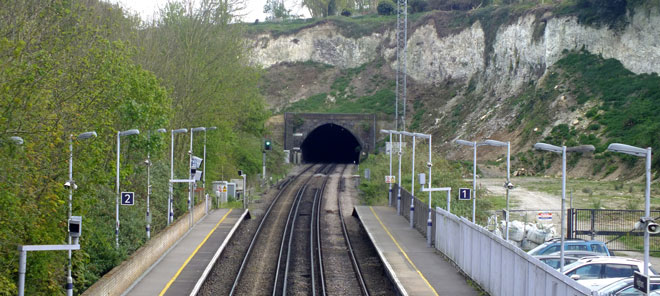
    Photo: Higham Tunnel. Phot by John O’Hare.

    The Union Canal between Edinburgh and Falkirk has links with the murderers Burke and Hare, who came from Ireland as navvies to work on the canal between 1818 and 1822. They subsequently killed 16 people to earn money by selling fresh corpses for medical experimentation at Edinburgh University. When the canal was restored a new LED lighting system was installed in the Falkirk Tunnel which reveals details including candle-holders, dynamite stores and shafts, and lends itself to artistic and theatrical events. In August 2017 the tunnel became a pop-up theatre venue for a play about Burke and Hare called “The Resurrection”, in a collaboration between Scottish Canals and The Walking Theatre Company.

    On a much more upbeat note, Dudley Tunnel is probably unique among canal tunnels in being licensed for civil weddings. The bride arrives on a Dudley Canal Trust tug and the ceremony is performed in the Singing Cavern, with room for 50 guests on land and a further 50 on a boat.

    Photo-top: Shrewley tunnel, Grand Union Canal, Dawn. Photo by Robert Silverwood

  • Boating at night on inland waterways

    Boating at night on inland waterways

    There are many reasons why a boater may find themselves having to boat at night.  It could be due to illness or emergency, such as a crew member becoming unwell or needing to get your boat past a short-notice stoppage.  It could be due to the timing of a tidal passage, or it could be through miscalculation of the time needed to reach a mooring, or it may simply be through choice.

    IWA supports the principle of being able to navigate at night. Boating at night is something that is allowed for in some but not all navigation authority byelaws, and for commercially operated boats it is often a necessity.  There are some places where it is prohibited, for example on the River Wey, Middle Level and Chelmer & Blackwater navigations – so it is best to check with the relevant navigation authority.  Most hire boat companies also prohibit boating at night, so if you are on a hire boat holiday in the winter you will need to make sure your schedule allows for mooring up before it gets dark.  Boat owners should check the terms and conditions of their insurance.

    There are a few things that boaters should bear in mind, especially if you’ve not been boating in the dark before.

    1.  Headlight

    Ensure your boat has a good headlight, particularly on narrow waterways where you may need it to see where you are going and to avoid damage to your own or other craft.  Bear in mind though that headlights are intended for use in tunnels and can easily dazzle oncoming boaters or towpath users.

    2.  Navigation Lights

    Whilst carrying a headlight alone is permissible for narrow boats on the narrow canal system, for larger craft and on larger waterways, rivers and freight waterways navigation lights are required.  These should consist of a white masthead light (not a headlight), a red side light on the port side and a green side light on the starboard side (neither of which should be visible from behind), along with a white stern light.

    Night boating on the River Thames. Photo by Tim Lewis.

    You should have these navigation lights fitted if you are cruising on any of these waterways, even if you do not intend to do any boating at night, as you may find you have to use them if you break down, or your plans change once you are on the waterway and you need to make a tidal passage late in the day or early in the morning, or you suddenly find visibility is reduced (e.g. due to fog) and there is nowhere safe to moor nearby.

    More detailed information, including requirements for vessels of different lengths and for different waterways, can be found on our boating pages.

    3. Passing Moored Boats

    When boating in the dark try to consider moored boats and the people who may be on board – especially if boating late into the evening, through the night or very early in the morning.  Sound travels on the water, so avoid having to shout to your crew, and slow well down past moored boats (pass even more slowly than you would during the day) to minimise disturbance.

    Passing moored boats. Photo by Paul Strudwick

    4. Have a Torch to Hand

    Make sure that your instruments are visible in the dark.  Head torches are great inventions and extremely useful when boating in the dark, especially when operating locks or mooring; however, be careful not to dazzle others by moving so that the beam shines in their eyes.  Having a hand held torch close to the steering position can also be a good idea – but bear in mind that bright lights will affect your night vision. Having a supply of spare batteries for your torches is also sensible.

    5. Navigating Your Route

    Make sure that you are familiar with your route, and have appropriate maps, guidebooks or navigation charts to hand, so that you know when to expect junctions, locks, bridges and bends and can recognise individual lit navigation marks.  Take particular care at these places and in particular take extra care if operating locks at night (where this is permitted). If you are boating single-handed give serious consideration to the risks.

    Beware of overhanging bankside vegetation, on cloudy or moonless nights in particular, and especially on rivers keep a look out for floating objects.  Depending on the surface material, towpaths or river banks may show up more than the darkness of the water in the waterway, and you can sometimes use the towpath or bank to work out which way the canal or river goes around a bend.  Night boating on rivers or larger waterways can bring other challenges and you will need to be on the look out for weir signs and navigation channels that may not be so obvious in the dark.

    6. Let Someone Know

    Make sure someone else knows where you are going, have some form of reliable communication on board (preferably marine band VHF radio on larger waterways where this is in use) and have an anchor ready for deployment in an emergency (and know how to use it!).  Even if you don’t wear a lifejacket the rest of the time, it can be a good idea if boating in the dark or in very low temperatures (immersion in very cold water is more likely to lead to life-threatening situations).  IWA advises against boating in the dark in other conditions with increased risks, e.g. floods, mist or fog, extreme ice or snow, etc.

    Photo-top: Boating at night on the River Weaver. Photo by Steve Wood

  • HS2 Phase 2b: the impact on the waterways

    HS2 Phase 2b: the impact on the waterways

    There needs to be greater attention to avoiding and mitigating environmental and community damage, including minimising impacts on the users, heritage and restoration of the inland waterways.

    The decision to scrap much of the Eastern Leg of HS2 Phase 2B is good news for the waterways along that route, however, we continue to be critical of the intention to press ahead with the Western Leg of HS2 2b.

    Our concerns raised in the previous consultations remain relevant but largely unanswered. They include some fundamental criticisms of the inadequate recognition of noise impacts on waterways, subsidence risks on the western leg route, and uncertainty for waterway restoration projects at Measham and Staveley.

    IWA’s major concerns are:

    • Landscape, noise and heritage impacts on the Trent & Mersey Canal in the Dane valley north of Middlewich
    • Noise and visual impacts on the Middlewich Branch of the Shropshire Union Canal
    • Threats, uncertainty and delay to the restoration of the Ashby Canal at Measham
    • Threats, uncertainty and blight to the restoration of the Chesterfield Canal at Staveley and Norwood
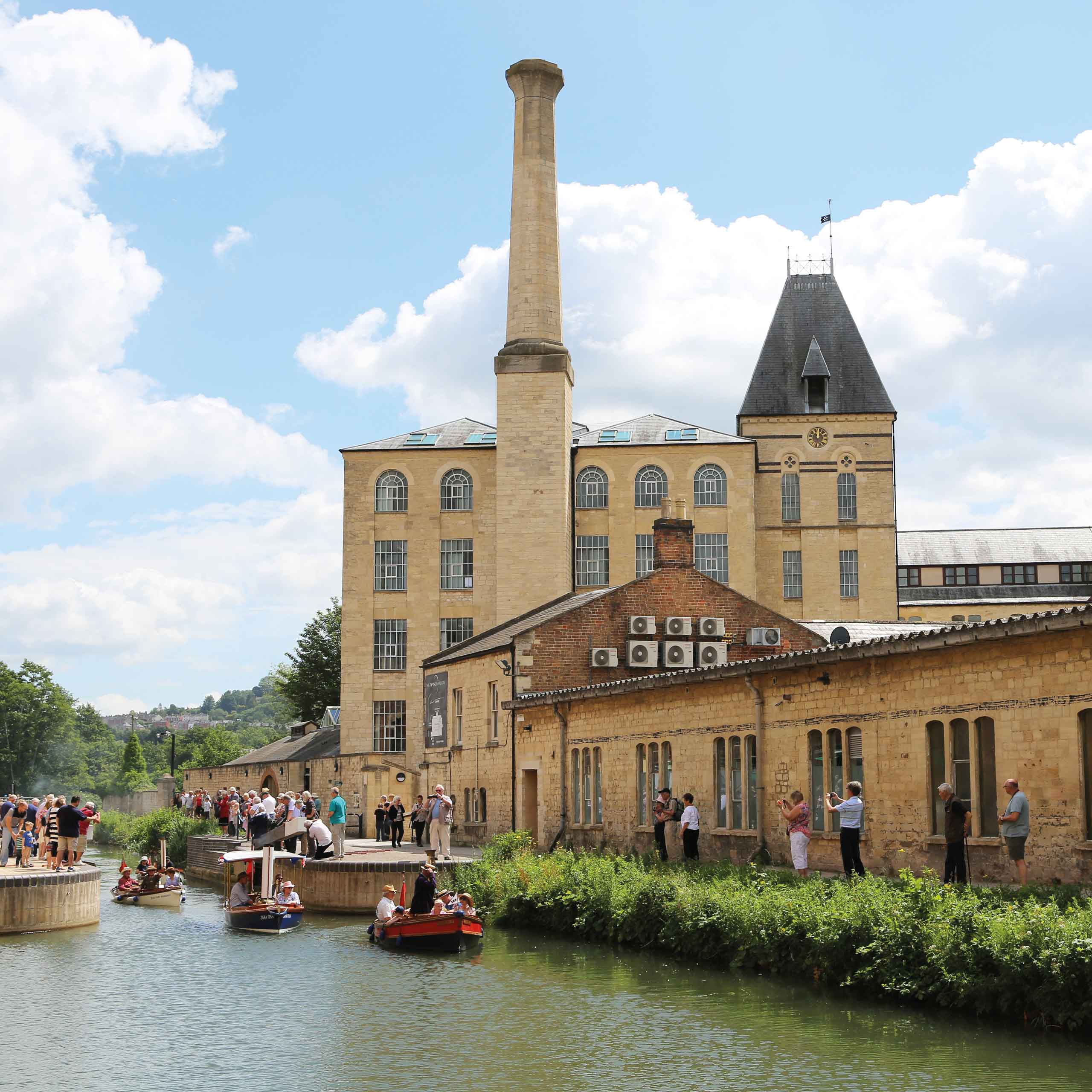
    Noise

    In particular, there has been a fundamental failure to acknowledge that waterway users are not just ‘transient’ but in many locations people live on boats for varying periods of time, and those places should be provided with noise mitigation to at least the same standards as would automatically apply to residential buildings at that location.

    Unlike buildings, however, boats cannot easily be retrofitted with double glazing, and their mobility and the outdoor lifestyle of boaters means that they are more dependent on external controls including noise fencing on viaducts and bridges, earth bunding and screen planting.

    IWA contends that wherever boats are permanently moored, or permitted to moor temporarily overnight or for a few days or months, they are likely to be occupied residentially and those locations should be protected by noise mitigation to residential standards.

    Whilst the design of bridges and viaducts is important, the minor additional visual impact of noise fencing should not be used as an excuse to deny the major audible benefits that it can provide.  To static boat residents or waterway users encountering HS2 at walking pace it will in the long term be the operational noise that most impacts and disrupts their lifestyle and activities.

  • So you want to rent a boat?

    So you want to rent a boat?

    Article by boater Kate Saffin with additional contributions from the London boating community.

    There are regular requests for boats to rent. However, be warned – this isn’t a guide to finding a boat to rent. It’s a summary of why you will find very few, what is realistic and what to be cautious of if someone offers you something that looks too good to be true.

    Official renting

    First, and most important, letting a boat is only permitted by Canal and River Trust if the boat has a permanent residential mooring, a commercial licence, insurance and boat safety checks (just like all the holiday hire boats you see around the system).

    Read Canal & River Trust’s guide to renting or hiring your own boat.

    Unofficial renting

    Unofficial renting, is where there is a boat without a home mooring, or one on a leisure mooring.  In this instance you are not renting a home, you are simply paying for the use of a ‘chattel’, a possession.  This means that none of the legislation designed to protect tenants applies. There is a good summary of the issues on the Landlord Law Blog.

    Photo: Regents Canal – Tim Lewis

    Why it’s hard to find a boat to rent

    You will rarely find boats advertised to rent because residential moorings are few and far between, even in London where there are more than on other parts of the system. However, boats to rent on residential moorings do turn up occasionally and are often managed by estate agents. These agents may not know very much about boats, so if you do find one, take someone with boat knowledge with you when you go to look, and don’t be fooled by nice decor. By going through an estate agent, at least you will have some recourse to law if you find something doesn’t work as you expected.

    Then there are some boaters who want to let their boats but aren’t on a residential mooring and don’t have the appropriate licence, insurance and boat safety certificate. Those who know they are doing something under the radar fall into two categories:

    • First, the boater who is going away for a period of time and wants to let the boat so that it is looked after and costs are covered.  They rarely advertise because CRT may become aware that the boat is being rented and refuse to renew the boat’s licence. They will tend only to let by word of mouth to trusted friends of friends.
    • Secondly, there are a few exploitative individuals who own several boats and choose to run an illegal letting business – they too will have networks they operate through that they don’t publicise.

    Then there are those who are looking for someone to look after their boat because they need to be away – perhaps working abroad for a few months. It is permissible to have a ‘boat sitter’ as long as they are not charging. They rarely advertise because the boat is their home, and they are very unlikely to let someone they don’t know live on it in their absence. They do not want to return to batteries that have been damaged or to letters from CRT because the boat hasn’t moved far enough. They will tend to look for a suitable sitter by word of mouth. Again it will be to trusted friends or friends of friends.

    So, in a nutshell, you will very rarely see a boat advertised to let. And if you do, please check it out carefully. Be particularly careful of the person who implies that you will have the same legal deal as renting a flat (you won’t).

    Some concerns about renting boats

    These are the some of the concerns that experienced boaters have expressed about renting a boat.  These are particularly aimed at those who have no experience of boating and are renting from a stranger.

    “Renting a boat which doesn’t comply is the same as someone driving a car without Tax, MOT, and Insurance. If a non-compliant rented boat explodes, catches fire etc. it is unlikely to be covered by the owner’s insurance which will have been declared null and void. Any third party damage or injury will also not be covered.”

    “ ’I would be happy with a continuous cruiser licence’ – but CRT would not. It is therefore technically not legal [to rent a boat without a residential mooring], which you might get away with for a while, until something goes wrong and CRT decides to take the boat’s licence away for breaking the terms and conditions and you lose your home.”

    “You have no recourse to letting law.  …I witnessed a girl working on one of the cafe boats bolt down the towpath screaming ‘That’s my boat. What’s it doing here! What have you done with my dog!?’ just this summer. Landlord dispute – took the boat (apparently abandoning the dog and either stealing all the girl and partner’s belongings, or dumping them on towpath).”

    “If you do a share boat or rent to buy, please make sure you get a proper contract drawn up, preferably by a solicitor. Not going into fine detail, but …I’ve heard some very odd stories indeed – one where the tenant was made homeless and evicted from the boat he was two months from owning (see note regarding ‘rent to buy’ below) and another where the tenant sold the boat with no legal comeback.”

    This is not to say that it will go wrong, just that it might.

    Photo: Camden, Regents Canal

    Other considerations and options

    There are some additional considerations and options for renting. These have also been supplemented with contributions from the London boating community.

    If you still want to pursue the idea:

    • Don’t do it because you think it will be cheaper – generally it isn’t, or not much, especially if you are renting legally.
    • For most of us living on a boat is a lifestyle choice not primarily a financial one. You need to want to empty a toilet regularly (and worry about whether the facilities will be in working order to do so), manage a temperamental solid fuel stove, live with running out of gas at midnight, wonder what that strange noise from the engine/water pump/bilges is, worry about security on the towpath and whether your bike is still on the roof…
    • You can try a long term commercial rental if you want to be on the move or can’t find a boat on a mooring. The rent (ÂŁ940-ÂŁ1400/mth) will be similar to a flat in London and reflects the level of maintenance, insurance and support that is needed. Google ‘long term narrow boat hire’ and you will find a few companies plus some other possibly useful links.
    • Note: searching on terms like ‘boat’, ‘rent’, ‘London’ will bring up a number of old adverts that contain very out of date information – “When I lived aboard I generally lived in the East London area…” – try that now and you’ll be in trouble very quickly!
    • Learn how to handle a boat– there are numerous centres that offer the RYA Inland Helmsman training. You can search RYA’s website for a centre near you.
    • Walk the towpath, get to know boaters. Look for opportunities to volunteer and get to know people. There are a regular clean ups around the London waterways, some organised by boaters (watch for details on the London Boaters Facebook page), others by local groups on the River Lea or the Lower Regent’s Coalition or IWA London Branches.
    • Check with any marinas in the area as to whether they allow their residents to rent and if so, keep an eye out for any opportunities.
    • You might also find the occasional room advertised in a shared boat – these are usually on the bigger static houseboats to be found on the Thames. Search terms; ‘houseboat’ (actually a static structure that just happens to be on water), ‘rent’, ‘London’.
    • Consider buying a boat.

    Things to check

    • Check whether you are being offered a legal rental – if so, make sure it meets the CRT requirements as above. Check that the licence, boat safety and insurance are legal for renting (because it they’re not, you may be the one to suffer).
    • If it doesn’t meet the legal requirements and you still want to take the risk, get an agreement drawn up by a solicitor that is specific to the boat and your circumstances – an off the shelf shorthold tenancy agreement will have no standing in UK tenancy law.

    Boat Sitting

    Some things to check when boat sitting:

    • If you are boat sitting check:
      • that the owner has cleared it with their insurers,
      • when the last boat safety certificate was done, and that any recommended work has been done,
      • that you know how everything works, particularly the smoke and CO alarms,
      • that you have someone to call on for advice and help – on a day to day basis as well as in an emergency
    • If the boat has no home mooring you must make yourself familiar with the current (and changing) rules about movement – if you don’t you could put the owner’s licence at risk (and thus your home). Currently this means covering a range of at least 20 miles in the course of a year and moving every 14 days (or more often).

    Rent to buy

    Finally a note on ‘rent to buy’ from London Boater, Paul Powlesland.

    “There have been a few posts recently about people wanting to buy boats in instalments. However, you should be aware that where possession and full ownership isn’t exchanged at the same time, there are serious risks for both the purchaser and the seller.

    From the seller’s point of view, if the buyer stops paying the instalments, they can sue the buyer. However, depending on the facts of the case, if the buyer has sold the boat on to a third party purchaser for value without notice (the so called ‘equity’s darling’), there is a strong chance that they will not be able to recover the boat and they will probably have a tough time tracking down the buyer who has made off with the cash.

    It’s not all rosy from the buyer’s point of view either, as there have been cases where all the instalments were paid, but the seller then claimed that it was merely rent and demanded back possession of the boat.

    In short, consider very carefully before entering into an agreement to buy or sell a boat in instalments.”

    Please note, all of the information in this blog is meant to serve as general guidance rather than specific advice.  If you want proper advice on a specific case, please seek a lawyer or qualified person.

    Photo-top: Little Venice on Paddington Arm of the Grand Union Canal by Adrian Rayson

  • IWA Wholeheartedly Supports Canal & River Trust’s “Plastics Challenge”

    IWA Wholeheartedly Supports Canal & River Trust’s “Plastics Challenge”

    We run over 250 ‘canal clean-up’ work parties every year through our branches and have been trying for over 20 years to address the problem of litter in our waterways.  We held our first Birmingham Canal Navigations (BCN) Clean Up back in 1997.  Since 2012, we have been running a sustained programme of canal clean-ups across the majority of our branches, taking in excess of 400 tonnes of plastic and other rubbish out of canals in that time.

    We firmly believe in the concept of “act local” and support Canal & River Trust’s idea that if every visitor picked up and recycled just one piece of plastic each time they visited, the canals and rivers could be plastic free in a year. If anyone is interested in keeping their local stretch of canal clear of litter, they are welcome to join one of our ‘canal clean-up’ events where all litter-picking tools and safety equipment will be provided. For more information, or to contact your local IWA branch, take a look here.

    Much of the litter that ends up in the rivers and canals has been blown there from the land, although boaters are also guilty of dropping litter from boats. We are actively encouraging our members and the wider boating community to be aware of how they dispose of their litter to ensure it doesn’t find its way into the water. As part of our Gaptracker Campaign, we are calling for better rubbish collection and recycling facilities along the waterways. Rubbish collection facilities should be situated at least every five hours of cruising time apart, which isn’t always the case. Often where there are rubbish bins, they aren’t emptied frequently enough and the overflowing rubbish ends up in the water.  We are working with all relevant Navigation Authorities, including Canal & River Trust to overcome these issues.

    Ivor Caplan, IWA National Chairman says “Our members are already very aware of the problem of litter in rivers and canals. We often hear tales from boaters of propellers that have to be freed from plastic bags. At IWA, we are looking to reduce overall plastic usage and we are ensuring all our events are now single-use plastic free. This started at this year’s Canalway Cavalcade and was very successful. IWA is more than happy to accept Canal & River Trust’s Plastic Challenge and looks forward to seeing a marked difference in the amount of litter in the UK’s rivers and canals in the future.”

    For more information about our canal clean ups or any other IWA events, please visit your local branch information pages or take a look at our events listings.

  • How to Moor a Boat

    How to Moor a Boat

    Learning how to safely moor your boat is an essential lesson to any new boater.  However a reminder for the experienced boater can also be valuable and can lessen the chance of damaging their boat, the bank or even another boat.

    Read on for an overview of how to moor your boat, what knots to use and the safety precautions to take.

    Encourage everyone to use long lines for mooring; it is good practise to reduce load and wear on rope, bollards, bank piling, mooring pegs, structure of the boat, boat bollards, and also to reduce the damage done when the water level changes more dramatically.

    The last one may be rare on the inland waterways, but any breach in a canal or change in level for emergency reasons, will result in damage to boat and/or bank (i.e. to both boat owner AND navigation authority), or of course pull your mooring pins out.

    Those who moor sensibly cause little or no damage.  Those who moor carelessly with short rope are either hanging there, damaging the boat, possibly causing the bank to give way, or drifting down-stream with rope in the water.

  • Historic Narrow Boat Features

    Historic Narrow Boat Features

    1.  Livery

    Carrying companies had different colour schemes or liveries, which helped with identification from a distance.

    Fellows Morton & Clayton’s early livery was black and white with a red dividing line but this changed in 1921 to red, green and yellow.

    The Grand Union Canal Carrying Company had four liveries, from the two-tone green of the original Grand Union Canal Company subsidiary, Associated Canal Carriers, then two tone blue, then the red, white and blue “coronation” livery to celebrate the coronation of George VI in 1937, and finally a wartime austerity livery with less lettering.

    2.  Signwriting

    Cabin signwriting on working boats tended to include a lot of information, some of which was required by law through the original canal company regulations. As well as the name of the boat and the fleet number, the cabin sides were painted with the company’s name and address, and in later years the telephone number.
    Image: Town Class Motor Dover in full GUCCCo livery and signwriting

    3.  Registration Number

    This number painted on the cabins of working boats indicated that the cabin had been registered as fit for habitation by the local authority. The Canal Boat Act of 1877 allowed local authorities to inspect boats and restrict the number of people per cabin, although they weren’t required to do this until the Act was amended in 1884.

    4.  Cabin Decoration

    It is thought that the families moving aboard (see evolution of the narrow boat) gave rise to the high level of decorative paintwork, brass and furnishings found on the long distance boats.
    Image: Narrow boat Friendship, now at Ellesmere Port Boat Museum, showing high level of decoration and painting

    5.  Rams Heads and Swans Necks

    On horseboats and butties, the rudder and tiller arrangement is known as the ‘elum’.  The rudder is the large blade (usually wooden, even on a metal butty) that allows the boat to be steered, with a detachable handle (’tiller’) connected to the top of the rudder (called the ‘rams head’).  A butty tiller is curved and can be turned the other way up when not in use to allow more room for getting in and out of the cabin.  Sometimes a horse’s tail would be hung from the rams head as decoration.

    On motor boats a smaller metal rudder is used to direct the wash from the propeller in order to steer the boat, and the tiller is connected to it by a solid ‘Z’ shaped metal bar known as a ‘swans neck’ or ‘swan neck’.  The horizontal bar of the tiller used to steer with is often made of brass, is held in place by a ’tiller pin’ and is again detachable to give more space when moored up for getting in and out of the cabin.
    Image: Thomas Clayton’s horse boat Gifford, also at Ellesmere Port, showing tiller in up position

    6.  Gunwhales and Cants

    On working boats, the top of the hull sides were traditionally finished in a solid strip of wood (even on metal boats) known as gunwhales (or gunnels).  On many historic boats these days they have been replaced with metal.  On motor boat cabins the gunwhales continue around the cabin, to allow access from the back deck to the engine room (also known as the ‘engine ‘ole’) and the back of the hold.  Butty cabins don’t have gunwhales, as in the absence of an engine room, there is generally a door giving access into the hold.  This gives more width inside the cabin.

    ‘Cant’ is the term for the continuation of the gunnels around the front or back decks of a narrow boat, again traditionally made out of wood, and therefore easily replaceable following wear and tear, but often these days replaced in metal.
    Image: This photo shows the cabin of a motor boat (with gunwhales) and the cabin of a butty (without)

    7.  Tumblehome

    A nautical term originally used to describe the shape of a ship’s hull, in historic narrow boat terms tumblehome refers to the inward slope of a cabin’s profile.  This change in dimension across the top of the cabin roof compared to the cabin at gunwhale height is an important feature of modern narrowboat design.  Too great a tumblehome will restrict the living space inside, but too little and the cabin is at risk of being damaged on bridges and tunnels.
    Image: Town Class Motor Whitby showing the tumblehome on the cabin

    8.  Pigeon Box

    A ‘pigeon box’ is a small raised box on the cabin roof with an opening pitched roof, often incorporating small brass portholes, used for ventilation and letting light into the engine room on a motor boat.  Some boats had simpler a simpler ‘flat box’.  It is thought that the term ‘pigeon box’ arises from the similarity in shape to baskets used for transporting carrier pigeons.
    Image: Carrying companies tended to supply flat boxes or plainer pigeon boxes, as shown here.  The more decorated pigeon boxes tended to be owned by the boatman himself and would be taken with him if he changed boats.

    9.  Inside the Cabin

    The term ‘boatman’s cabin’ is a modern one, and it is more traditional to refer to the living cabin as the ‘back cabin’ or simply the ‘cabin’.  Over generations since narrow boats were first used on the canals (see evolution of the narrow boat), the most efficient design for a cabin evolved and most back cabins have identical layouts, regardless of what carrying company the boat was built for. On the left (facing forwards) inside the door (to keep the steerer warm on a cold day) is found the cooking range. In front of that is the table cupboard, with a vertical door which can double up as a table when lowered. A drawer below the table is known as the ‘knife drawer’ (and sometimes as the ‘crumb drawer’ due to the crumbs landing in it as the table is put away). In front of that is the ‘bed ‘ole’ with a cross bed that folds out across the width of the cabin.  On the right side of the cabin is a simple bench for sitting on, which can also be used as a further bed, and is known as the ‘side bed’.
    Image: A tantalising glimpse into a back cabin – despite the pride that boatmen felt in the overall appearance of their boats, cabins were always very private places and it was considered rude to look inside someone else’s cabin unless invited.

    10.  Water Cans

    There is no running water or plumbing in a back cabin, and the water supply lives on the roof in a water can (or two).  Many people call these water cans ‘Buckby Cans’ but in fact a ‘Buckby Can’ was specifically a water can that had been bought from Buckby on the Grand Union Canal. Kettles are filled directly from the water can (by taking the kettle out to the water can rather than vice versa). Frequent water points would have been essential in the days before boats had large water tanks, and were often at a lock, so that a water can could be filled while going up or down a lock without wasting any time.

    Enamel bowls would have been used for washing people and clothes, along with a ‘dipper’, a shallow basin that could be used for scooping water out of the canal.
    Photo: The water supply for the whole family – a system still used today by many owners of unconverted historic boats

    11.  Mop and Water Can Arrangement

    You may have noticed that on working boat back cabins the mop is always in a particular place – leaning up on the water can.  This tradition goes back to horseboating days, and relates to how horse boats passed each other without getting the towlines tangled up, given that both horses would be on the same towpath.  One towline would be slackened by the horse slowing down, so it passed under the other boat, while the position of the mop helped the first one’s towline ride up over the obstructions on the cabin roof, with the steerer just lifting it over the range chimney once it was in reach.
    Image: Mops and water cans at IWA Waterway Festival at Beale Park in 2010

    12.  Cratch Boards

    The ‘cratch’ is the name given to the area at the front of a narrow boat’s hold, protected by a ‘cratch board’ (also known as a ‘deck board’).  The shape is triangular with the top of the triangle cut off.  Often highly decorated, it supports the top planks and protects the cargo.
    Image: A beautifully decorated cratch board on Malcolm Braine’s boat Cactus, painted specially for the Queen’s Diamond Jubilee in 2012

    13.  Cloths and Planks

    Cloths supported by a wooden frame are used over the hold to protect perishable cargoes.

    The ‘top planks’ form the top of the tent-shaped arrangement, with diagonal ‘uprights’ spaced along the hold.  ‘Stands’ are the vertical supporting posts which are usually decorated, as is the ‘mast’ which is the first upright support for the top planks, which includes on its top a ‘looby’, a spring loaded pin which protrudes above the top planks and is used for towing.  At the stern of the hold the top plank rests on a ‘cabin block’ on the cabin roof.

    When a boat was empty, or carrying a cargo such as coal that did not require protection from the elements, the top planks would be lowered to gunwhale level, where they would rest on the horizontal ‘beams’.  The ‘beams’, usually three down the length of the hold, protect the ‘chains’ which are positioned across the hull and can be used for pulling in the sides to prevent spreading.

    Sometimes just side cloths would be used to prevent water splashing in if there was little freeboard.
    Image: This photo of Southern Cross at the Braunston Historic Boat Gathering in 2014 shows the cratch and top planks in position at the front of the boat, and the planks lowered along the rest of the hold.  Note the smartly painted stands and mast (which consists of the decorated wooden ‘boxmast’ and the metal ‘topmast’ and ‘looby’ above the planks).

    14. Uxters!

    There are other features to be found on historic narrow boats, and stories behind them, but for now this article will finish with ‘uxters’ or ‘uxter plate’.  Uxters is a little known word (which might be useful if playing Scrabble!) used to describe the (usually) concave metal bottom plate below a historic motor boat’s counter stern, immediately in front of the ‘skeg’ (the metal bar that the rudder is attached to and that protects the rudder from hitting obstructions) and behind the ‘swim’ (the deeper part of the hull).
    Image: This photo shows Skylark, built by WJ Yarwoods & Sons of Northwich for WH Cowburn & Cowpar Ltd (see Blog 2 in this series) in dry dock for blacking.  The photo is looking forwards and shows the rudder, the propeller and the swim (the back of the hold as it narrows towards the back of the boat).  The “uxters” is the bottom plate above the propeller.

    This is the third feature in our series on historic narrow boats, which includes the evolution of the narrow boat and a historic boat spotting guide.

  • Canal aqueducts

    Canal aqueducts

    The word aqueduct is thought to have first appeared in the 16th century, as the Latin aquaeductus. It is from ‘aqua’ water, and ‘ducere’ to convey. Appropriately Roman, as Romans were the master exploiters of aqueducts.

    Early Aqueducts

    Crete has early examples of simple water channelling systems from the Minoan period. Similarly, Egypt & China both had their quanats to carry water underground. The first long-distance canal systems were constructed by the Assyrians in the 9th century BC.

    In the 7th century BC Assyrian king Sennacherib constructed a wide canal with a 920ft (280m) long white stone ‘bridge’ to bring water to Nineveh. The Jerwan aqueduct is acknowledged as the first large above-ground aqueduct.

    The Greeks then got in on the act, with places like Athens being supplied by long distance aqueduct systems in the 6th century BC.

    Roman Aqueducts

    When in Rome, what did the Romans do? Some Roman aqueducts are still in use in Rome today! They provided drinking water to inhabitants – a million of them at its peak – up to 1 cubic metre (1 tonne) each every day. This is about five times what we in the UK use on average today. The Roman aqueducts not only provided drinking water for the Romans but also supplied the bath houses with ample water. Others acted as indoor sewer systems that carried water away from the city. The water flowed and emptied by gravity into giant cisterns in the city, distributed by lead pipes to most parts.

    The invading Goths and Visigoths knew the importance of water supplies to Rome, and systematically destroyed them. The structures were not put back into use until the Renaissance period.

    canal aqueducts in Britain

    Barton Swingbridge crosses the Manchester Ship Canal - Graham and Marilyn Speechley - 2004
    Barton Swing Aqueduct. Photo by Graham and Marilyn Speechley

    Brindley’s Barton Aqueduct

    Completed in 1761 and opened on 17th July to cross the River Irwell, this was the first canal aqueduct in Britain. The stone aqueduct was about 600’ in length and 36’ in width at the top, the waterway being 18ft (5m) wide and about 4 1/2ft (1m) deep carried in a puddle channel across the structure. James Brindley is said to have ‘retired to his bed for several days’ when it opened, as it sagged a bit. However it was still in good condition when replaced in 1893 by the Barton Swing Aqueduct. Designed by Sir Edward Leader Williams when constructing the Manchester Ship Canal, it is still going strong today.
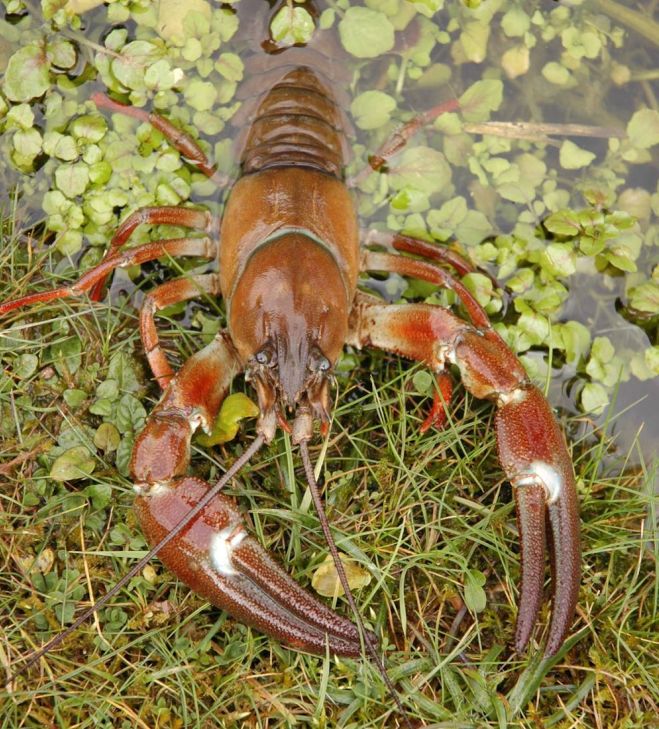
    The aqueduct was high and finely built, to leave space for the Mersey and Irwell Navigation boats to pass. Perhaps as a result of the sagging, Brindley’s aqueducts from then on were very squat and massively constructed, as can be seen in his longest remaining one carrying the Trent and Mersey Canal over the River Dove, north of Burton on Trent with its 23 arches.

    Royal Gunpowder Mills

    The Royal Gunpowder Mills in Waltham Abbey had their own canal system. It began with the Millhead Stream, used for the smooth and safe delivery of raw materials and collection of gunpowder. This finally extended to a system over 5 miles long linking all the buildings involved in making gunpowder.

    The cast iron aqueduct was one of two aqueducts built in 1878-9 to carry the extended high level canal system over the natural waters of the original River Lea. Both these aqueducts are made from three huge cast iron plates (the base and two sides) brought by barge and then lifted and riveted on site. There is a third aqueduct near Newton’s Pool of a slightly different design. There are only 26 cast iron aqueducts in Britain. Three of these are in the Gunpowder Mills.

    Telford’s first Iron Canal Aqueduct

    Longden-on-Tern. Photo by Dr Peter R Lewis

    The Shrewsbury Canal was originally constructed with Josiah Clowes as Chief Engineer, however he died in 1795 part way through construction. Thomas Telford, who was at the time Shropshire’s County Surveyor and already engaged on the Ellesmere Canal, took over.

    One of Telford’s first tasks was to rebuild a stone aqueduct over the River Tern at Longdon-on-Tern. It had been built by Clowes but swept away by floods in February 1795. Telford originally intended to replace like for like. However the influence of Shropshire Ironmasters such as William Reynolds in the Shrewsbury Canal Company may have led Telford to jointly design the simple cast iron trough with Reynolds. The design used cast iron trough sections from Reynolds’ Ketley ironworks bolted together on site in 1796. The main trough was 62 yards long (57m), 7.5ft (2.3m) wide and 4.5ft (1.4m) deep, with a half height narrower trough to one side which formed the towpath.

    The aqueduct was the world’s first large-scale iron navigable aqueduct, though it was narrowly beaten by a much smaller 44ft long (13m) structure on the Derby Canal built by Benjamin Outram.  The Derby Canal aqueduct itself was removed from site for safe keeping when the canal was filled in by Derby City Council, however the ironwork went missing possibly scrapped during a clearout. Never throw anything away!

    The largest aqueduct in Britain

    Pontcysyllte aqueduct Llangollen canal
    Pontcysyllte Aqueduct

    Pontcysyllte Aqueduct, designed and built by Telford and overseen by Jessop, is the largest aqueduct in Britain. It is 1,007ft long and carries the Llangollen Canal (originally the Ellesmere Canal) over the valley of the River Dee. It is constructed of local stone with a cast iron trough 11ft 10in (3.6m) wide and 5ft 3in (1.6m) deep which extends under the towpath.  The aqueduct holds 1.5 million litres of water and takes two hours to drain.

    The pillars were constructed to a hollow and tapered design, to reduce the overall weight of the structure and size of the pier foundations.  Mortar used was mixed from ox blood, lime and water and the sealant for joining the cast iron aqueduct plates from Welsh flannel and a mixture of white lead and swarf from boring waste. Begun in 1795 it was completed in 1805 and cost a total of ÂŁ47,018 6 shillings and 7 pence. ‘Pontcysyllte’ means “Cysyllte Bridge”.

    Stratford Canal’s Edstone Aqueduct


    Edstone Aqueduct, Stratford Canal. Photo by Dr Neil Clifton

    The 475ft (145m) Edstone Aqueduct is the longest aqueduct in England. It takes the Stratford Canal over the tracks of the former Alcester Railway line. Locomotive firemen would often top up their boilers via a convenient pipe feeding down from the aqueduct!

    The Canal Network’s First Ancient Monument

    Rennie’s Dundas Aqueduct carries the Kennet & Avon Canal over the River Avon and the Wessex Main Line railway from Bath to Westbury, near Limpley Stoke in Wiltshire, England. It is named after Charles Dundas, the first chairman of the Kennet and Avon Canal Company.

    Closed in 1954, for a while in the 1960s and 1970s the canal was dry and it was possible to walk along the bed on each side of the river as well as through the aqueduct itself. The aqueduct was relined, with polythene and concrete and restored, reopening in 1984.

    It is Grade I Listed, and the first canal structure to be designated as a Scheduled Ancient Monument in 1951.

    And the most elaborate aqueduct?

    Engine Arm aqueduct. Photo by Angela Acott.

    The aqueduct carrying the Engine Arm over the Birmingham Main Line was one of the later cast iron examples. It is a single span cast at Horsley Iron Works. It is ornately decorated with a gothic ‘blind arcade’- a series of pillars linked by arches. Painted as it is today, this looks very impressive.

  • Getting to Grips With Single Handed Boating

    Getting to Grips With Single Handed Boating

    IWA supports the principle of single handed boating, but acknowledges that risks of accident are much greater if you are boating without crew, and recommends the following advice for people boating on their own.

    Planning ahead

    Single handed boaters should take responsibility for their own actions in the knowledge that the risks associated with boating on their own are greater than with a crew and they should limit those risks according to conditions.  For example, someone who frequently single hands their boat through locks in normal weather conditions may decide to postpone his or her trip due to extreme conditions such as ice or snow.

    When boating single handed it is sensible to plan ahead and to have an idea of where you intend to get to each day, especially on rivers or waterways with few places to moor.  It’s also a good idea to plan for practical things, such as ensuring that you have enough food and drinks easily to hand and extra layers of clothing or a waterproof jacket easily accessible in case the weather should change.  Some boaters prepare hot drinks in a flask, before they set off, to drink later on.
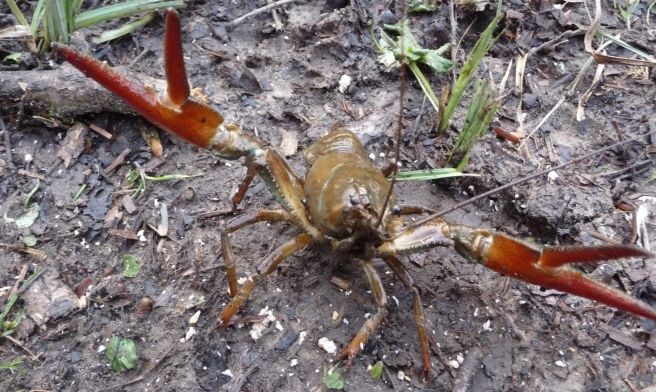
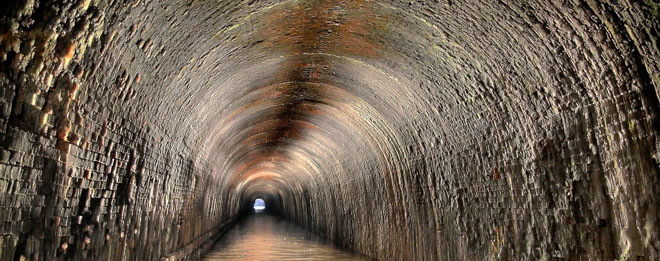
    Mooring and setting off

    A centre line (typically attached to the roof of a narrow boat or to bitts or cleats on the stern quarter for barges or cruisers) of a good length is essential for single handed boating for a number of reasons.  It is useful when mooring up, enabling you to bring the boat alongside the bank before then making it secure at each end.

    A centre line is also handy for temporarily mooring up your boat at the lock landing stage while you get the lock ready, but make sure it is tied up tightly enough or that the engine is left in forward gear to hold the boat in, so that one end of the boat won’t swing out in front of boats coming out of the lock.  A centre line can also be used for those occasions when you need to moor up very briefly to use the toilet or boil the kettle, for example, but remember that if the rope is attached to the boat roof, passing traffic may make the boat tilt significantly.

    Having the centre line coiled ready near the steering position means you can step off the boat with rope in hand. Photo by Alison Smedley
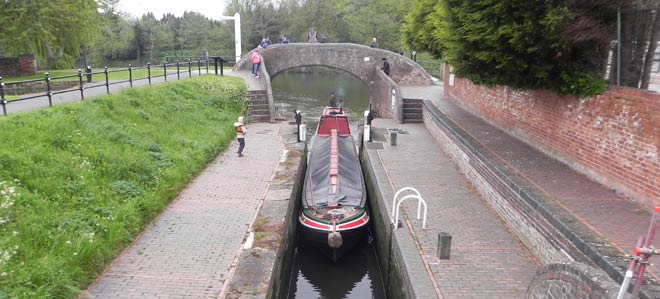
    The centre line should be long enough for the end to be coiled up and placed close to the steering position, so it can be picked up easily as you step off the boat.  Another handy tip is to position the end of the rope to the side of the cabin closest to the towpath and move it across if the towpath changes side or to have two ropes, one on each side (especially on a larger barge or cruiser), so that you can always easily step off the boat with rope in hand.  On a river or tideway with noticeable flow, it is essential never to step off the boat without a rope in hand; if the boat drifts away while you are ashore there will be no-one on board to bring in back in again!

    When you set off from a mooring, make sure you coil the mooring ropes neatly so that they are ready to use when you want to moor up again later on. It’s a good idea to have the mooring hammer and pins handy too.

    Locks

    Allow extra time – it will probably take you longer to get your boat through a lock than it would with crew, as you will have no-one available to go ahead to prepare locks.

    When operating locks single handed it’s a good idea to do things as efficiently as possible so you don’t get over tired, although you will find that there is no way to avoid a certain amount of walking backwards and forwards.   Take it steady and don’t run, as that may lead to a fall or slip.

    Experienced single handed boaters will adapt their own technique for going through locks, which will be based on their knowledge of how their boat behaves in different types of locks and in certain conditions (eg wide or narrow locks, going up or going down) and on knowledge of specific hazards with locks on a particular waterway which may result in the boat getting caught up (for example wide gaps between balance beams and planking on river locks which may catch your bow or lockside chains on which a hard-chined narrow boat may hang up).

    A narrow lock with a lock ladder makes for easy work for the single handed boater.  Photo by Alison Smedley
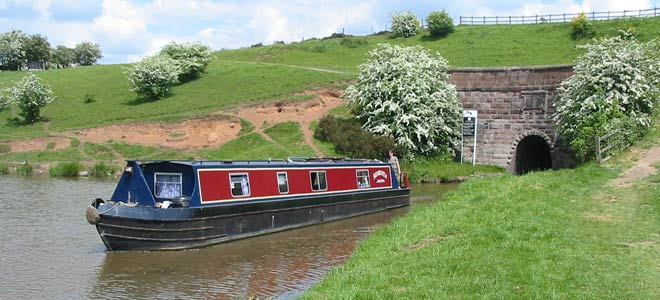
    Most locks these days have lock ladders fitted, which makes life much easier for the single handed boater.

    Just as when locking with a crew, it is essential to keep an eye on what the boat is doing at all times and to check that it is floating freely and hasn’t got hung up anywhere.  Even in narrow locks it is always sensible to have a rope (ideally a centre line) on the lockside with you, so that you can pull the boat out of trouble if necessary and can move it to a ladder allowing you to board.

    On river navigations and canals with wide enough locks, it’s always best to share locks with other boats in order to save water.  If the other boat has plenty of crew they may be happy to operate both sides of the lock but don’t assume so and be prepared still to do your bit.

    On some larger waterways there is a requirement for marine band VHF radio (and it’s a good idea on larger waterways even where it’s not obligatory), in order to communicate with lock and bridge keepers and other vessels.  On certain larger waterways, such as parts of the tidal rivers Ouse and Trent, the byelaws prohibit single handed boating and you may be denied access to the tideway at places such as Goole if you are alone, so you will need to find some crew if your journey includes any of these stretches.

    Lift and Swing Bridges

    Moveable bridges, just like locks, should have a landing area where you can tie up the boat while you open the bridge, then return to the boat and take it through, tie up again and return on foot to close the bridge.  Some moveable bridges still have the operating controls on the offside, which can make it difficult for the single handed boater and operation usually involves having to nose the boat right up to the bridge in order to get off, so that you can get back on again once you’ve opened the bridge in order to move the boat through, and then carry out a similar procedure once you are through the bridge in order to close it again.  IWA policy is to press for proper landing stages to be provided on the offside in these cases but there are still bridges where the only option is to climb over bridge railings with rope in hand.

    Tunnels

    Before entering a tunnel it’s worth making sure that you have a torch to hand (and a spare in case the batteries fail), and a waterproof jacket, as most tunnels tend to have water dripping from the roof and there won’t be anybody in the cabin to pass out a coat to you!

    Caldon Canal, Leek Tunnel

    Weather conditions

    Ice, snow, rain, hail and strong winds are all types of weather that can make single handed boating more difficult and when these weather conditions are extreme it is probably advisable to postpone your trip.  Don’t forget the effects of too much sun either.  If boating in hot weather or a heatwave it is advisable to wear a hat and sunscreen, make sure you have plenty of cold soft drinks to hand and be prepared to moor up for a siesta during the hottest part of the day.

    Safety considerations

    Even if you don’t wear a lifejacket all of the time, it can be a good idea if you are boating on your own in certain conditions, such as on rivers, through tunnels, in the dark or in cold weather conditions (immersion in very cold water is more likely to lead to life-threatening situations).

    On rivers and tidal waterways (and in tunnels) falling overboard when alone may be extremely hazardous, even if wearing a lifejacket.  On a boat steered with a tiller, contact between the rudder and floating debris when the boat is moving at a reasonable speed can be enough to unbalance the steerer.  Risks can be minimised by steering the boat from the safest position possible; for example on a traditional-stern or semi-trad narrow boat, stand in the hatches with the doors closed behind you, so that you can only fall inside the boat.

    Wearing stout shoes with a good grip is sensible and do take extra care when stepping on and off the boat in the rain, ice or snow, as surfaces are likely to be slippery.

    It’s good practice to keep the roof of your boat clear so that you can get on and off using the roof when locking. Lock ladders are rarely in the right place (and in the bottom of a narrow lock it is difficult to walk along the gunwales to get to the lock ladder), so you will need a way of easily getting on to the cabin roof (a small folding metal step is easily installed on the cabin side if you don’t already have one) from the steering position.

    Single handed boater at Fradley on an early spring day. Photo by Alison Smedley

    It’s a good idea to know where you are along the waterway and what feature, such as a junction, flight of locks or a tunnel, is coming up next, so you might want to make sure you have a waterway guide showing the whole of your route handy.  If you are boating on a river or tidal waterway it’s sensible to know where there are safe places to moor in an emergency.  It’s also advisable to ensure that your anchor is ready for use at all times on rivers and tidal waterways.

    These days most boaters have a mobile phone and when boating on your own this is recommended, as you may need to call for help in the case of an accident or sudden illness.  It’s a good idea to know roughly where you are along a stretch of waterway as if you can inform the emergency services of the nearest bridge name or number this can usually help them to locate you.  It can also be a good plan to make sure that family or friends are aware of your route and to arrange to make regular contact with them.

    Many of these suggestions equally apply if you are boating with a crew, so whatever trip you are planning, with or without friends and family, do stay safe.