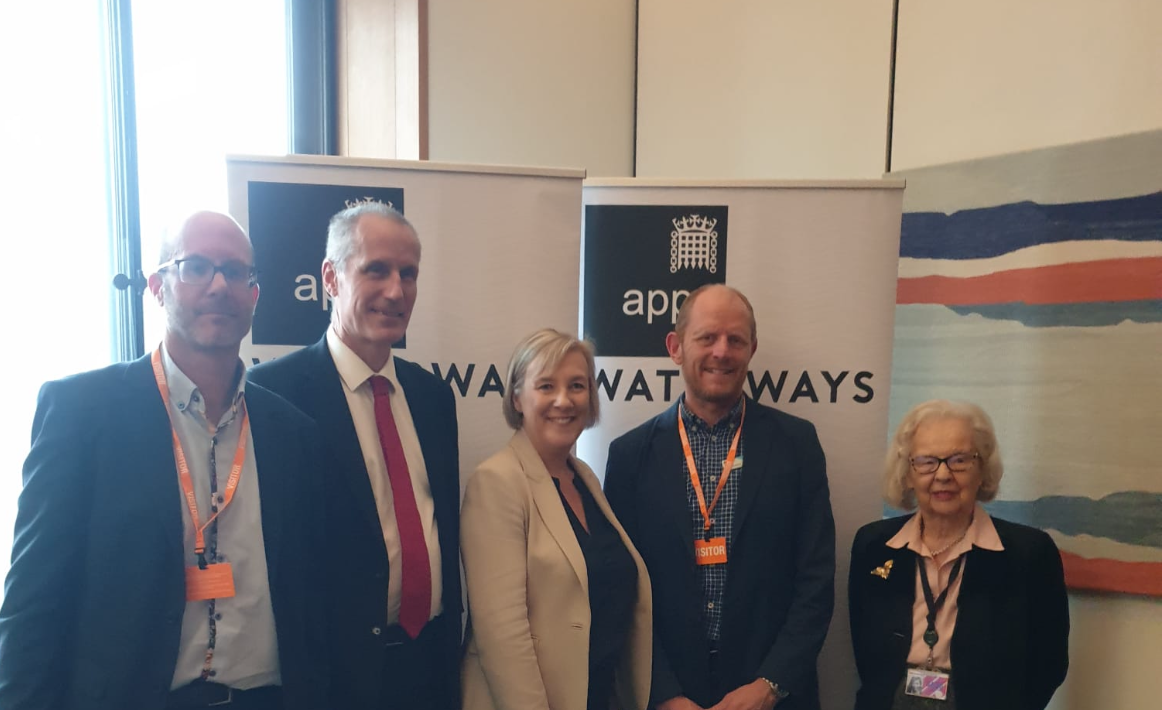
This week (14th October), under the secretariat of the Inland Waterways Association (IWA), the All-Party Parliamentary Group (APPG) for the Waterways convened to hear expert evidence from the Canal & River Trust (CRT) and the Middle Level Commissioners (MLC) on the growing impact of climate change across the nation’s waterways.
Members heard that changing rainfall patterns in the Middle Level are affecting vegetation management, while reduced water flows in the River Nene, combined with sea-level and bed-level rises, could prevent boats from entering or leaving the system. Flooding and coastal surge risks are also increasing, leaving low-lying areas vulnerable. Responsibility for these regions lies primarily with the Environment Agency (EA), but navigation authorities are operating under mounting financial pressures.
The session highlighted that while waterways are among the first to experience the effects of climate change, they can also be part of the solution through adaptation, mitigation, and enhancement of the natural environment in pursuit of net zero.
Mr Esterson, Sefton Central MP, and chair of the Waterways APPG, questioned the MLC on their experience of recent flooding, which revealed how many communities remain disconnected from the risks of living below sea level.
Mr Esterson said:
“There are real challenges as the impacts of climate change intensify, but also significant opportunities in how we adapt and mitigate. These are serious issues relating to our waterways, that go far beyond those who live and work on the water. Our changing climate affects communities, economies, and environments alike. Yet within that jeopardy lies opportunity; opportunity to improve how people enjoy our waterways and to remind MPs just how many of their constituents live near and depend upon them.”
A major theme of the discussion was the question of funding, with Defra’s settlement for the Canal & River Trust reduced at a time when climate-related infrastructure costs are rising sharply.
Attached photo L-R: Paul Burrows (Chief Exec of the Middle Level Commisioners), Bill Esterson Chair (MP for Sefton in Liverpool), Lisa Smart (MP for Hazel Grove nr Stockport), Adam Comerford (National Hydrology Manager for CRT) and Baroness Lin Golding.
The Broads Authority has invited comments on its proposal for a below-inflation increase in 2026/27 boat tolls of 2.5%, coupled with investment in some improvements to navigation.
This has been enabled, despite falling boat numbers, by a belated recognition by Defra that navigation is fundamental to the character of the Broads, bringing benefits to the economy, the natural and built environment, local communities and the lives of individual people.
IWA has previously made this case to Government, pointing out that adequate funding is needed for safety provision and maintenance, yet the Broads Authority has been the only major inland navigation authority not to receive government funding to support maintenance of navigation, only ring-fenced National Parks grant funding. IWA urged Government to recognise the need for financial support to ensure that navigation and the character of the Broads are maintained, and Defra has now responded by allowing more flexible use of National Park funding to support navigation – albeit without providing any new money.
IWA’s Navigation Committee has written to the Broads Authority setting out IWA’s concerns in considering next year’s tolls – that the current level of maintenance should not be degraded, improvements should be made to navigation where possible, and efforts should be made to stem the decline in boat numbers – and supporting the proposed increase in boat tolls.
[The photo shows boating and leisure activities on the Broads – by Charles Stride]
At this year’s AGM at the Jubilee Conference Centre in Nottingham, we celebrated the winners of the Sustainable Boating Awards, presented in partnership with Towpath Talk. These awards recognise individuals, organisations, and businesses making a real difference in sustainable boating. We also presented the IWA National Awards 2025, honouring members and waterway campaigners whose dedication has helped protect, improve, and bring new life to our inland waterways.
The results of the awards are as follows:
Sustainable Boating Awards:
NON-COMMERCIAL AWARD 2025
Awarded to the individual, charity or community organisation that, in the opinion of the judges, has made the most valuable contribution to sustainable boating during the last twelve months.
Fountainbridge Canalside Community Trust
For developing a sustainable strategy for their fleet and helping evaluate a unit that offers the possibility of converting an existing diesel boat to a parallel hybrid at an acceptable cost.
(Thank you video at the end of this article)
COMMERCIAL AWARD 2025
Awarded to the business that, in the opinion of the judges, has made the most valuable contribution to sustainable boating during the last twelve months.
Lynch Motors For their pioneering work in bringing to market a parallel hybrid technology that offers a cheaper and more sustainable means of retrofitting an electric drive to a diesel boat.
For members of the Association whose efforts and support are considered to have brought significant benefit to the Association over a sustained period.
• Nigel Hardacre
A dedicated member of the branch committee since 2004, bringing IT expertise and a passion for waterways. He keeps the branch’s online presence active and engaging as well as leading hugely popular guided walks and talks. Nigel’s work has become a vital way of raising funds and awareness for the branch. He also gets stuck into working parties, putting his chainsaw and strimmer training to good restorative use.
• Nick Parker
An outstanding achievement of 17 years volunteering on IWA’s finance and investment committees. Nick’s work has been essential to the strength of the organisation. His attention to detail and persistence have helped steer IWA’s finances with wisdom and security.
• Andrew Phasey
Recognised for exceptional long-term contribution to the delivery of the IWA Certificate of Boat Management Scheme. Andrew is the heart of this training scheme and thanks to his perseverance, over 200 volunteer skippers of small passenger boats have the skills and qualifications they need to operate safely. Andrew ensured the scheme remained one of IWA’s most impactful contributions to waterway restoration.
• Jeanne and Derek Smith
Acknowledged for an incredible 50 years of continuous service. They have both shown loyalty, energy, and spirit during this time, inspiring so many others. They have organised National Trailboat Rallies, edited publications, led waterways walks, and run sales stands and websites. Extraordinary dedication.
• Verna Smith
Verna’s contributions began when she ran local branch stands with her sister. Since then, she has served as branch chair, regional chair and trustee. She has more recently been active with the Environment Agency too. Verna’s work on publicity and campaigning is truly remarkable.
CHRISTOPHER POWER PRIZE
For a person, society or trust who has made the most significant contribution to the restoration of an inland waterway.
There is a cash prize associated with this award, which is given to the waterway restoration group associated with the winner, where the winner is a named individual. The aims and objectives of the group must be consistent with IWA’s aims and objectives. The trophy is a carved wooden otter.
Helen Watson-Moriarty
Helen’s dedication has seen 15 miles of towpath converted and over £2.5million secured in grants. Helen has recently negotiated £10,000 from Lancaster City Council to enable CRT surveys. Alongside this, Helen is passionate about community engagement, organising events and writing walking and cycling guides.
BRANCH ACHIEVEMENT AWARD
For the IWA Branch which, in the opinion of a panel consisting of the National Chair, Deputy National Chairs and Chief Executive, has made the greatest progress and achievement in promoting the Association’s aims and objectives during the past year. All Branches are considered, without need for nomination. The award consists of a silver salver, donated to IWA by former National Chair David Stevenson for the purpose in 1998.
Leicestershire Branch
Celebrated for their exceptional efforts in organising the IWA Harborough ’75 event. Special recognition of Andrew and Debbie Shephard for their leadership and input. The first-class event had national significance for IWA. It was a vibrant, memorable celebration bringing people together. The event honoured the past while engaging new supporters for the future.
CYRIL STYRING TROPHY
This is the Association’s premier award. For an IWA member who has, in the opinion of trustees, made an outstanding contribution in furthering the Association’s campaign.
Helen Whitehouse
Helen’s long-standing service has made her an exemplar for us all. Since joining IWA in 1983, Helen has held multiple roles, from committee to trustee. In each role she has brought energy, vision and commitment. Helen has earned the Association’s highest honour for enduring service, wit and spirit. She has run seminars, organised publicity, and supported members. Helen has also looked after IWA clothing and managed the IWA sales and recruiting stand for many years. Helen brings people together and always offers creative solutions. The waterways have benefitted enormously from Helen’s unfailing support.
IWA is incredibly proud to recognise these champions for their vital contributions to our waterways.
IWA welcomed over 100 members to its 66th Annual General Meeting on 27th September at the Jubilee Centre in Nottingham, with 80 people attending in person and 23 joining via Zoom. National Chair, Mike Wills, opened the day with thanks to members, staff and volunteers for their continued support.
The event began with an energetic presentation from Campaigns & Public Affairs Director, Charlie Norman. Charlie highlighted the successes of IWA’s campaigns, from the Bridgewater Canal breach, which garnered national press coverage, to Langport’s river regeneration project, which demonstrated the power of collaboration. Looking ahead, Charlie described 2025 as a strategic year to prepare IWA for an even stronger 2026.
An exciting announcement was the upcoming launch of the Waterways Risk Index, a pioneering mapping system unique to IWA, which will identify the most urgent challenges facing the network. Charlie emphasised how this evidence-led approach will strengthen IWA’s voice in parliament, in the press, and with communities.
There were also updates on the progress of IWA’s Freight Group and Sustainable Boating Group, alongside praise for campaigns such as Better by Barge. Each example underlined IWA’s influence in shaping the future of Britain’s waterways.
Later, Hannah Rigley and Paul Thomas shared the story of this summer’s Mon & Brec campaign. Facing unprecedented low water levels and restrictions, IWA worked alongside CRT and local communities to highlight the risks. The campaign petition gathered 14,000 signatures, secured cross-party support at the Senedd, and pushed for both immediate solutions and long-term resilience.
The formal AGM session saw members approve the minutes of the previous meeting, review finance updates, and confirm the reappointment of Trustees Mike Wills and Dave Chapman. Mike reflected that IWA has entered a new period of clarity and consolidation, with strengthened objectives and renewed energy.
The afternoon featured the presentation of IWA’s National Awards and the Sustainable Boating Awards, recognising outstanding contributions across the association. Members also heard specialist talks on sustainable boating, water management and restoration, before departing for guided visits to local canal restoration sites.
The Canal & River Trust (CRT) has issued a notice of plans to close Sykehouse Lock, on the New Junction Canal near Thorne, South Yorkshire from the 3rd November to 19th December, for bottom and top gate repairs.
IWA says the six-week closure is excessive and disregards the impact on navigation and local businesses. The duration of the intended closure means that the impact on navigation users, particularly commercial freight, will be substantial. The route is used by Casper River and Canal Transport, and Mainmast (Exol Oil).
Between the two companies, one barge load of oil (400 tonnes), two 300 tonne barge loads of scrap, and one 100 tonne load of cement per week are transported through the lock. This adds up to 1100 tonnes per week, and the closure puts the equivalent of 88 25-ton lorry journeys per week back on road, adding to congestion and pollution in the local area.
We’re calling on CRT to minimise the length of the stoppage to reduce the effect on commercial water freight, local roads, and air quality.
IWA’s Freight Group released a recent report highlighting the untapped potential of our inland waterways as a sustainable alternative to road freight. With the UK striving to meet net zero targets, the report shows that moving freight by barge offers substantial environmental and economic benefits.
David Lowe, IWA Freight group said “To maximise the benefits of freight on the waterways the infrastructure needs to be available, and maintenance on key traffic routes carried out as efficiently as possible.”
Riverside revival £300k Langport River Project has transformed 7.6 miles of river into a visitor destination, attracting around 250,000 people a year, helping new cafés, shops and services thrive
Community Cocklemoor meadow and Huish Bridge now boast renewed pathways, pontoons, canoe steps, fishing platforms, picnic areas, a slipway, cycle hire and a community boat, thanks to a partnership between Langport Town Council and IWA
Lasting impact With smart solar lighting, e-bike charging, recycled materials and biodiversity monitoring, the project delivers sustainability as well as local pride: plans are for more paths, parking and moorings
Regeneration of the riverside in Langport, Somerset, has given this traditional market town a new lease of life. Five years on from initial completion of the Langport River Project, the Upper River Parrett attracts around 250,000 visitors per year and new businesses and services have opened in the town.
To celebrate the project’s success, local film-maker Gordon McKerrow has produced a short documentary about how it has helped boost Langport. The film was first screened in Langport on 16th of September to celebrate partnership and volunteer effort by the council and IWA, alongside community groups and local businesses.
Val Saunders commented:
“A range of new businesses have opened since the river project brought new life to the town. Langport has become a café culture centre and we rarely have an empty shop on the high street. The town has developed a renewed sense of civic pride.”
While the project ensured that 7.6 miles of river are now navigable for trail boats and paddle craft, its focus was to create an attractive destination in the centre of town, between Bow Bridge and Huish Bridge. The picturesque Cocklemoor lies at its heart, with activities including walking, paddleboarding, swimming, fishing, cycling and boat trips. Now, approximately 250,000 people per year visit the riverside.
Ray Alexander added: “Langport’s story shows just what can be done to enhance an area by improving its waterway and waterside. It wasn’t a big, multi-million-pound project, but it has achieved so much for the area.”
And Gerard Tucker, Town Clerk, concluded:
“The Langport Community expresses its gratitude to the IWA for their support in helping Langport in the delivery of its vision. We do not consider the regeneration of Langport to be complete and the refurbishment of more paths, creation pf cycle paths and additional parking are on our list for one day! Perhaps even a mooring for our community boat, The Duchess of Cocklemoor, to make it easier for people to access and enjoy the river.”
The funding neared £300,000 ten years ago, sourced from a combination of European funds, local authorities and the Canoe Foundation.
More about the regeneration
A 7.6 mile stretch of the river and its tributaries is now designated as navigable, from the sluice gates of Oath Lock upstream to Thorney Mills half lock (disused) along with short sections of the River Yeo and the River Isle. Fortunately, no major remedial navigational work, such as dredging or lock repair, was needed.
Cocklemoor is a riverside meadow with new pathways, pontoons, canoe steps, accessible fishing platforms, picnic spots, seating and information boards. From here, Langport’s community boat The Duchess of Cocklemoor runs pre-booked trips, led by local volunteers.
At Huish Bridge, the slipway has been restored for trail boats and paddle craft, with a new car park and community space. Langport Town Council acquired both Cocklemoor and the Huish Bridge slipway from the Environment Agency to deliver the project. Nearby, a cycle hire operates at Bow Bridge and a rowing club is based at Huish Bridge.
Sustainability, wellbeing and ecology were forefronted. The facilities include ‘smart’ solar lighting, recycled plastic furniture, e-bike charging points, outdoor exercise equipment and locally made willow bird hides. A system of monitoring the biodiversity of the riverbank has been established.
The IWA West Country Branch worked with councillors and council staff to initiate the project and see it through. An IWA consultant engineer surveyed the slipway and advised on its restoration. IWA’s Waterway Recovery Group helped at Langport on three occasions: removing silt from the slipway, undertaking tree clearance works and, earlier this year, renewing the paths across Cocklemoor.
The Inland Waterways Association, (IWA) through its Sustainable Boating Group, has made a Submission to the Department for Transport’s (DfT’s) Call for Evidence on Decarbonising Smaller Vessels.
It has looked at propulsion and the use of domestic energy on leisure boats. The Group has a clear strategy to decarbonise this sector, so a submission has been made this week to the DfT.
The first part of the strategy relates to new build craft. It recognises that when high volume diesel engine production ceases, these engines will not be available to marinise, and inland waterways craft will use electric drive. Most boat builders today offer an electric option.
However, until either an adequate recharging network is installed or there is a step change in battery technology, even with the support of photovoltaic cells, a back-up generator will be required. As the waterways are currently underfunded the installation of sufficient charging points is unlikely without government assistance.
Bowman Bradley, Chair of the IWA Sustainable Boating Group, said:
“We believe that there is a clear technological pathway for decarbonisation of the inland waterways leisure fleet which can be achieved quickly and at low cost. However, given the current state of inland waterway funding and regulatory obstacles, it cannot happen without the assistance of central government.”
The existing feet is large and will be around for many years. Most will not be converted to electric drive. Hydrotreated Vegetable Oil (HVO) has been identified as a sustainable ‘drop in’ substitute for mineral diesel, both for existing engines and back-up generators, which can bring about an immediate reduction in emissions without capital investment.
Unfortunately, HVO, for reasons of price and regulatory complexity, is not readily available to leisure boaters. IWA is working with the Cruising Association, The Royal Yachting Association and British Marine to ask the government to adopt policies that will make HVO available to leisure boaters at an acceptable price.
IWA is concerned that in the pursuit of renewable diesel, non-sustainable sources are avoided, and support government measures to that end. We believe that decarbonisation is desirable and deliverable but will not happen without government assistance.
Removal of the safeguarding for the cancelled rail development paves the way for the Measham Waterside housing development to proceed which includes restoration of 1100 metres of the Ashby Canal. It will also simplify the Chesterfield Canal restoration at Staveley.
The Ashby Canal restoration at Measham has been blighted by HS2 since 2014. The original route cut through the middle of the planned housing estate, rendering it and the associated canal restoration unviable This was amended in 2016 and again in 2017, and a further review promised in 2018, but then finally abandoned in 2023.
The Chesterfield Canal could have been forced to build an extra lock and to deepen another planned lock to pass under the site of a former railway bridge to be reinstated as access to an HS2 depot, even though that had been subsequently abandoned.
Phase 2b East (East Midlands to Leeds) was abandoned in 2021 and HS2 East (Kingsbury to East Midlands Parkway) cancelled in 2023, with all the safeguarding due to be removed by Summer 2024.
IWA had written to the Rail Minister in February this year about the unnecessary delay and its effect on the two canal restoration projects, and welcomes this belated announcement.
In a 6-Monthly Report to Parliament on 17 July, the Secretary of State for Transport said “I am today formally lifting the safeguarding directions for the former Phase 2b Eastern Leg (between the West Midlands and Leeds), removing the uncertainty that has affected many people along the former route.”
For the abandoned Phase 2a (Fradley to Crewe) the planning safeguarding was largely lifted in January 2024 although the land and property acquired on the route has not yet been sold and the Act of Parliament for its construction remains in place.
On the former Phase 2b West (Crewe to Manchester) route the safeguarding still remains pending future decisions on Northern Powerhouse Rail.
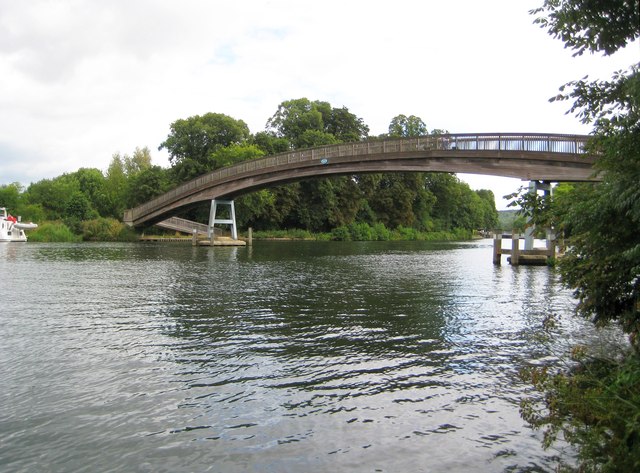
The EA shut Temple Footbridge which crosses the Thames west of Temple Lock, near Marlow, in May 2023. A subsequent restriction notice sets out the plan to close the river completely from 10 September to 8 October 2025.
The Inland Waterways Association (IWA) says the round-the-clock closure is excessive, unnecessary, and disregards the impact on navigation and local businesses. The duration and timing of the intended closure at one of the busiest times of year and the impact on navigation users, both private and hire boaters, along with businesses, will be substantial.
Verna Smith, IWA’s South East regional chair, said:
“Closing one of the most popular stretches of the Thames for a month during one of busiest times of the year makes no sense. It’s bad for businesses as well as everyone else. All river users, including anyone who wants to walk the Thames Path National Trail, have been in limbo for over two years.
“Serious questions need to be asked: how did EA’s neglect allow this structure to deteriorate so badly? Why has it taken so long to act? And most importantly, what is its plan to deliver a sustainable repair and properly manage the assets it is responsible for?”
IWA calls on the Environment Agency to:
Postpone the planned removal of the bridge section until November if the works genuinely cannot be completed within 48 hours;
Publish a clear timetable and firm commitment for the full repair of the bridge, ensuring that future works do not involve prolonged river closures; and
Provide limited daily passage for boaters during any closure period, especially if postponement is not possible, allowing at least a few hours of access each day to reduce disruption.
On 9th July, IWA representatives joined members of the “Preserve & Protect the Mon & Brec Canal” group and other local campaigners outside the Senedd to call on Welsh Government ministers and Natural Resources Wales to act so that the future of the Monmouthshire and Brecon Canal is secured for the next generation.
Following the Senedd debate and a meeting with key stakeholders, Deputy First Minister Huw Irranca-Davies MS announced on 17th July that the Welsh Government “intends to prioritise capital funding of up to £5m within its budget to upgrade the pumping station that is supporting the current temporary [water-supply] agreement.”
Additionally, he announced that a Welsh Government led “Task and Finish Group” will work together with key stakeholders to develop further options to build resilience in the canal’s capacity and identify how any capital works and ongoing costs of the water supplied will be met.
Paul Thomas, IWA South West and South Wales Region Secretary, said: “We welcome Huw Irranca-Davies’s statement which shows that the Mon & Brec canal is finally being taken seriously. The Welsh Government’s emergency investment is a vital first step to provide certainty to those whose livelihoods depend on the canal. But this job isn’t done. The new Task and Finish Group must move quickly and deliver a fair and lasting solution. The Mon & Brec is loved by communities, boaters, businesses and wildlife. It deserves a future as rich as its past. ”
Responding to the Chancellor’s Spending Review, Bowman Bradley, Chair of IWA’s Sustainable Boating Group, said:
“We are disappointed that the Government has again overlooked the inland waterways sector in its 2025 Spending Review. Despite our detailed proposals and the sector’s substantial £4.41 billion annual contribution to the economy, the absence of targeted support for sustainable boating is a missed opportunity.
“Hydrotreated Vegetable Oil (HVO) stands out as a viable, cleaner alternative to diesel, offering up to 90% reduction in carbon emissions and compatibility with existing engines. The fact is that without fiscal incentives or infrastructure investment, its adoption remains limited. This inaction not only stalls our progress towards net zero but also does not help the livelihoods of 133,000 individuals employed within the sector.
“The Government’s apparent failure to invest sensibly undermines its own environmental commitments and neglects the potential of our waterways to lead in sustainable transport.
“Substantial increases in investment in infrastructure were announced, but the missing piece of the puzzle is delivery.”
On Wednesday 9th July, IWA along with members of the “Preserve & Protect the Mon & Brec Canal” group will gather outside the Senedd to call on Welsh Government ministers and Natural Resources Wales to act so that the future of the Monmouthshire and Brecon Canal is secured for the next generation.
It will begin at 12:00pm, featuring a rally from 12:30–14:00 bringing together campaigners, canal businesses, local residents, and liveaboard boaters. Campaigners are seeking an immediate and sustainable solution to the water supply crisis affecting this iconic canal.
The Monmouthshire, Brecon and Abergavenny Canal, a vital heritage waterway that has operated for over 225 years, is facing an existential threat due to Natural Resources Wales’ current abstraction licence. The licence severely restricts the flow of water into the canal. This is not because of drought or water shortage, but to protect the River Usk, a Special Area of Conservation. Yet the modelling used to inform this decision has proven unreliable, with the canal running dry just 10 days after reopening earlier this year.
Paul Thomas, IWA South West and South Wales Region Secretary, said:
“The canal’s future is hanging in the balance. Without immediate action this summer, the Mon & Brec could become unusable again by March 2026, with devastating consequences for businesses, boaters, wildlife and local communities.”
The temporary workaround in place involves CRT (Canal & River Trust) paying up to £1 million a year for additional water, which is not financially sustainable. The cost is diverting money from essential maintenance and dredging, putting the canal’s future further at risk.
A report last year showed that Britain’s inland boating and tourism sector alone contributes £7.6 billion annually to the UK economy. If this uncertainty continues, businesses will be unable to take bookings or plan for 2026. Liveaboard residents also face the real prospect of losing their homes.
IWA fully supports the protection of the River Usk, but warns that the current approach is deeply flawed.
Paul Thomas concluded:
“This isn’t just about boats and water, it is about people’s livelihoods, homes, wildlife, industrial heritage, health, and the very identity of the area.
“The canal and the Usk must be treated as a single, interconnected ecosystem and rivers and canals should not be seen to be in competition with each other.”
IWA is calling for the Welsh Government to step in now, and is putting forward a series of practical solutions, including:
Reconvening the Usk & Wye Abstraction Group to review the flawed modelling and abstraction licence;
Recognising the canal and river as a combined ecological system;
Supporting CRT with grant funding and access to alternative water sources;
Legislating for Dŵr Cymru Welsh Water to include navigable waterways in strategic water planning; and
Creating a dedicated project for the River Usk, similar to the existing Upper Wye Catchment Restoration scheme.
The Cam Conservancy (the Navigation Authority in charge of 6 miles of the River Cam in Cambridgeshire) has warned that it may “become unviable and inoperative” without intervention, as its financial struggles continue and its two locks remain closed. This is a crisis that threatens not just Cambridge’s river users, but the city’s economy and safety. However, this isn’t contained to one area.
The Cam Conservancy’s situation is symptomatic of a vulnerability that could threaten the entire waterway network along with communities and businesses nationally. Across Great Britain, navigation authorities are buckling under mounting financial pressures and climate change impacts.
IWA supports the Cam Conservancy’s urgent call for a comprehensive national review of waterways infrastructure. Our rivers and canals aren’t just recreational assets, they’re vital for local economies and the environment, an irreplaceable part of our national heritage and they must be well maintained to prevent flooding and risk to life. For this reason IWA is leading the Fund Britain’s Waterways coalition of more than 160 organisations to campaign for sufficient funding to safeguard the future of our waterways
On Tuesday 13th May, under IWA’s secretariat, the All Party Parliamentary Group (APPG) for the Waterways convened to hear expert evidence from Wilts and Berks Canal Trust and Buckingham Canal Society.
13 MPs and their representatives attended to learn about the benefits of waterway restoration, citing the 50 canal restoration projects around the country. Example of the economic benefits of the Kennet and Avon canal were given:
· £92m p.a. GVA increased economic activity
· 11.2 million visits p.a. (up from 7.7million in 1995)
· 2700 FTE jobs along canal corridor
· 1230 FTA jobs form increased canalside activity e.g. hospitality
· Doubled canalside development
Martin Hollis, Chair of the Wilts and Berks Canal Trust, explained that housing beside waterways attracts a 10-20% premium. On health and wellbeing, he referred to research indicating that waterways users have higher life satisfaction and are more active. He summarised by saying canal restorations:
· deliver significant Economic, Health/Wellbeing and Nature/Biodiversity benefit,
· have been shown to stimulate doubling of Development and Housebuilding
· alleviate Flooding and (as a side benefit) increase Agricultural Productivity & Yield
Terry Cavender, Executive Officer of the Buckingham Canal Society, gave background on the Buckingham Canal Society, explaining that although they are a charity, they need to think and act commercially to take advantage of opportunities, and ensure paperwork including insurance and Health and Safety is covered.
He cited advice for other restorations to capture everything, manage the ‘now’, consider all of the restoration phases including the before / meanwhile uses, during and after; and, have a vision that can evolve. Crucially they need to have sustainable funding plans for the future.
Given the assembled political audience, he further laid out ways that MPs can help support waterways restorations:
· Recognise canals as national infrastructure
· Support the funding of our waterways by encouraging DEFRA to review all of the waterways grants – they need to be index linked
· National Planning Policy Framework should protect restoration routes and include restoration groups as statutory consultees
· National policy to use canals for flood alleviation and water transfer/supply
Bill Esterson, MP, chair of the APPG thanked the speakers and mentioned how he has been pleased to see developers investing in waterways sites in his constituency.
Lord German as co-chair raised the issue of leveraging these issues to get funding – need to incentivise private development – and provide evidence that there’s a 10-20% uplift in property value thanks to the proximity of a waterway.
Charlie Norman, IWA’s Director of Campaigns and Public Affairs, said:
“Canal restoration projects deliver huge benefit and deserve active support from voters, Councils and Parliament. It is also incredible how much volunteer expertise and time is devoted to restoration. This was a particularly well attend and enjoyable APPG session with thanks to all who contributed.”
The Annual Waterways Restoration Conference at the National Waterways Museum was jointly organised by IWA and Canal & River Trust on 26th April 2025.
We had a packed audience for this event, which was held at the historic venue at Ellesmere Port. Special thanks go to the excellent speakers and compere who made the Conference inspiring and delightful, to IWA Chester and Merseyside Branch, and all the volunteers who helped hugely throughout the day, and to the Museum and Archives teams.
The event was really made by the attendees, locally and from far and wide, who networked and offered so much in terms of questions and comments. Mike Wills, IWA Chair committed the organisation to increasing the Association’s capacity to support efforts in support of restoration projects. The challenges remain huge, however, and restoration groups are going to have to depend on each other more.
The Conference slides can be downloaded from the links below.
After the event there was a fascinating walk around Chester’s historic waterways, organised by John Herson of IWA Chester & Merseyside Branch and Chester Civic Trust – see the video here.
We would like to thank the Daniel Adamson Preservation Society for displaying the remarkable hand-built model of The Danny the restoration story of which is available on the Society’s website.
The Canal & River Trust (CRT) established an independently led Commission to review the legal framework around boat licensing, to explore whether it is still appropriate in view of the changes in use of the waterway network over the last 30 years. The Commission started its review in January and is expected to run until September 2025. Its report will be submitted to the Board of Trustees, who will decide whether, and if so how, to take the recommendations forward.
The Commission ran a survey of boaters and other stakeholders in March and April, covering both the experiences that people have had and any changes they would like to see to the Trust’s approach to boat licensing. IWA submitted a response including the following key points:
It would be preferable if the review covered licensing for all navigation authorities as a step towards a joint system.
The licensing framework should be kept as simple as possible to encourage compliance.
The system should encourage more cruising, particularly on lesser-used waterways.
The term ‘continuous cruising’ is not felt to be understood or helpful and should be removed.
More thought should be given to the wider issues of residential boating, possibly a specific licence with appropriate benefits.
Representatives of IWA’s Navigation Committee have been invited to a meeting with the Commission members to explore the IWA response in greater depth. Further reports will be provided as appropriate.
IWA has successfully completed the final details in setting up the new charity designed to increase support for the Chelmer and Blackwater Navigation in Essex.
In November 2024, plans were announced by IWA’s trustees and the board of Essex Waterways Ltd to form a new charity, whose objectives were the continued success of the Navigation. With the share in Essex Waterways Ltd transferred to Essex Waterways Navigation Trust on 31st March, the arrangements are now complete.
Managed by IWA’s wholly owned subsidiary, Essex Waterways Ltd, the Navigation has been a great success. It has gone from a position of near bankruptcy and poor maintenance to a much-loved amenity enjoyed by an appreciative local population and promoted as a star attraction of the county by both Visit Essex and the local authorities.
Not only has the historic waterway been enjoyed by many visitors and locals, it has also provided significant employment with trip boats and waterside businesses, as well as maintenance work. The Navigation has become a model of efficient operation and sustainable management.
IWA and Essex Waterways Navigation Trust will maintain close relations, and some of the charitable activities performed by Essex Waterways Ltd will transfer to the new charity. Freehold ownership of the Navigation remains with the Company of Proprietors of the Chelmer and Blackwater Navigation, established in 1793 by Act of Parliament, which has contracted Essex Waterways to manage the Navigation for as long as Essex Waterways Ltd wishes to do so.
Mike Wills, IWA national chair, said: “After a joint review by both IWA’s trustees and the directors of Essex Waterways Ltd a new chapter has started, and all the final details have now been satisfactorily settled. IWA’s commitment to the Navigation is undiminished, and we are pleased that it will stay connected as part of a wider IWA family.”
Roy Chandler, chair of Essex Waterways Ltd, said: “Taking on management of the Chelmer and Blackwater Navigation was a courageous decision by IWA’s trustees in 2005, and we are grateful for the confidence and support for our endeavours over the past 20 years. We believe that we have demonstrated how an inland navigation can be managed to a high standard on a modest budget, in sympathy with the local environment and support and goodwill of appreciative users We have faced many challenges over the years, and no doubt there will be many more to overcome in future years. “We appreciate the recent encouragement of Chelmsford City Council to extend Navigation into Chelmsford City Centre outlined in its recently published draft Local Plan, and we look forward to operating the recently restored historic lighter ‘Susan’ on the Navigation. At the heart of this are our enthusiastic staff and dedicated volunteers, without whom none of this would have been possible.”
IWA has submitted a response to the Call for Evidence issued by the Independent Water Commission.
The Commission was launched by the UK and Welsh Governments in October 2024 and is chaired by Sir Jon Cunliffe, a former Deputy Governor of the Bank of England. It is tasked with carrying out the largest review of the water industry since privatisation.
The topic of water resources management is becoming increasingly important for the future of the inland waterways. Through Navigation Committee, IWA has previously responded to consultations on regional Water Resource Plans, various water companies’ Water Resource Management Plans, and the Fens, South Lincolnshire and SESRO (Abingdon) reservoirs. There are various proposals for water transfer schemes, of which the Grand Union Canal Transfer is the most advanced. Not only would these bring income to currently navigable or restored canals, they also make clear the role of canals as a part of the national infrastructure.
IWA’s response to the Call for Evidence makes the following points:
There is a need for joined-up strategic water planning, across the country as a whole and with a multi-sector approach (i.e. including key users such as inland waterways as well as water companies)
Inland waterways both navigable and capable of restoration must be seen as part of the national infrastructure and included in the picture
Suggesting a duty on water companies to consider navigable waterways in their strategic planning
Navigation authorities do not have enough funds even to maintain the status quo let alone invest for the future, especially in the face of climate change
Abstraction laws need to consider canals and rivers as part of the same overall picture
Potential for mutual benefits from e.g. water transfer schemes, both for currently navigable waterways and restoration schemes
Noting that there are already water transfer schemes on navigable waterways (e.g. Llangollen, Gloucester & Sharpness, Bridgwater & Taunton Canals; Yorkshire Ouse and River Lee Navigation)
Highlighting the Grand Union Canal Water Transfer Scheme as an example of canals becoming essential parts of national infrastructure again
Identifying the key role that some of the 500 miles of waterway restorations could play, in particular mentioning the main schemes where restorations and water transfer could go hand in hand (e.g. Cotswold Canals Severn-Thames Transfer (CCSTT) scheme; Buckingham Arm; others)
Mentioning the numerous benefits of an inland waterway over a buried pipeline and regeneration benefits along the route
Recommending that water companies liaise with restoration societies and/or ourselves to understand the potential schemes and explore the wider benefits of individual schemes, considering if there are examples that could benefit from a revised Ofwat Innovation Fund.
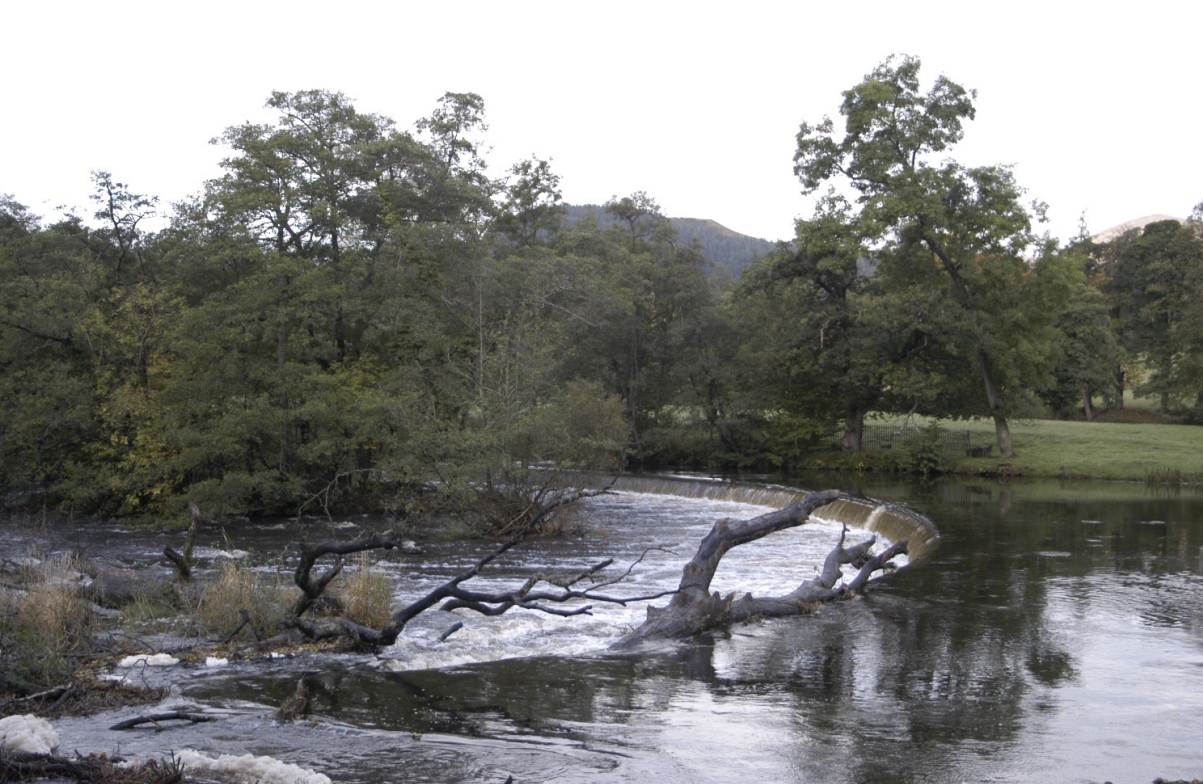
[The photo shows Horseshoe Falls on the River Dee, which supplies water to the Llangollen Canal, including water carried via the Llangollen Canal to the 21 acre Hurleston Reservoir, which holds 85 million gallons of public drinking water supply for south Cheshire – by Adrian Rayson]
Better by Barge makes a compelling case for shifting freight transport from congested roads to the country’s 5,000 miles of navigable rivers and canals, helping to cut emissions, improve air quality, and reduce congestion.
With the UK striving to meet net zero targets, the report demonstrates how moving freight by barge offers substantial environmental and economic benefits. A single freight barge can carry up to 1,500 tonnes, removing the need for up to 75 heavy goods vehicles (HGVs) from the roads. This shift could reduce carbon emissions from freight transport by as much as 76% per tonne, while also making urban areas cleaner and safer by cutting air pollution and traffic accidents.
Here are IWA’s Freight Group Chair, Gerry Heward’s views: “Waterways already exist as a national transport infrastructure, and they have the capacity to handle more freight. This report proves that moving goods by water is not only cost-effective but also significantly reduces carbon emissions and urban air pollution.”
The report also draws attention to the social and health benefits of reducing HGV traffic in cities, where high-density populations suffer disproportionately from poor air quality. Logistics UK Water Council’s Pamela Mounter called the findings “timely and relevant”.
To make the most of the UK’s inland waterways, Better by Barge recommends:
Government investment to improve capacity and encourage modal shift.
Support for low-carbon fuels like Hydro-treated Vegetable Oil (HVO) to aid the transition to Net Zero.
Protection of key freight sites from redevelopment pressures.
Reintroducing Freight Facilities Grants (FFGs) in England to help businesses connect to waterways.
Expanding the Mode Shift Revenue Support (MSRS) scheme to make water freight more cost-competitive.
Investment in training to build skills in the water freight sector.
The Better by Barge report underlines that inland waterways have an essential role to play in the UK’s journey towards a greener future. With the right policy support, investment, and infrastructure, shifting more freight onto water is a practical and achievable step in tackling climate change and congestion.
Support the FBW Flotilla in Gainsborough on 1st April 2025. The journey begins with a flotilla of boats setting off from Keadby (River Trent) on 1st April 2025 as the start of the major FBW campaign cruise to the heart of government, culminating outside the Palace of Westminster on 7th May. This year’s flotilla is led by Hazel Owen, Chair of the AWCC (Association of Waterways Cruising Clubs) and a member of the FBW steering group. There is still the chance to join the flotilla.
The boats will depart from Keadby on 1st April and progress upstream, aiming to be joined by further boats at West Stockwith and Gainsborough. The flotilla is set to pass through Gainsborough at approximately 10:00 a.m. on 1st April, and this is the chance to show support for Britain’s waterways.
SUPPORT THE FBW FLOTILLA IN GAINSBOROUGH, 1st APRIL 2025 Come to Gainsborough by 9.30 a.m. on Tuesday, 1st April, to support the Fund Britain’s Waterways flotilla as it makes its way towards Westminster.
The flotilla carries a crucial message: our canals and rivers are both valuable and valued but need adequate funding. The first group of boats will have set off from the Strawberry Island Boat Club in Doncaster at the end of March. They will join the tidal River Trent at Keadby, making their way upstream. At around 8:30 a.m. on 1st April, boats from the Chesterfield Canal at West Stockwith will join the flotilla. The combined flotilla will then pass through Gainsborough around 10:00 a.m., where they will be greeted by more boats and supporters on land.
Please note: this is a “passing through” event due to tidal schedules, so make sure to be at the river pathways near the bridge in Gainsborough by 9:30 a.m.
You could also visit West Stockwith at 8:00 a.m. to catch the flotilla as it sets out. This event is the first of many leading up to the main Campaign Cruise at Westminster. The FBW flotilla will continue its journey drawing attention to the ongoing need for investment and support for Britain’s inland waterways.
The FBW campaign was launched in 2023 to highlight the severe underfunding and deteriorating condition of the country’s network of canals and navigable rivers. The campaign continues to seek support of parliamentarians and the general public to secure the necessary resources for the upkeep of these vital waterways. Hazel Owen, who will lead the flotilla, said: “The need for greater investment in our waterways has never been clearer. This flotilla is not just about boats; it represents the voices of everyone who cares about the future of our canals and rivers. We must show Parliament that we are serious about safeguarding these precious resources.”
To take part in the Cruise on a boat in the flotilla: For details please contact Andrew Phasey on info@fundbritainswaterways.org.uk.
While we acknowledge the need for housing, a healthy, thriving waterway network should not be the price that has to be paid for new homes. Good planning should provide everyone with a decent home they can afford, as well as preserve and protect our heritage.
The Melksham Link is a crucial initiative to connect the Kennet & Avon Canal near Semington to the River Avon at Challymead. This restoration would allow boats to navigate through Melksham, past Melksham Gate Weir, and eventually connect to the historic canal line near Forest Farm before joining the Thames and Severn Canal.
We highlighted two major concerns. First, the developer has blatantly ignored strategic proposals for the area, despite acknowledging awareness of the Melksham Link plans. Second, the consultation fails to address the significant negative consequences of blocking this vital waterway connection.
The Wilts and Berks Canal Trust is optimistic about securing planning permission for the Melksham Link this year. However, the Berryfield developer has deliberately objected to the canal scheme to clear the way for their housing development, disregarding both the Melksham Neighbourhood Plan and the Wiltshire Council Local Plan.
We believe the developer should be required to modify their proposal to take account of the canal restoration and this is why we have submitted an objection.
Blocking the canal route would deprive Melksham of significant potential tourism, leisure, and employment opportunities that would accompany a restored waterway, including canalside hospitality venues, marinas, and retail establishments.
The council is already familiar with successful restoration work on the Wilts & Berks Canal, including the popular stretch at Pewsham Locks near Lacock and ongoing rebuilding around Swindon. We think this should be used as a model to show that it is possible to build new and much-needed housing, while protecting canals.
These are the reasons why IWA has formally requested that the Planning Committee reject this application. If you’d like to submit your own views the planning application can be found here and is open until 12th March 2025.
Thanks to the many volunteer hours that have been dedicated to this process. This objection also shows the importance of vigilance by local people and organisations as well as the enormous expertise within IWA. Waterway supporters are encouraged to report any local plans that threaten restoration to their local IWA Branch, IWA’s Chesham office or the relevant local restoration society.
Recent decisions on water abstraction licences pose a serious threat to the Monmouthshire & Brecon Canal (Mon & Brec) and could drastically reduce water levels, jeopardising the canal’s long-term sustainability and the communities, businesses, and wildlife that depend on it.
The Canal & River Trust (CRT) recently lost an appeal regarding water abstraction from the River Usk and Trosnant Spring, limiting the amount of water that can be used to feed the canal. Without adequate water supply, CRT has warned that sections of the Mon & Brec could become unnavigable or even face closure, though this would be the worst-case scenario. We believe even the prospect of this is unacceptable. Many businesses do well in this area, and they can do without even the hint of uncertainly especially as we come into warmer months and the holiday season.
For over 225 years, this canal has supported local economies, provided habitats for wildlife, and been a recreational space for all canal users. It’s also a significant part of Wales’ tourism industry: hire boat companies, trip boats, and canalside businesses generating jobs and revenue for the region currently operate successfully and are in need of reassurance. Up until now, the Welsh Government has supported canal restoration, most notably with the Montgomery Canal. We now need that same commitment for the Mon & Brec.
IWA is actively working to ensure the canal’s future. We are urging Welsh Government to work with Natural Resources Wales (NRW) to reconsider the impact of these water restrictions, not only on the Usk’s ecology but on the canal itself with its diverse ecosystem.
In South Wales, canal restoration efforts in Cwmbran have made significant progress, with restored bridges, new moorings, and lock gate replacements. Decades of investment, much of it funded through government grants and the National Heritage Lottery Fund, must not be wasted. Losing the northern section of the Mon & Brec would be very bad for future restoration and regeneration projects.
We have written to Senedd members, the Deputy First Minister and Cabinet Secretary for Climate Change and Rural Affairs in the Welsh Government, and relevant MPs to put pressure on getting the right outcome for the Mon and Brec.
Paul Thomas, IWA South West and South Wales Region Secretary, said:
“This is a serious threat to the Mon & Brec Canal, we can’t just watch it happen. Cutting water supply risks making parts of the canal unnavigable, which would be bad news for local businesses, tourism, and wildlife. For over 225 years, this waterway has been at the heart of the community, and we need the same commitment to its future that we’ve seen for other Welsh canals. This is why we are urging the Welsh Government to work with Natural Resources Wales to reconsider these restrictions, and we are writing to all relevant politicians. People love their local canal, but waterways as we know and value them would not exist if not for the historic campaigning of many before us. That work is still needed today.”
The UK’s rivers and canals are home to thousands of boats, from leisure cruisers to working barges delivering freight. They are also vital green-blue corridors, enjoyed by millions of walkers, cyclists, and nature lovers. However, most boats still rely on fossil fuels. IWA wants boating to be more sustainable and even though the current overall contribution to UK carbon emissions from boats is very small, we want to help reduce emissions on the waterways.
This is why IWA’s Sustainable Boating and Freight Groups has submitted a representation to the Treasury, focusing on the need to review the supply and taxation of alternative fuels.
Why Change is Needed
Environmental Benefits Moving towards cleaner energy will help protect wildlife and reduce pollution.
Economic Impact Our waterways support over 133,000 jobs and contribute billions to the UK economy.
Health & Wellbeing Active use of canals and rivers improves public health, saving the NHS over £1 billion annually due to the health benefits of active waterway use
Challenges to Greener Boating
While new boats are being built with electric or hybrid engines, most existing boats still run on diesel. Alternative fuels like Hydrotreated Vegetable Oil (HVO) are cleaner but remain stubbornly expensive and difficult to access. Bankside charging infrastructure for electric boats are also limited.
What Needs to Happen?
To make sustainable boating a reality, we are calling for: ✔ Affordable, cleaner fuel Tax incentives and better availability of HVO fuel. ✔ More charging points Investment in bankside charging for electric and hybrid boats. ✔ Joined-up government support A clear strategy that helps boaters transition to net zero without unnecessary cost and complexity.
The case for government action has only grown. By simplifying the fuel supply landscape, investing in infrastructure, and ensuring a coordinated policy approach, the Government can bring in a fair and practical transition towards net zero for leisure and commercial inland boating.
The Waterways All-Party Parliamentary Group (APPG) held its first working meeting in parliament on January 21st, chaired by Lord German. The usual chair, Labour MP for Sefton Central Bill Esterson was called to the chamber minutes before the meeting started.
The APPG noted with deep sadness the recent passing of Baroness Jenny Randerson, who had been due to attend. Her longstanding support for, and love of, the waterways has been appreciated.
Pictured (from left) are: Lord Michael German, Abtisam Mohamed MP, Uma Kumaran MP, Wendy Morton MP, Baroness Llin Golding. Not pictured but present: Sir Gavin Williamson MP PHOTO CREDIT: Susie Mather
The APPG discussed concerns over the growing crisis facing the UK’s inland waterways network, citing recent breaches on the Bridgewater and Huddersfield Canals as evidence of worsening infrastructure decline.
Members emphasised that despite the significant economic, social, and environmental benefits of the waterways, and the tireless contributions of volunteers, chronic underfunding is leading to increased structural failures, posing both safety risks and financial burdens.
Discussion focused on the critical need to safeguard the network’s future. The group also outlined key priorities for the coming year, including environmental management, flood defence, and sustainable freight solutions.
The Bridgewater Canal breach was cited as a stark reminder of the financial and operational challenges posed by ageing infrastructure.
The fragmented ownership of the network and the responsibilities of private navigation authorities in maintaining infrastructure were also discussed.
The APPG committed to progressing discussions on climate resilience and waterway funding, with plans to bring the issue to a Westminster Hall debate to drive parliamentary awareness and action.
As secretariat, he Inland Waterways Association (IWA) hopes the now 24-strong group will unlock the environmental, social, economic, and cultural potential of the UK’s rivers and canals by boosting local economies, promoting sustainability and connecting people to nature.
Fund Britain’s Waterways (FBW) is a growing action group currently comprising 145 member organisations representing hundreds of thousands of users and supporters of inland waterways. Its sole purpose is to campaign collectively for an increase in government funding of Britain’s inland waterways to avert their decline, and to promote awareness of the huge economic, environmental and social well-being value they provide.
FBW made a submission to the Autumn Budget 2024. Since then we have seen the collapse of embankments on both the Bridgewater Canal and the Huddersfield Narrow Canal on New Year’s Day following sustained heavy rainfall. These events demonstrate the vulnerability of our canals to the increasingly frequent severe weather events resulting from climate change. Increased investment will be needed in order to future-proof the network.
We have therefore presented a strengthened argument in our Spending Review submission and repeated our request to Government that:
the importance of Britain’s inland waterways as a unique national asset and part of the national infrastructure is recognised
the deterioration in condition that is already happening is acknowledged
a review of government funding for all Britain’s inland waterways be carried out as a matter of urgency, with the aim of defining a sustainable funding solution which will enable the current benefits of our canals and rivers to be maintained and enhanced for future generations.
To fund our inland waterways properly would cost a small (in government terms) investment measured in millions not billions of pounds. In return the country will continue to obtain billions of pounds of benefits for health, economic and environmental benefits, much of the benefits in less well-off areas.
We are already seeing the waterways deteriorating and businesses suffering, and the rate of deterioration is increasing because of the impact of extreme weather events caused by climate change. If underinvestment continues this will become worse until a tipping point is reached and waterways have to be closed, wasting the benefits as well as the millions of hours of volunteer time and millions of pounds of public money that have gone into the current network. Read the full submission here.
The Peel Ports Group owns Clydeport, which functions as the harbour authority for 450 square miles of waterway in and around the River Clyde and its estuary.
Recently they announced that they would be imposing an annual fee, commencing in April 2025, on all leisure craft operating on their waterways which includes Loch Fyne giving access to the Crinan Canal. The charge will apply to boats between 6 metres and 24 metres in length within the Clyde jurisdiction north of Irvine, and will apply to permanent berths and visitors. The charge proposed is £120 per annum and £90 for summer.
The restoration of the Wilts and Berks Canal is an ambitious 70-mile project to recreate a cross-country navigation network. Opened in 1810, along with the North Wilts Canal in 1819, the Wilts & Berks Canal was formally abandoned by Act of Parliament in 1914. It has always been known by the shortened form of the county names to reflect the wording in the original Act of Parliament. After abandonment, ownership of the Canal was returned to adjacent landowners and local authorities, and some sections of the canal were sold. The main line route of the Canal runs from Abingdon on the Thames to Semington on the Kennet & Avon Canal; there were branches at Calne, Chippenham, Longcot and Wantage, and the North Wilts Canal runs from Swindon to Cricklade.
The Wilts and Berks Canal Trust has been making great progress on several fronts, with backing from partner organisations and help from the IWA’s Waterways Recovery Group. For example, in Swindon, new sections of canal are being built by developers as part of Council planning conditions. There is much good work being done in Swindon, so this planning proposal is particularly disappointing and sufficiently serious that IWA has objected to the plans for the redevelopment of the Oasis site. This site is just north of Swindon Station where the North Wilts Canal is planned to be restored to link up to the Thames and Severn Canal route at Cricklade. As the national campaigning body promoting restoration of the waterways network, IWA supports the vital work which the Wilts & Berks Canal Trust, which is an IWA corporate member, is doing.
The plans for the Oasis site ignore the needs for reserved routing for the re-establishment of the Canal through this part of Swindon. Permitting this development as proposed would preclude through restoration for several generations, thereby denying the residents of Swindon of the multiple advantages that a restored Wilts & Berks Canal would bring them. It would also be a serious setback to plans to reconnect Swindon to the rest of the national waterways network.
Objecting to the proposal, IWA has written: “We urge the Planning Committee to reject these applications until modified (in a comparatively minor degree) to permit the eventual rebuilding of the canal through this area. We understand that the developers have been aware of this opportunity for over a decade but seem to have ignored the needs of a restored Wilts and Berks Canal in the detail of their plans. It is therefore for the planning authority to protect this route. The current plans should be rejected until they incorporate an effective future route for a restored canal.”
The proposals include 700 homes, and it is well established that canals can be an excellent feature in new developments giving the community walking and wheeling routes; potential for water sports, being adjacent to a leisure centre, and helping nature recovery by creating a blue-green corridor for wildlife. IWA hopes that the Council will seize this opportunity not just because it will enable Swindon to be well connected by water again but also because of the benefits to local people and their physical and mental health.
This case shows the importance of vigilance by local people and organisations. Waterway supporters are encouraged to report any such threats to restoration to their local IWA Branch, IWA’s Chesham office or the relevant local restoration society.
Neath Port Talbot Council issued a Neath and Tennant Canals options appraisal consultation in November 2024 to look at possible ways to restore and regenerate the Neath and Tennant canals for the benefit of people, places and the environment.
The Council held a community workshop in early December 2024 to share options and gather views from the public. Two IWA South Wales Branch representatives, as well as several IWA members, and representatives from local canal groups attended a packed workshop at Aberdulais.
IWA has responded to the consultation options put forward by the Council. Whilst encouraged that the Council sees the benefits that the canals’ restoration can bring, IWA feels that the lack of an option to return the canals to full navigability ignored the significant benefits that a wider ranging vision would bring. IWA feels that the options presented lacked the ambition and strategic vision demonstrated by other canal restorations elsewhere in the UK that have revitalised town and city centres.
The Branch referred Neath Port Talbot Council to IWA’s comprehensive report Waterways for Today which explains how navigable waterways can act as a catalyst for investment and regeneration. The report also provides evidence showing why waterway focused projects are perfect for including in regeneration projects and third party funding bids.
Restoration of both the Neath and the Tennant canals to full use is complicated by ownership issues. Neath Port Talbot Council terminated a Neath Canal Public Access Rights Agreement in December 2023 which previously gave the public access to parts of the Neath Canal towpath.
IWA is very concerned that the options presented made no mention at all of key canal historic assets that need protecting in the short term. The Aberdulais Aqueduct (a Scheduled Ancient Monument) and associated weir are vital parts of both canals, and their continuing neglect is having, and will have, a significant impact on the viability of the canals’ restoration and future use. The IWA has an ongoing campaign to raise the issue of the potential threats to this important canal asset. Repair of the aqueduct and weir needs to be part of a wider plan to protect local houses and other properties at Aberdulais from potential flooding.
IWA believes that:
The Aberdulais Aqueduct, weir and associated flood works need to be protected and work completed as soon as possible.
Canal ownership relationships need to be resolved so that works can be completed along both the canals.
A new partnership or dedicated organisation needs to be set up.
A clear Vision and Strategic Plan needs to be created supporting the Vision of Full Navigability of the Canals.
To view IWA’s response to the consultation, click here.
The canal, River Teign and an unused railway line all run parallel in a section of the valley near Kingsteignton. Heavy rain building up in the canal and on land to the west of the railway embankment caused some 60 metres of canal embankment south of Teign Bridge to collapse. The water flowed into an adjoining clay pit owned and operated by Sibelco.
A similar length of railway embankment also collapsed. The Templer Way pedestrian route along the canal towpath, and the Stover Trail for pedestrians, cyclists and horse riders, on the western side of the railway, have both been washed away.
For background, the railway and canal are owned by Network Rail, with the canal leased to Teignbridge Council and sub-leased to the Stover Canal Trust which is working on its restoration. The railway has been non-operational for some years and there is now concern as to whether Network Rail will try to use the occasion to close it permanently.
The Stover Canal Trust is an IWA corporate member. Its Chairman, Paul Taper, shared his initial assessments: “It is clearly early days, and needless to say, the costs will be considerable. One of the first actions will be to rebuild the canal embankment, which may need piling etc. to make it strong and watertight. The water in the quarry pit will need to be tested by the Environment Agency for contamination and, only if suitable, can be pumped back into the canal and river. Pumping time is estimated at nine months due to the sheer volume of water involved.
“The railway embankment will need to be rebuilt if flood water is to be retained on its western side. Both the Templer Way, along the canal towpath, and the Stover Trail, to the west of the railway, will need to be reinstated.”
Additional damage was done to the canal north of Teign Bridge. Stover Canal Trust volunteers held an ad hoc work party shortly after the storm and made good the damage to two footbridges and some of the towpath on the northern half of the canal.
A meeting was held between Sibelco, Stover Canal Trust, the Environment Agency, Teignbridge District Council and Devon County Council to discuss the issues regarding pumping out the quarry and preventing it from happening again. Network Rail were invited but did not attend the meeting. Further update meetings will be held at two monthly intervals.
Aerial photo of the devastation several days after Storm Bert. To the left the railway track hangs loose. The line of the canal can just be made out in the centre, running immediately parallel to the track. The flooded clay pit lies to the right, having been filled through a breach in the canal embankment. (Photo: David Abel)
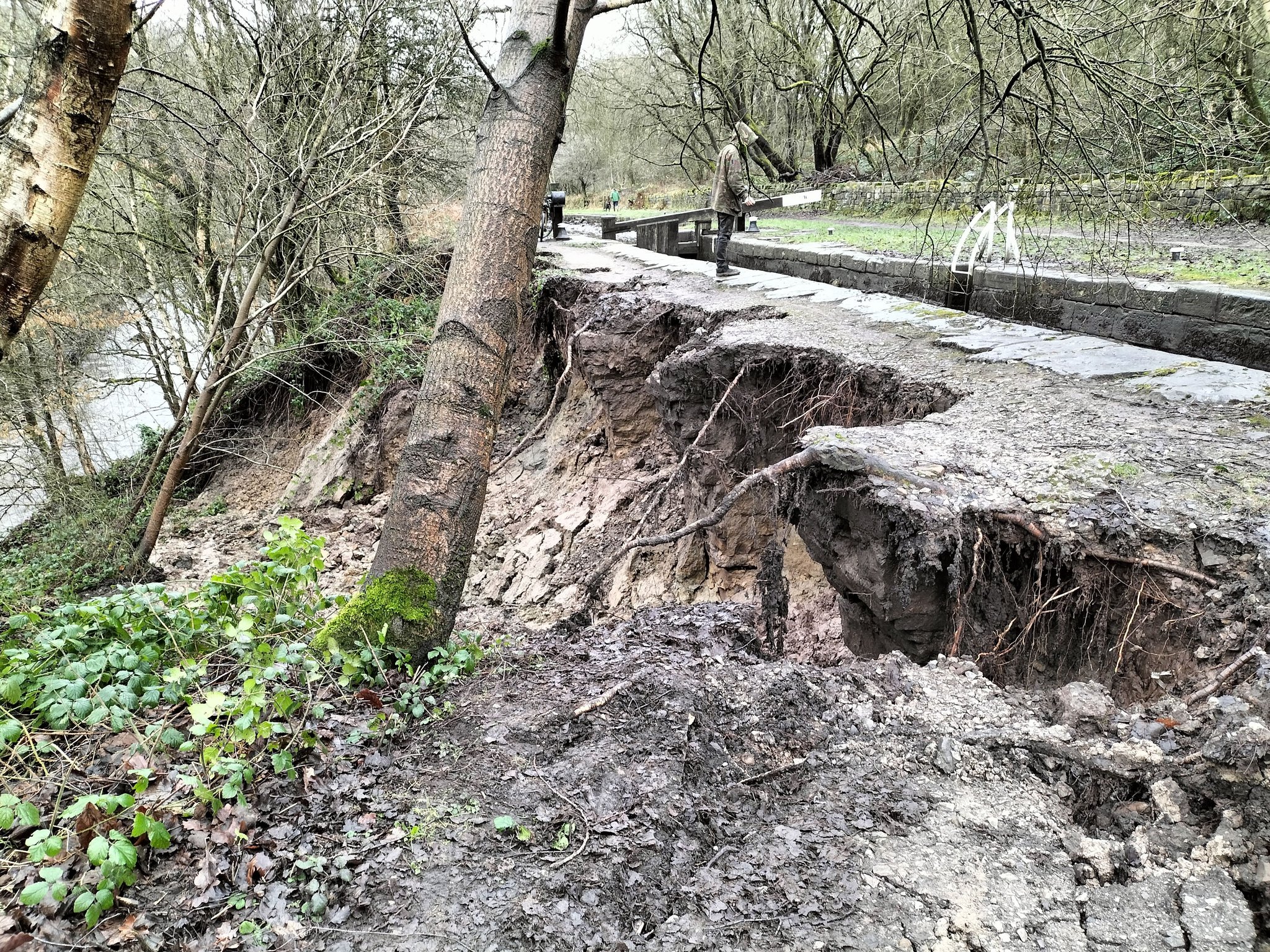
The mainstream media is giving widespread coverage to the collapse of the Bridgewater Canal embankment near Dunham Massey in Greater Manchester on New Year’s Day following sustained heavy rainfall. Less widely reported is that the rain also led to a structural failure of the embankment supporting the side of Lock 11W on the Huddersfield Narrow Canal to the north east of Manchester. As a result Canal & River Trust (CRT) had to close the canal between Locks 12 West and 10 West on 1st January until further notice.
A section of the Bridgewater Canal embankment near Dunham Massey in Greater Manchester collapsed on New Year’s Day after sustained heavy rainfall, resulting in water pouring into neighbouring fields and flooding a sewage works.
The BBC reported that 90mm of rain fell on north west England over the New Year’s period. A major incident was declared because of serious flooding across Greater Manchester, Lancashire and Cheshire, including the breach of the canal. Greater Manchester Fire and Rescue Service reported evacuating nearly 1,000 people during the incident.
The collapse has attracted widespread public attention: drone footage and photos of the breach have been widely shared across social media and one video became the ‘most watched’ on the BBC news website. Canal & River Trust has issued a statement making clear that the canal is not one of its waterways, and also stressing the vulnerability of all canals and infrastructure of this age to extreme weather arising from climate change.
The Bridgewater Canal is directly owned by the Bridgewater Canal Company Limited, which is owned by Peel L&P, a division of Peel Holdings plc. It forms part of the popular Cheshire Ring cruising circuit and is also an important north-south link between the Leeds & Liverpool Canal at Leigh and the Trent & Mersey Canal at Preston Brook, as well as part of the east-west routes across the Pennines on the Rochdale and Huddersfield Narrow Canals.
Somerset Council issued a consultation document in September on its proposed Taunton Waterways Strategy.
IWA’s West Country Branch reviewed the proposed strategy and, whilst generally supportive of the proposals, felt that significant benefits of waterways-focused development had been overlooked.
The draft Strategy focuses on the opportunities that waterways offer to mitigate flooding, enhance biodiversity, encourage active and sustainable travel and build a sense of community. But the roles that waterways play in creating jobs and bringing financial benefits through tourism and leisure were hardly touched on.
The Branch’s response to the consultation made a series of suggestions intended to provide the Council with a wider perspective on the benefits of navigable waterways. It also flagged up that the Grand Western Canal had been omitted from the Strategy, despite its origins in Taunton, plus the need to refer to wider waterways issues in Somerset, which could have a positive and lasting impact on the town.
The Branch referred Somerset Council to IWA’s comprehensive report Waterways for Todaywhich explains how navigable waterways can act as a catalyst for investment and regeneration. The report also provides evidence showing why waterway focused projects are perfect for including in regeneration projects and third party funding bids.
To view the Branch’s response to the consultation, click here.