The Environment Agency has recently announced that even though a large majority of customers did not support the proposal, it has decided to increase boat registration fees by 9%.
IWA acknowledges that the Environment Agency’s funding position has left it in a difficult position, considering how inflation has impacted on its costs such as building, materials and repairs. However, as shown by the consultation response, the majority sentiment amongst our membership who use the EA waterways is that the 9% increase is too much.
This is largely due to the impacts on navigation of increased delays to planned winter maintenance works, with more and more works encroaching on summer boating. In particular, access between the Great Ouse, Middle Levels and River Nene was prevented due to delayed work. Through passage on the Nene was not possible until 1 June, Denver crossing was closed until 10 June, Brownshill Lock was closed until 17 June and Brandon Lock remains closed at the time of writing.
Other concerns include a significant increase in the number of lock failures, the numerous weirs blocked by debris and abandoned boats which increases the risk of floods, various investment decisions that fail to prioritise navigation, loss of income through failure to enforce regulations, and failure to maximise commercial opportunities.
We are also concerned that the Environment Agency’s navigation teams have lost many of their more experienced staff who had in-depth knowledge and understanding of the waterways when communicating with business and leisure customers. More effective management will require more responsive and well-informed operation managers.
The Environment Agency has stated that the rise in registration fees will be used to improve the experience of users. As we said in our consultation response these are some of the aspects where IWA would like to see improvement:
greater reliability for navigation and better facilities for boaters;
speedier attention to faults and shorter stoppage times;
streamlining and rationalising EA’s procedures including its very complicated charging regime;
increasing revenue by better enforcement of unlicensed boats (many of which will be uninsured and without Boat Safety Scheme certificates);
reviewing the criteria for issuing and lifting strong stream advice;
improving reliability of existing equipment (particularly gear boxes and electrical systems at locks);
more efficient use of staff including subcontractors for the winter maintenance works programme.
Sue O’Hare, Chair of IWA’s Navigation Committee, said:
“It is understandable that the Environment Agency has felt the need to make a significant increase to boat registration fees, but it is disappointing that its funding position has made this necessary. Through Fund Britain’s Waterways IWA is campaigning for adequate national and local government funding for all Britain’s navigable rivers and canals to ensure that future generations can continue to enjoy their many benefits. At the same time it is incumbent upon all navigation authorities to ensure that their funding is used effectively and efficiently.”
Time: 1:00pm – 2:00pm Location: W2 Palace of Westminster
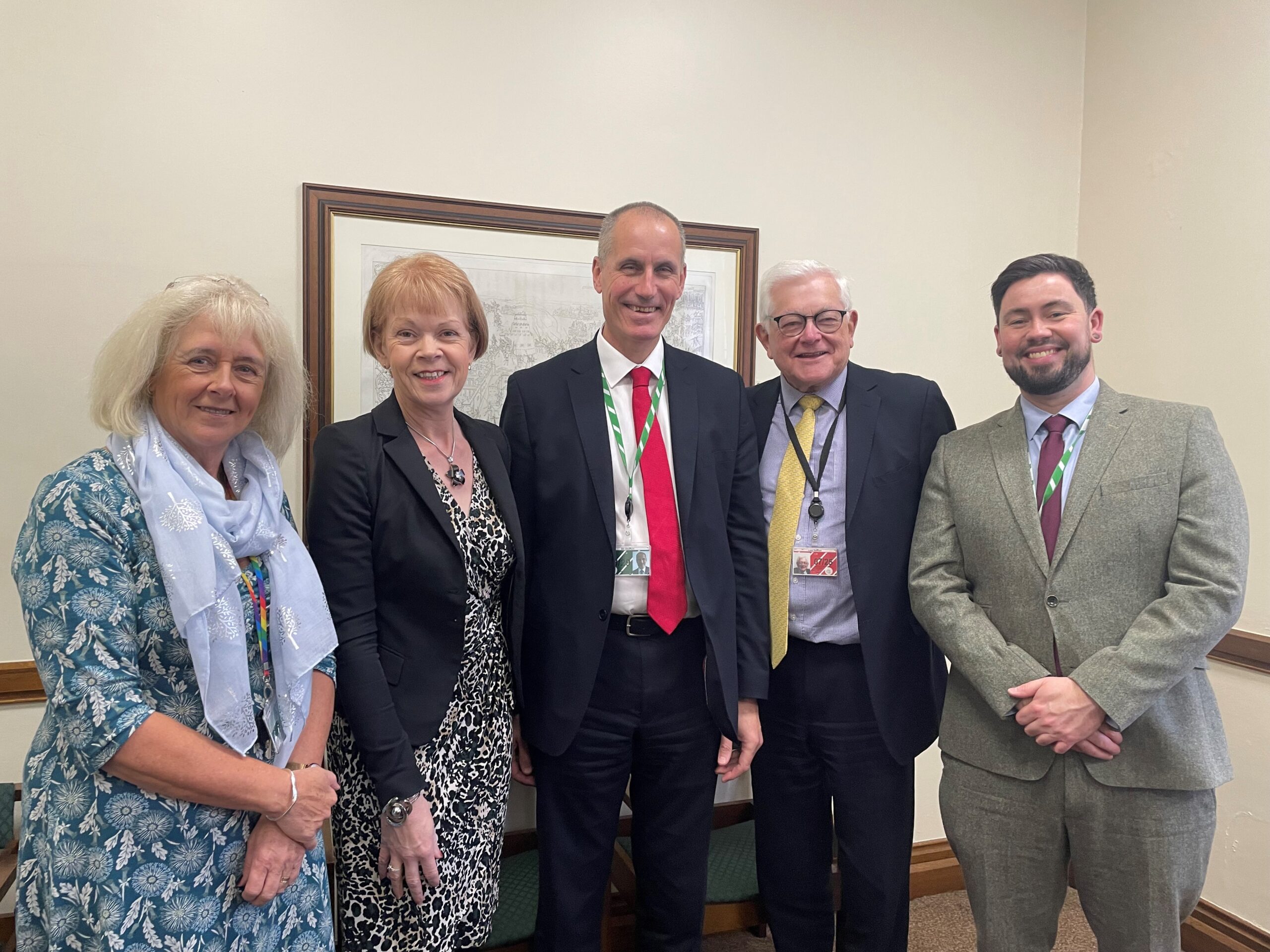
On Tuesday 12th November, the Waterways All-Party Parliamentary Group (APPG) hosted its inaugural meeting in parliament.
The meeting was an opportunity for parliamentarians to meet the APPG’s secretariat (Inland Waterways Association) and elect the APPG’s officers.
The Waterways APPG has appointed Bill Esterson, MP, as its new Chair. Mr Esterson proposed officers, with existing rules meaning that one must be from the government party or parties, and at least one from the main opposition party. A show of hands supported the election of Wendy Morton as vice-chair, and Uma Kumaran along with Lord German as co-chairs.
Among the vice chairs and officers of the group are a number of newly elected MPs as well as some long-standing waterway supporters.
Bill Esterson, APPG chair, said:
It is not just boaters who make use of our waterways. Canals and rivers are a valuable resource for leisure, active travel, industry, energy, and even in the case of the Leeds to Liverpool Canal as a source for water borne district heating. The tranquillity of time spent by the water, along with the wildlife that thrives around clean waterways, is truly something to be cherished and enhanced. All these interests can coexist, and I look forward to chairing this influential All-Party Group and highlighting, both in Parliament and beyond, the importance of waterways to our nation’s economy and environment.
Charlie Norman, Director of Campaigns and Public Affairs from IWA, said:
IWA warmly welcomes Mr Esterson’s appointment as Chair of the APPGW. It’s clear that he really grasps the importance, value, and relevance of the UK’s inland waterways and the need for adequate funding. We look forward to working both with him and an almost entirely new slate of members over the course of this parliament.
The closure is currently planned to last from November 2024 to March 2026 because, although Scottish Canals has funding to build the necessary replacement lock gates, the Scottish Government has not yet made available the funds to fit them and for associated lock repairs. If all the funding had been available together, the work could have been completed much more quickly.
Construction of the waterway commenced in 1768 and was finally completed in July 1790. For it to have lasted so long is a tribute to both contemporary engineering prowess and the restoration work undertaken at the turn of this century.
The Forth & Clyde Canal declined in the second half of the 20th century and was finally closed in 1963. In March 1999 National Lottery Funding, totalling £100 million, was precured to reopen the navigation and the process of decay was reversed: new channels have been engineered, blockages circumnavigated and more than 30 bridges rebuilt to reinstate the coast-to-coast waterway we see today.
An important part of this vision was the rôle the waterway would play as a transit canal allowing seagoing leisure vessels to move between Scotland’s east and west coasts. Completion of this restoration was almost 25 years ago, which is the useful life of a lock gate. Across the waterway’s 34 miles there is a total of 39 locks, few of which have received significant attention since the reopening.
The eastern end of the navigation – running from Lock 16 near the Falkirk Wheel for 2¾ miles down to Lock 2 at the Kelpies – will shortly be closing for sixteen months. This is to allow re-gating of five of the fifteen locks in the flight and a thorough investigation of all the locks themselves. This section of the navigation includes several short pounds which will be totally dewatered (preventing navigation) thereby making the whole operation more efficient.
An early design by prominent engineer John Smeaton, much of this end of the waterway crossed unstable ground and the locks were constructed on what were effectively timber rafts, using pitch pine. Whilst it is not unusual to find wooden floors to locks, running the timbers under the lock walls for added stability is uncommon.
Timbers forming the lock floors are, in places, in poor condition with significant holes visible. These are relatively easy to replace but it is the condition of the timber, hidden under the masonry forming the lock chambers, that poses a large unknown.
Whilst funding is now in place for the five sets of lock gates, money still needs to be found to cover the cost of their installation and to underwrite any issues in this highly unusual construction that are uncovered along the way. It is this considerable uncertainly that dictates such an extended closure, as current diving investigations can only determine the extent of lock-related works and the state of the visible sections of the timber flooring.
Scottish Canals has been in touch with Transport Scotland demonstrating that navigation is a public rather than a private benefit and therefore deserves financial support from the Government. This position is supported by RYA Scotland, by the Lowland Canals Association and also by IWA. IWA agrees that the Scottish Government should recognise the value of navigation to the public as a general principle, together with the value of the Forth & Clyde Canal as a sea-to-sea link.
IWA is delighted to announce the appointment of Hugh Pearman as the new Chair of its Heritage Advisory Panel. As an experienced and celebrated journalist, editor, and author, he brings a background gained in a distinguished career and a deep commitment to preserving the architectural and engineering heritage of Britain’s inland waterways.
Hugh spent over three decades at the forefront of architectural journalism. From 1986 to 2016, he served as the architecture and design critic for The Sunday Times, and later as editor of the RIBA Journal from 2006 to 2020. His latest book, About Architecture, explores engineering and architectural achievements including those related to canal heritage. His extensive contributions to media and heritage have included roles on Arts Council England’s architecture advisory group, co-founding the RIBA Stirling Prize in 1996, and chairing the ‘Art for Architecture’ initiative at the Royal Society of Arts from 2000 – 2004. He was made an Honorary Fellow of the Royal Institute of British Architects in 2001 and his contributions to architecture and the arts were recognised with an MBE in 2019.
Beyond his professional life, Hugh is a longstanding IWA member with a personal enthusiasm for the heritage of Britain’s inland waterways, providing planning and architectural guidance for the Association’s London Region. He is the current Chairman of a campaigning architectural heritage charity, The Twentieth Century Society.
Commenting on his appointment, Hugh said:
The waterways network is a precious and rich working historical resource, available to all, linking urban and rural locations. It exists today because of the time and effort of the thousands who have worked to save and enhance it since IWA’s founding. It is now at a vulnerable moment. We need to be on high alert and make the strongest possible case for it as a key national heritage asset.
IWA recognises the challenges facing the UK’s waterways today. Historic structures are aging, climate change is exerting pressure on water management, and funding for conservation remains uncertain or inadequate. Hugh’s leadership arrives at a crucial moment as the Association works to safeguard the waterways from degradation or loss.
Under his guidance, the IWA Heritage Advisory Panel will continue collaborating with navigation authorities and other stakeholders to ensure that conservation and celebration of the network’s heritage remain a priority.
In May 2024, due to safety concerns regarding the structural integrity of the lock islands at Baits Bite and Jesus Green locks, the decision was taken to close the locks until further notice.
Visual and underwater camera surveys have now shown that the fabric of both locks is unstable and vulnerable to collapse. Both lock islands carry public footpaths over the river, and the footpath at Baits Bite was closed by Cambridgeshire County Council at the same time as the Conservancy closed the lock and remains closed.
Both locks will require stabilisation work to make them safe in the short term and rebuilding in the medium term. The immediate stabilisation work is likely to cost around £1.5 million per lock, with the need greatest at Baits Bite. Rebuilding the locks is likely to cost at least £5 million each, probably more.
The Conservancy has stated that funds for the immediate stabilisation work are not readily available to them, and the medium-term rebuilding of the locks is beyond the Conservancy’s financial means.
The Conservancy’s income comes almost exclusively from fees, which just cover routine operations and it receives no additional funding for capital works. As a result, the Conservators are exploring potential sources of external funding.
The situation has left many boats stranded on the river with no maintenance facilities on the affected stretch, and no visitors able to reach the popular tourist destination of Cambridge by boat. Some have been forced to crane their boats out in order to leave.
Sue O’Hare, Chair of IWA’s Navigation Committee, said:
“Through Fund Britain’s Waterways IWA is campaigning for adequate national and local government funding for all Britain’s navigable rivers and canals to ensure that future generations can continue to enjoy their many benefits. The circumstances of the River Cam are unique but the need for funding is universal.”
The Norfolk and Suffolk Broads are a valuable natural asset, recognised by their National Park status. Uniquely among National Parks, the Broads area includes 125 miles of navigable waterways. These waterways are fundamental to the character of the Broads and bring benefits to the economy, the natural and built environment, local communities and the lives of individual people. About 7.5 million people visit the Broads each year, drawn by the special qualities of the wetland landscape and the tranquillity of the waterways threaded through it, traversed by boats of all shapes and sizes. As a result tourism in the Broads contributes £775 million to the Norfolk and Suffolk economy and supports over 7,000 jobs. The Authority’s briefing is available here.
The Broads receive National Park Grant funding from Defra, but the Norfolk and Suffolk Broads Act 1988 requires this to be used solely for funding National Park expenses and not for maintaining the waterways to keep them safe and navigable. Rather, all navigation costs must be funded from navigation tolls paid by over 8,000 private boat owners and 54 hire boat companies. This has resulted in the need to increase tolls substantially in recent years, which has generated considerable public disquiet. The number of both privately owned and hire boats has been decreasing, partly as a result of the increase in charges but also because of other factors such as poor weather, the cost of living crisis and relatively cheap foreign holidays. In consequence the Broads Authority briefing on navigation charges states a significant shortfall of £394,000 in the budget for management of the Broads navigation for 2025/26 and sets out some stark options. Ultimately the situation poses a threat to the essential character of the Broads and will potentially degrade their National Park status, as well as their contribution to the economy.
IWA previously set out its concerns over the need for large toll increases in a representation to the Secretary of State for Transport and urged Government to recognise the need for financial support to ensure that navigation and the character of the Broads are maintained. As noted in the representation, the Broads Authority is the only major inland navigation authority that does not receive government funding to support maintenance of navigation. Government has argued that use of the Broads waterways is a private benefit which should not be funded, despite waterways and boating being an integral part of the special qualities justifying the National Park designation – and therefore a public asset. Many people as well as boaters enjoy the public benefits provided by the rivers and wetlands.
The Broads Authority has written to the Government demonstrating that navigation is a public rather than a private benefit and deserves financial support from the Government. This position is supported by the Broads Society and also by IWA. IWA agrees that Government should recognise the value of navigation to the general public and provide a permanent regular annual navigation supplement to the Broads Authority, in addition to its funding as a National Park.
Sue O’Hare, Chair of IWA’s Navigation Committee, said:
“Through Fund Britain’s Waterways IWA is campaigning for adequate national and local government funding for all Britain’s navigable rivers and canals to ensure that future generations can continue to enjoy their many benefits. The circumstances of the Broads are unique but the need for funding is universal.”
Severn Trent Water, Affinity Water, and Canal & River Trust have consulted on plans to transfer available treated recycled water from the Birmingham area, via the canals, to an area supplied by Affinity Water in Hertfordshire and Bedfordshire. Water would be piped into the Coventry Canal, probably at the top of Atherstone Locks, and would flow south via the Oxford and Grand Union Canals to an abstraction point somewhere near Leighton Buzzard. It would then be piped to a reservoir near Luton to help alleviate shortages in part of Affinity Water’s public water supply area.
This is not a new idea – the Llangollen Canal, Gloucester & Sharpness Canal, Bridgwater & Taunton Canal and Fossdyke have all been used for water transfer for many years and this brings in extra income for CRT. However, every canal has its own specific character and we need to make sure we get the best deal for the Grand Union out of the scheme. IWA submitted a response supporting in principle the concept of water transfer schemes if they facilitate improved navigation in areas that are currently subject to a water shortage. The consultation does not provide any of the detail required in order to assess heritage impacts or the effects of engineering modifications. The next stage of consultation needs to closely define the extent and costs of all these interventions, well in advance of any Development Control Order (DCO) application, so that IWA and others can provide detailed advice and take an informed position on this proposal.
While the use of the canal for water transfer in drought periods has the potential to eliminate the sort of lock-use restrictions we have had in the past in dry summers, we will want to be assured that the scheme will not have negative effects on canal users. So we will be looking for answers and reassurance on matters such as:
the impact of raised water and bank levels on bridge headroom, flood risk, water depth, moorings and heritage
the location, design of and power supply for pumping facilities;
the currents that will be generated in the canal, especially through the fixed cross-section of Braunston Tunnel;
the way the scheme will be operated during drought periods;
water quality of the transferred water;
This will be a project authorised by central Government under a Development Consent Order (DCO) and the aim of the promoters is to apply for the DCO early in 2026. This will be followed by a period of ‘Examination in Public’ by the Planning Inspectorate, then a decision on the DCO, probably in 2027, with a view to the scheme being operational by 2033.
IWA will feed in its views as the scheme is developing and, at the appropriate time, will consider whether to make what is called a ‘relevant representation’, which would enable us to participate in the Examination in Public.
The public consultation closed on 25 October. Details of the scheme and consultation arrangements are available on the web at: www.guctransfer.co.uk. Further opportunities to comment will be opened up as the scheme progresses.
In the cause of sustainable boating, many boats and boaters are moving away from fossil fuels, like diesel, gas and solid fuel, towards electricity, both to propel the boat and for domestic purposes.
One result of this is the increasing use of new technology batteries on boats, usually based on lithium chemistry. These may be installed in your boat or be part of portable appliances and devices brought on board.
Bowman Bradley, chair of the Sustainable Boating Group said “Whilst these new battery technologies bring much benefit, we are all becoming aware of the hazards that can result if they are damaged or used incorrectly. Many of these hazards exist whether we are afloat or onshore, but some are specific to boats and boaters. Whether you have realised it or not, you almost certainly have lithium chemistry batteries somewhere on your boat, even if only in your mobile phone, and, of course, the larger the battery the greater the potential hazard.“
The Boat Safety Scheme has published comprehensive information regarding lithium-ion battery safety on boats and IWA encourages all boaters to read it at:
At this year’s Annual General Meeting held at De Montfort Universityin Leicester, we introduced the Sustainable Boating Awards, in partnership with Towpath Talk. These awards highlight individuals, organisations, and businesses making a positive impact on sustainable boating. The IWA National Awards 2024 were also presented at the AGM. These awards aim to recognise members and other waterway campaigners who have contributed to the Association’s work and made the inland waterways a better place.
The results of the awards are as follows:
Sustainable Boating Awards:
NON-COMMERCIAL AWARD 2024
Awarded to the individual, charity or community organisation that, in the opinion of the judges, has made the most valuable contribution to sustainable boating during the last twelve months.
Kay & Paul Sumpner, ENB ‘Old Nick’
…for their outstanding work promoting the online exchange of information about electric boating, including organising Electrika – the first inland waterways boat show for electric boats.
Awarded to the business that, in the opinion of the judges, has made the most valuable contribution to sustainable boating during the last twelve months.
Mothership Marine
…for their innovative electric propulsion systems and sustainable boat fit outs, featuring larger propellers and fitting large PV cell arrays.
The judges were also impressed by their use of recycled materials in their fit outs.
COMMENDATION 2024
Ortomarine
…for their work in developing monitoring technology for electric boating and their willingness to share information with others to allow electric drives to develop faster, including access to the data from their trials on the Severn, and for their support of Electrika.
IWA National Awards
RICHARD BIRD MEDALS
For members of the Association whose efforts and support are considered to have brought significant benefit to the Association over a sustained period.
• Pete Fleming
A key volunteer with the Waterway Recovery Group (WRG), Pete’s contributions to IWA’s Canalway Cavalcade are invaluable, particularly his dedication to event planning and volunteer leadership. He takes on key planning roles for the event build up and is on-site to lead the workcamp volunteers for the entire weekend. Pete is pivotal in ensuring everything runs smoothly and is invaluable to the team and organisation. Pete was unable to attend as he was at a Waterway Recovery Group Weekend Camp.
• Emma Greenall
A long-standing WRG volunteer, Emma has played strategic roles behind the scenes, ensuring the success of IWA Canalway Cavalcade.
Emma has confidently stepped into several strategic roles for Canalway Cavalcade, both behind the scenes and on the ground during the weekend event. She has been key to ensuring Cavalcade runs successfully and is a great asset to the team and organisation. Emma was unable to attend so alternative arrangements will be made to present the award.
• Peter Hill
Recognised for his 18 years of outstanding service as editor of Aegre – the East Midlands news magazine, championing incorporation of IWA corporate image and brand identity to enhance the Association’s profile.
• Bernard Morton
Acknowledged for his inspirational leadership of the Northampton Branch, bringing out the best in his team. None of Northampton Branch’s achievements would have been possible without his exemplary leadership skills, along with his support and encouragement of the Committee.
CHRISTOPHER POWER PRIZE
For a person, society or trust who has made the most significant contribution to the restoration of an inland waterway.
There is a cash prize associated with this award, which is given to the waterway restoration group associated with the winner, where the winner is a named individual. The aims and objectives of the group must be consistent with IWA’s aims and objectives. The trophy, a carved wooden otter, was presented to the Association by Volvo Penta.
Ali Bottomley (Womble)
Ali’s dedication to the WRG Training Weekend has been extraordinary, having an amazing impact on both WRG and other canal restoration volunteers and societies.
BRANCH ACHIEVEMENT AWARD
For the IWA Branch which, in the opinion of a panel consisting of the National Chair, Deputy National Chairs and Chief Executive, has made the greatest progress and achievement in promoting the Association’s aims and objectives during the past year. All Branches are considered, without need for nomination. The award consists of a silver salver, donated to IWA by former National Chair David Stevenson for the purpose in 1998.
Northampton Branch
Celebrated for their exceptional work on the Northampton Arm, transforming it into a thriving space for boaters and walkers, while supporting local schools, artists, and community groups. With its seventeen locks, the Arm is one of the longest adopted stretches of Canal & River Trust managed waterways. Working closely with local partners, schools, artists and corporates, the Branch has ensured the waterway has benefitted from painted and ceramic murals, a mosaic trail, new benches, towpath resurfacing, and the installation and maintenance of defibrillators.
CYRIL STYRING TROPHY
This is the Association’s premier award. For an IWA member who has, in the opinion of trustees, made an outstanding contribution in furthering the Association’s campaign.
Ray Alexander
Ray’s decades of service have transformed waterways across the Southwest and nationwide. His tireless commitment, knowledge, and leadership have earned him the Association’s highest honour. Ray demonstrates that in fighting for the waterways there must be a blend of hard work, patience, knowledge, loyalty, being with the right people at the right time, and producing technical and promotional documentation to a high standard.
The waterways have benefitted enormously from Ray’s long involvement. He has been a consistently influential and reliable champion and a highly respected representative of the Association.
IWA is incredibly proud to recognise these champions for their vital contributions to our waterways.
Our 65th Annual General Meeting was held on Saturday 28th September at De Montfort University in Leicester. IWA thanks all of the members who attended either in person or on Zoom, and is also incredibly grateful to the volunteers and staff who helped out during the event.
Before the formal AGM commenced, attendees watched a presentation about IWA’s campaigns by Deputy National Chair, Sue O’Hare. The presentation detailed the progress made since 2023 from a campaigning perspective and provided an insight into the future of IWA campaigning including the Association’s Campaigns Strategy. The presentation also summarised the progress made by the Fund Britain’s Waterways group since its launch in June 2023 and detailed IWA’s involvement as a member of the FBW steering group. Attendees were encouraged to take action to help Fund Britain’s Waterways by signing the FBW petition, making a donation, lobbying their MP or engaging with the campaign on social media.
The campaign-focused presentation was followed by a talk on restoration by Waterway Recovery Group Chair, Mike Palmer. His presentation explored some of the successes and challenges faced in the world of waterway restoration over the past year. It also provided a reminder of the many benefits that our waterways offer, as identified in our Waterways for Today report, while highlighting the considerable value that restoring unused waterways could provide.
After a short break for refreshments, the AGM began during which members approved the minutes for the Annual General Meeting held on 23rd September 2023. Members also approved the appointments and reappointments of the following Trustees for terms of three years each:
Robert Atkins
Christl Hughes
Colin Porter
Hannah Rigley
Ian Sesnan
Presentation of the Sustainable Boating Awards took place after the formal AGM. The awards were launched earlier this year through a collaboration between Towpath Talk and IWA’s Sustainable Boating Group (SBG). The purpose of this new award scheme is to celebrate people and organisations which have had an impact in the sustainable boating community, with separate prizes for commercial and non-commercial innovations. This was followed by presentation of the annual IWA National Awards, the results of which can be viewed here.
After the formal AGM, an open discussion on residential boating took place which was facilitated by Deputy Chair of Navigation Committee, Ivor Caplan. Attendees debated the impact residential boating has on cruising, the uptake of people buying boats in the search for affordable housing, and what IWA’s involvement should be in terms of campaigning for residential boating.
Members enjoyed a free lunch before departing for a guided walk with award-winning Canal & River Trust Volunteer Rob Hetherington. The tour started at Castle Gardens on what has become known as the ‘Mile Straight’ of the Grand Union Canal Leicester Line, which is a canalised section of the River Soar. From there, attendees strolled along the navigation to Lime Kiln Lock which is where the IWA National Rally of Boats was held in 1967.
Thank you to everyone who came along to this year’s Annual General Meeting. We hope that the success of this year’s event will encourage even more members to join us at next year’s AGM!
A major aim of the reforms is to increase the rate of house building by changes to the planning system, including a mandatory housing-need assessment method, and designation of parts of the Green Belt as ‘grey belt’ where development will be permitted.
Whilst canalside redevelopment of ‘brownfield’ sites in built-up areas is usually beneficial to the waterways, major built developments in the countryside that destroy the rural environment of waterways can damage their heritage setting, wildlife, tourism value and economic benefits. This is particularly so in Green Belt areas which are designated primarily to prevent urban sprawl, promote urban regeneration, and safeguard the countryside.
IWA’s response is critical of the Green Belt and the ‘grey belt’ proposals, and the general approach of blaming the local planning system for failures of the house building market. There are many other detailed changes that IWA has commented on including ‘sustainable’ development, the control of major housebuilders over housing market supply, and ‘affordable’ housing. IWA also expressed concerns about the landscape impacts of increasingly large wind turbines being built onshore, and a preference for rooftop solar rather than large scale solar farms on agricultural land.
Some of the consultation questions provided opportunities to promote better recognition by the planning system of the needs for residential boat moorings provision, the potential for water transfer by canals, reduced planning application fees for canal restoration charities, recognition of the tourism value of waterways, and new and updated canal Conservation Areas. A detailed response about waterways freight was also included, as an appendix.
IWA’s comments on residential boats were:
Another group of people totally ignored by the National Planning Policy Framework is residential boaters. The canals and navigable rivers are home to tens of thousands of people living full-time on boats. These include static houseboat residents, ‘liveaboard’ boaters on river cruisers and canal narrowboats that spend much of their time moored in marinas or on linear off-side canal berths, and waterborne travellers licenced by Canal & River Trust as ‘continuous cruisers’. In the absence of any planning guidance, there is a troubling neglect and inconsistency in local plans and the response of local planning authorities to planning applications for the provision of residential boat moorings. Some councils allow marinas to include residential berths, many simply ignore the issue, but others specifically exclude it by policy or conditions. Living afloat is widespread and increasing, and local planning authorities with inland waterways in their areas should be required by the National Planning Policy Framework to assess and make appropriate provision for this as an integral part of their housing provision. Such allocations should take account of the locational restrictions on provision of residential moorings compared with ‘bricks-and-mortar’ properties, of the lesser landscape impacts of low-profile boats compared with buildings, and of the need and ability of boats to move to access services.
IWA and its partners in the Fund Britain’s Waterways group have submitted a joint representation to the Government Spending Review on the more general issues of waterways funding. Additionally, the Sustainable Boating Group has submitted their own, focusing on the need to review the supply and taxation of HVO biodiesel. IWA’s Freight Group has also submitted a representation.
New craft are increasingly being built using electric propulsion. However, the existing leisure fleet, mainly using mineral diesel, will last many decades. Conversion of most of it to electric propulsion is unlikely and the scrapping of so many serviceable diesel engines would be environmentally undesirable.
The ‘FAME’ biodiesel currently being used in B7 road diesel is unsuitable in a marine environment (even at 7%) because it causes expensive engine failures which, in some instances, results in safety issues.
The only practical way of decarbonising the existing leisure fleet is for it to use Hydrogenated Vegetable Oil (HVO) as a fuel. Because of price volatility and complex government regulations HVO is not readily available for leisure boaters to use at a price they are prepared to pay.
Leisure boating supports many jobs and provides a significant contribution to the national economy.
IWA has therefore asked that the upcoming budget and spending review includes a holistic approach to the supply of HVO to leisure boaters that will simplify the regulatory regime, allow HVO to be sold on the inland waterways at a relatively stable and acceptable price and hence allow the economic value of the sector to be protected and the existing fleet to be largely and rapidly decarbonised. Based on our estimates, we believe that the cost to the Treasury will be very small.
IWA has written to Network Rail to express concern about the ongoing problems with the opening times of the Vazon bridge over the Stainforth and Keadby Canal.
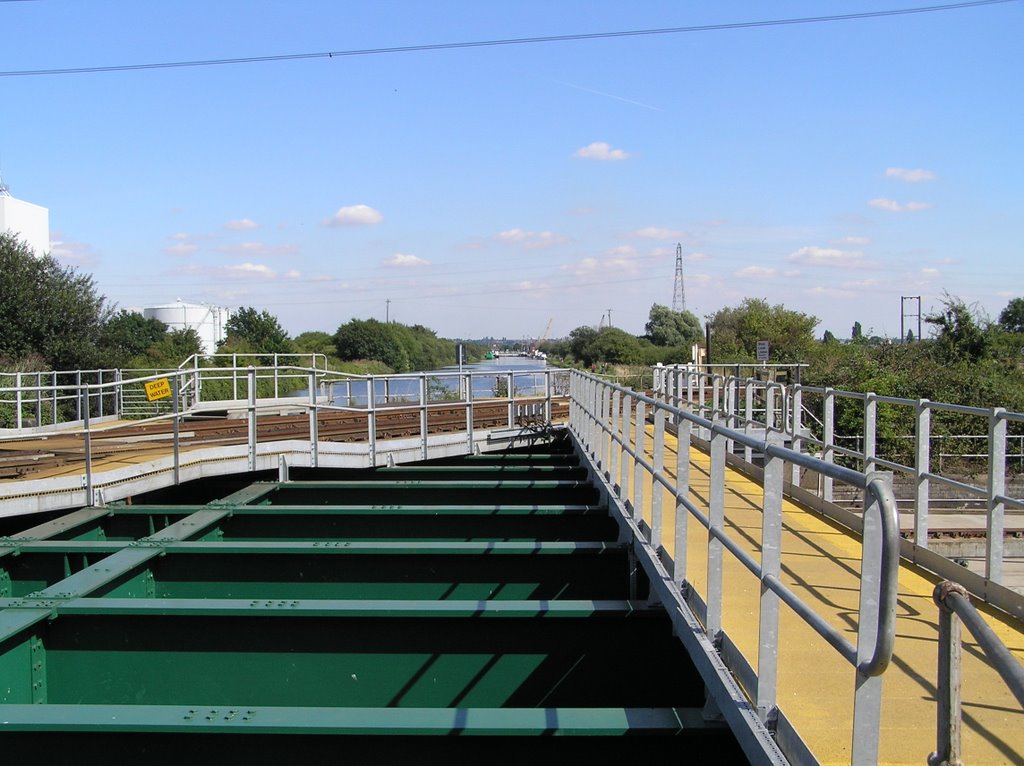
The Vazon Sliding Railway Bridge works by sliding open to allow boats on the Stainforth and Keadby canal to pass, before returning to its original position, enabling trains to continue with their journey. The crossing connects trains between Doncaster, Scunthorpe and the Lincolnshire coast and is a busy rail freight route. The sliding bridge is Britain’s only sliding railway bridge over a canal, with the original structure dating back to the 1860s.
Sensors on the structure alerted Network Rail teams to a a fault with its mechanism which involves a key component that allows the bridge to slide across the canal. The part needs replacing and a new one is now being specially made.
Prior to the maintenance work, the bridge was opened for boaters as required, but at the time of writing the bridge is only opened at 10pm each day, with no indication of when normal service will resume. One daily 10pm opening is not only potentially dangerous due to the need to cruise in the dark but takes no account of tides, further limiting the availability of navigation. The bridge is now illuminated and signed to aid boaters, but whilst this is welcome, raises the further concern that Network Rail are looking to make this one opening in 24 hours a permanent arrangement.
Navigation rights at the Vazon bridge precede the railway as the Stainforth & Keadby Canal was already in use when the rail line was built and are covered by Act of Parliament. IWA has asked for reassurance that, once these bridge repairs are completed, the rail bridge will return to its normal service of being opened for boaters when required, and when this service would be reinstated.
In the meantime, thanks are due to Celyn Winter and Callum Joinson, two members of the “Try the Trent” group, who have been helping boaters navigate through the rail bridge and the nearby road bridge since night time access was required a month ago.
Update: Keadby Bridge reopened on 24th September after engineers completed their investigations.
Fund Britain’s Waterways is a growing action group currently comprising 136 member organisations representing hundreds of thousands of users and supporters of inland waterways. Its sole purpose is to campaign collectively for an increase in government funding of Britain’s inland waterways to avert their decline, and to promote awareness of the huge economic, environmental and social well-being value they provide.
Our request to Government is that:
the importance of our inland waterways as a unique national asset and part of the national infrastructure is recognised;
the deterioration in condition that is already happening is acknowledged; and
a comprehensive review of Government funding for all our inland waterways should be carried out as a matter of urgency, with the aim of defining a sustainable funding solution which will enable the current benefits of our canals and rivers to be maintained and enhanced for future generations.
To fund our inland waterways properly would cost a small (in Government terms) investment measured in millions, not billions, of pounds. In return, the country would continue to obtain billions of pounds of benefits for health, economic and environmental benefits, much of those benefits being enjoyed in less well-off areas.
We are already seeing the waterways deteriorating and businesses suffering. Without urgent action the inland waterway network will be in serious jeopardy. If the condition of waterways continues to deteriorate, waterways will ultimately have to be closed, businesses will be harmed, communities placed at risk, the benefits lost, and millions of hours of volunteer effort wasted.
IWA is concerned that boaters have been trapped since September 2023, unable to pass through Glasson Dock because of a failure of the tidal gate that connects the Dock to the Sea, and a stand-off between the Port of Lancaster Commission which owns the gate, and the Environment Agency. The funding plight of navigation authorities in the area has been aggravated by the failure of a gate at the tidal end of the Ribble Link and a breach at Hollowforth Aqueduct, both of which are major works that will take months to fix at great expense. And boaters are, literally, stuck in the middle.
At Glasson Dock, the 38 year-old gate is currently stuck, and although it’s owned by the port, in 2001 the Environment Agency added an extension to the gate to make it a flood defence. The port is not responsible for flood defences for the area. No modifications were made to the supporting structures. Since then, the port maintained and operated the gate with minimal contribution from the Environment Agency. In recent years, the port has spent a fifth of its annual turnover maintaining the gate. Over three years ago the port informed the Environment Agency that the gate was beyond its lifespan and needed replacing and that the port could not afford to do this. The Agency confirmed that replacement funds were in its capital scheme budget.
Update October 2025 – The Lancaster canal is no longer isolated. The sea gate at the dock is still away for repair or replacement. Boats can use the basin lock and get out to sea, but there remains a problem is with high spring tides and flood risk to local population around the dock area. Ribble Link is fully back in operation and has been open for most of 2025 dependent, as always, on the weather and tides from April to September. Hollowforth Aqueduct has been fully repaired.
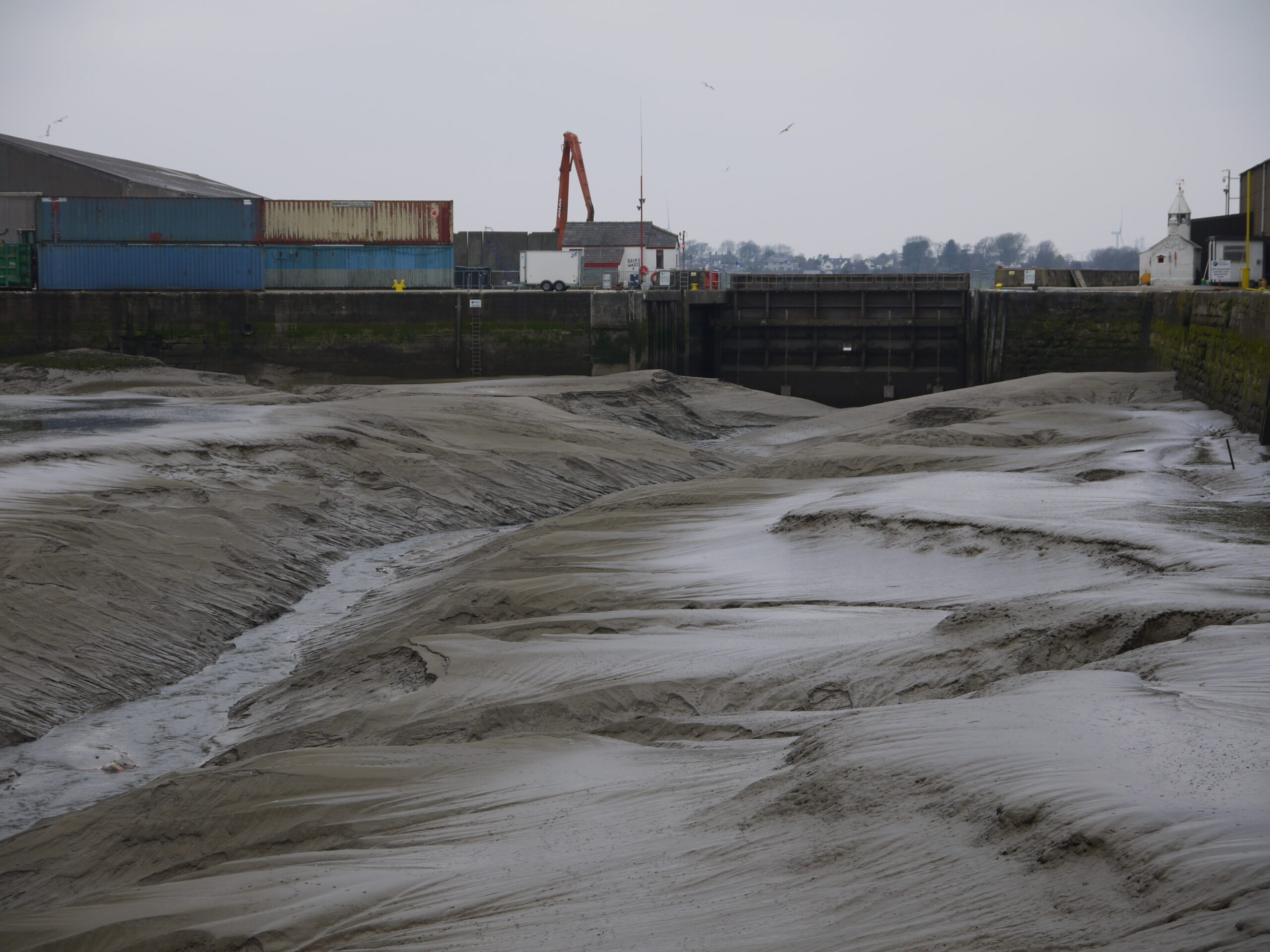
[The photo above shows Glasson Dock, with tide out but the sea gate still in place – taken in July 2024 – by David Faulkner.]
Restoration of the bridge was an amazing achievement, and facilitates further restoration of the Montgomery Canal. The work has been led by a volunteer group over the past 8 years. Originally intended to be volunteer-built at a cost of about £300,000 but, following the Covid pandemic, it was built by a contractor in 2023 at a cost of £1.1m – and that money was sourced through public appeal from individual and group donations and grants. The whole project was described by Shropshire’s Lord Lieutenant as, ‘an incredible job’.
What follows below is a slightly modified version of an article, by Martin Ludgate, that appears in Navvies 324. You can subscribe to Navvies here, from only £5 per annum.
Until around 1960 it was possible for boats to make a through journey east-west through the centre of Manchester. From the Bridgewater Canal at its Castlefield Basin terminus to the west of the city centre, the surviving one-mile length of the Rochdale Canal climbed through nine locks (the ‘Rochdale Nine’) to Ducie Street Basin. Beyond there, the main trans-Pennine length of the Rochdale Canal had been abandoned (with little hope of reopening), but the Ashton Canal turned right and climbed another 18 locks to Dukinfield Junction. Here the Huddersfield Canal (generally regarded as another hopeless case) continued straight ahead, but boats could turn right into the Lower Peak Forest Canal, then cross Marple Aqueduct and climb Marple Locks to join the Upper Peak Forest and Macclesfield canals. From there, the Macclesfield led to the Trent & Mersey, which in turn connected to the Bridgewater, completing a 100-mile circuit – which waterways supporters later dubbed the ‘Cheshire Ring’.
The popular Ware Boat Festival, run by IWA Lee & Stort Branch every year to coincide with the Ware Festival, organised by Ware Town Council, due to take place on the 5th to the 7th of July, has had to be cancelled at the last minute. Hertfordshire County Council has issued a closure order for a large section of the towpath on the River Lee through Ware, including the entire site on which the Festival was to be held.
The closure is on the grounds that the state of the towpath is now so dangerous as to constitute a danger to the public. Hertfordshire County Council has erected barriers at either end and entrances to the towpath to prevent public access, and anyone setting foot on the towpath could be liable to prosecution and a substantial fine. The towpath has been in a poor state for many years, deteriorating each year, and usually volunteers from IWA Lee & Stort Branch undertake a few days’ work to make things safe for the festival. The towpath, which is a public right of way, was assessed by Hertfordshire County Council’s contractors, Ringway, who identified 40 serious and dangerous issues, each of which could have been enough on their own to issue the closure order. Hertfordshire County Council say that the issues are so serious that they have no choice but to maintain the closure until substantial works are undertaken, as a matter of public safety.
The cost of the works is estimated at £100,000s, which Hertfordshire County Council will fund, as highways authority, but only when they have the budget as it has been classified as a ‘complex’ issue for a specialist team. There is no timescale for the work; IWA has asked for assurance the work would be complete before the 2025 festival, but this has not been forthcoming so far. The decision demonstrates a lack of multiagency partnership working, as no consultation with the town council, Canal & River Trust or IWA took place.
Craig Haslam of IWA Lee and Stort Branch said “This is a sad and disappointing day for our local boaters and the wider community of Ware after 20 years of staging this incredibly popular festival. We do not question the need for significant improvements. However, we feel this could have been achieved through a planned closure when footfall and river traffic is quieter, rather than electing for the blunt instrument of a full an immediate closure via a prohibition order which we believe is a disproportionate approach and was done with no consultation.”
The situation highlights the fragility of Britain’s inland waterways, and that it is not just boaters who are affected when the waterways are not funded and maintained adequately. The Fund Britain’s Waterways group has come together to campaign to persuade national and local government to ensure that the benefits provided to the public by the waterways do not continue to be eroded.
In support of Fund Britain’s Waterways (FBW), IWA asked boaters for their views on the state of the inland waterways network and how it impacted on their cruising in 2023. The boaters’ survey was intended both to provide a snapshot of current conditions and as a benchmark to enable the identification of future deterioration if funding continues to be inadequate. As with FBW, it covered all navigations in Britain, and it gathered crucial insight into various aspects such as condition of locks, depth of water, ease of mooring and provision of services.
726 boaters responded anonymously during March and painted a picture of declining condition since their previous cruises and in the long term over the total period that they had been boating. This really does back up FBW’s argument that our waterways are already deteriorating and action is needed urgently.
You can read the IWA press release about the results of the boaters’ survey here and a summary of the results here.
There have always been moorings of a fashion for commercial barges stopping at the Ferry Boat Inn en-route up or down the Trent. The Inn dates from 1823.
From the 1950s to the 1970s, the moorings and associated concrete slipway were maintained by a local sailing club based on the river, but when the sailing club ceased operation at the site just over 40 years ago, the timber and concrete moorings fell into disrepair with only ad hoc repairs carried out by local boaters.
There was a foot ferry across the river by the moorings, to Shelford on the opposite bank. The ferry ceased operation in around the 1950s, but the steps and slipway either side are still present.
The Ferry is an ancient one, being referred to as far back as the year 1275 when it “yielded a mark yearly”.
With a shortage of visitor moorings on the River Trent, local boaters from the Facebook group “Visitor Moorings on the River Trent & Associated Waterways”, led by Robert Aspey (now IWA Nottinghamshire Trent Group Moorings Officer), met on site in 2018 to see what could be done to repair these dilapidated visitor moorings. They were now in a dangerous condition with many planks missing from the fixed timber pontoon, only one mooring ring still present, and overgrowth over the whole site.
When contacted, Canal & River Trust and the brewery that owned the Ferry Boat Inn said they did not know who owned the moorings. Eventually, Severn Trent Water were tracked down as the owners of the freehold. One of their managers agreed to meet the group on site and thanked them for pointing out the poor state of the timber moorings, as the water company would have been liable for any accidents.
[The photos show the moorings at Stoke Bardolph – by Robert Aspey]
IWA is deeply concerned about the double effect of funding cuts and the recent prolonged extreme weather on access to and within the Anglian waterways.
Boaters are unable to navigate to or from the Great Ouse, as there is no completion date for the desilting works at Salter’s Lode, which did not start until 27th May. It could be mid-June or later before the first boat from the Middle Level and beyond will be able to access the Great Ouse system, and for Great Ouse boaters wishing to use their Anglian Pass licences to access the Middle Levels and Nene. The impact of the stoppage is already being felt by local boatyards and hireboat companies, whose trade relies on the navigable connection.
The River Nene is expected to open fully on 1st June after winter works were delayed by the recent extreme weather and navigation on the Bedford Ouse is also affected by the ongoing closure of Brownshill Lock due to failure of parts which will need to be fabricated, with no date yet available for its reopening due to the complex nature of the repair. Further upstream, the Cam Conservators have had to close both Bait’s Bite and Jesus Locks due to structural concerns, with no timescales yet available for their reopening. Brandon Lock on the Little Ouse is also closed until further notice due to siltation. A broken beam on the Northampton flight connecting the canal system to the River Nene further limits access to the region.
The Upper Great Ouse, the Ely Ouse and the Middle Levels are currently all isolated from one another, and no boats are able to get to the extremities of the Ely Ouse’s tributaries at Cambridge or Brandon. Whilst the waterways are open either side of all these closures, they create a fragmented system with users prevented from accessing key facilities and services, and hire boats trapped.
Paula Syred from Fox Narrowboats in March said “Not only will half of our hire season have been affected, we have also seen a major down turn in our workshop and slipway services as customers have had to cancel or reschedule their work, being unable to reach us. The only growth in business this year has been from boats being lifted onto lorries to escape the area.”
Sue O’Hare, Chair of IWA’s Navigation Committee said “Combined with inadequate funding, issues such as these will only worsen as the impacts of climate change are increasingly felt. The Fund Britain’s Waterways group has come together to campaign to persuade national and local government to ensure that the benefits provided to the public by the waterways do not continue to be eroded.”
The Environment Agency was approached for a response but was unable to comment in the pre-election period.
The Group’s objective is to make ‘subsidised’ HVO readily available, at an affordable price to ALL recreational boaters and not just limited to the inland waterways (Category A, B and non-tidal Category C waters, as designated by Marine Shipping Notice No 137) – as is currently the case. At present craft operating in tidal waters cannot benefit from Road Transport Fuel Certificates (RTFCs) two of which are applied to every litre of HVO sold to qualifying craft. Their value varies but they are currently worth £0.17 each, so a litre of HVO effectively attracts ‘subsidy’ of £0.34.
Volatility in pricing is a real concern and does nothing to encourage boatyards and marinas to stock the fuel. In early April 2024, the wholesale price of HVO was only £0.12 (12%) greater than gas oil (red diesel) per litre, but by early May that differential was more like 50%. This is believed to be largely down to fluctuations in commodity markets as fuel prices themselves vary, alongside the raw materials (or feedstock) which are quite separately governed by the agricultural commodity market.
Manipulating the value of an RTFC would, in theory, represent a government ‘device’ for controlling this volatility but with their current low value there is limited room for (pricing) manoeuvre. Two years ago an RTFC was worth £0.42 so, with an effective subsidy of £0.84 attached to each litre of HVO sold, there was ample room to make an external impact. Those in the fuel industry are therefore suggesting that the time has come to revisit Hydrocarbon Oil Duties Act 1979 – the Act that laid down our current fuel duty mechanisms: https://www.gov.uk/hmrc-internal-manuals/oils-technical-manual/hcoteg31000.
The HVO Joint Working Group is currently building a case for RTFC application to all recreational boating around demonstrating that the consumption of diesel fuel (and potentially, HVO should it be made affordable) is extremely small and will therefore have little effect on revenue for HMRC. In addition, we are pointing out that this sector has few other alternatives to decarbonising as the biofuels allocated to both the Coastal and Deep Sea Maritime sectors are inappropriate for recreational boat users.
Furthermore, the sea-going recreational sector depends upon reliable fuelling of their diesel engines, which may well still have a long life ahead of them, making scrapping an environmentally undesirable, unrealistic and an extremely expensive option. The emphasis on ‘reliable’ being a reference to problems with ‘diesel bug’ (and associated mechanical issues) exacerbated by the FAME content of mineral diesel on sale in marinas and boatyards.
HVO sold in the UK is currently supplied by Neste and manufactured in Rotterdam. It is shipped to Stanlow (supplying Crown Oil and it’s agents and subsidiaries) and to Dagenham from where it is distributed by Certas. It has been mooted that with the refinery element of Grangemouth closing down, Neste (or one of its competitors) should be encouraged to establish an UK HVO manufacturing plant on the site.
Finally, taking the bigger picture, the limiting of RTFC-eligibility to vessels plying Category A, B and non-tidal Category C waters is having a negative environmental impact on commercial carrying on the inland waterways, where many craft are transporting bulk cargoes, on tidal rivers into UK towns and cities, where air quality is at a premium. The Rivers Thames and Medway being good examples as, indeed, could be the Rivers Clyde and Tay.
Not only is HVO 90% carbon neutral, it’s polluting nitrogen oxides and particulate emissions are substantially reduced, so there are consequently significant health benefits (apart from the obvious carbon reduction) to be gained where water-borne traffic interfaces with dense populations.
The Department for Transport has told IWA that it intends to put out a Call for Evidence around maritime biofuel use, but as yet the Department has offered no time scales. To this end, the Group’s energies are predominantly focused on establishing usage data and general fact gathering in the belief that further, individual approaches to the Department, will only be referred to this upcoming consultation process.
If you don’t have a permanent mooring you can use as an address, you can choose to register at either:
a place where you spend most of your time
or where have some connection e.g where your family or friends live
You could register at the place where you were last permanently registered to vote. Alternatively, you could register at somewhere like the boatyard you use for maintenance for example. It’s worth bearing in mind that if the address you use to register to vote is not the same as the one you use for banking this could impact your credit rating.
To register to vote in this way, you’ll need to download and complete a form for someone with no fixed or permanent address.
Filling in your form The application form includes instructions on how to fill it in correctly.
When you fill in the form, you’ll be able to say how you want to receive information about your registration. You can collect it from the electoral services team at the local council for the address you’re registering at, or have it delivered to an address you provide.
Where to send your completed form Once you have completed the form and made sure you have signed it, you need to send it to the electoral services team at the local council for the address you’re registering at.
You can send your form by post. The electoral services team at your local council may also accept a scanned copy of your form by email, but you should check with them first.
Don’t forget you now need need Photo ID to vote, but it doesn’t need tomatch your address, just your name. Find out more here.
Postal and Proxy Voting
These methods can be useful if you are unable to get to the polling station where you are registered. The deadlines for these are:
The Inland Waterway Association’s annual celebration of the waterways in London took place over the first May bank holiday from Saturday 4th to Monday 6th May. Little Venice was once again transformed into a vibrant spectacle of colour and vitality as over 100 boats arrived from far and wide, and visitors from all walks of life came together to share their passion for waterways. This annual gathering saw almost 10,000 visitors on the first day, with a similar number joining on an equally sunny day on Sunday. Even the torrential rain on the bank holiday Monday did little to dampen the buzz.
There really was something for everyone with narrowboats, both modern and historic, moored alongside widebeam boats in the Pool. Continuous cruisers, liveaboards, and leisure boaters, local residents and those from further afield gathered to celebrate the waterways and highlight the importance of the theme of this year’s Cavalcade, “Funding Britain’s Waterways”. The theme reflected the widespread recognition that what we know and love about the waterways network is under threat, with the government’s decision to curtail funding for Canal & River Trust and the increased operational and inflationary demands on navigation authorities nationwide. It was encouraging to see many boaters proudly flying Fund Britain’s Waterways flags and sporting FBW banners on the sides of their boats.
The event was officially opened by the VIP party led by the Lord Mayor of Westminster, Councillor Patricia McAllister who was joined by Councillor Geoff Barraclough, Cabinet Member for Planning and Economic Development at Westminster City Council, Richard Parry, CEO of Canal & River Trust, and Mike Wills, National Chair of IWA, Libby Bradshaw, Ceremonial and Children’s Activities Manager for the event, and Paul Rodgers, Event Director and Chair of the organising committee.
The Lord Mayor welcomed everyone to the City of Westminster and thanked IWA for organising the event. Following brief speeches and a resounding round of applause from the thousands of visitors lining the towpath to thank the over 100 volunteers who help put on the event, the Lord Mayor was invited to ring the bell to formally open the festival. This was echoed by cheers around the Pool, the ringing of bells and horns, and the start of the Pageant.
The long weekend included a packed schedule, as always, with a unique selection of events and activities. Stallholders and food stands brought a variety of crafts and interest to the event this year, many being based locally to Little Venice. Particular highlights included many regular attendees such as hand-woven baskets made by WoodWoolWillow, Peruvian delights by Inkas Craft, Handmade by Janet, and our regular Candle Powered Victorian Steamboats. Visitors were treated to many delicious treats too, including the vibrant Caribbean Hut, flavourful Moroccan cuisine from Harissa & Lemon, and of course plenty of ice cream which proved to be popular whatever the weather! As in previous years, we welcomed the ever-professional Jervis team and their real ale bar which provided the perfect place to enjoy a break in the sunshine – and shelter during the rain!
One of the most popular destinations in Rembrandt Gardens was the Wild over Waterways marquee, which offered a range of activities to keep the little ones entertained and spark their curiosity in the waterways. Children and adults alike were entertained by whimsical performances from the ‘Suitcase Circus’ aboard the Puppet Barge. Faces were being painted and there was plenty of learning and joviality in the marquee over the weekend. Sunday saw the return of the much-loved Teddy Bears’ picnic in the beautiful surrounds of the gardens while activities for older children and young people were led by the Pirate Castle from Camden, with paddle sports taking place across the weekend.
Whilst the theme of this year’s event focused on the existential threat to the waterways nationally, the event also continued its tradition of engaging with the local community. One way of doing this is through the Schools Art Exhibition which featured a range of impressive art projects from local schools. The message that our waterways should be saved for the enjoyment of all came through loud and clear in the creative and collaborative efforts of younger canal fans.
This year’s Event Director, Paul Rodgers, who joined the organising committee for the first time this year, expressed his thanks to the team of volunteers without whom the event would not be possible. Over 100 volunteers were mobilised to deliver this year’s event both in the planning process and the hugely demanding logistical deployment on the ground. This included the experienced team from IWA’s Waterway Recovery Group, more commonly seen across the country supporting canal restoration projects, who transformed Little Venice and the surrounding area in the week before the event.
Collaboration with partners is also crucial to the success of the event with Canal & River Trust, Paddington Central and Westminster City Council taking the lead in a demonstration of what can be achieved when waterways charities, businesses, government, and the many supporters of the event come together.
This year the evenings brought a vibrant celebration of boating too. Friday night was the regular quiz, a packed tent for our annual Martin Ludgate extravaganza – raising nearly £100 from the raffle for IWA. Saturday night once again saw an open mic night in the bar, compered by Mark Saxon. On Sunday evening, Craig Haslam once again excelled as Master of Ceremonies for the Procession of Illuminated Boats, where the boaters covered their craft with as many lights as would fit to the delight of hundreds of spectators standing on the Horse Bridge and around the Pool. thrilled everyone who saw their performances and we thank them so much for their participation.
On Monday afternoon, the awards were presented by John Edmonds, Vice President of IWA London Region. The award winners for 2024 were:
Marcus Boudier Trophy
For the best decorated privately entered boat in Saturday’s themed Pageant, was awarded to Galatee owned by Simon Hodgkinson & Sarah LaBrasca of Slash Arts & Canal Dream CIC
The Ray Dunford Buckby Can Trophy
For the best decorated boat entered by a waterway or community group:
Not awarded
The Cruise Electric Trophy
For the best illuminated boat in Sunday evening’s Procession:
Tros Yr Afon, steerer Phil Gaskell
Runner up: Galatee, owned by Simon Hodgkinson & Sarah LaBrasca of Slash Arts & Canal Dream CIC
The Graham Capelin Award
For the best entry by a boater who has not previously taken part in either the Saturday Pageant or Illuminated Boats:
Purple Emperor, owned by Ian Marr
The Westminster Trophy
Donated by the City of Westminster for the winner of the Boat Handling Competition:
Iquitos, steerer Mike Moore
Runner up: Fulbourne, steerer Robin Hendley
3rd place: Middlesex, steerer Tim Lewis
The Roger Squires Trophy
Presented by St Pancras Cruising Club in recognition of Roger’s ten years as their Commodore, it is awarded to the best novice competitor in the Boat Handling Competition:
Purple Emperor, steerer Ian Marr
The Mike Stevens Memorial Trophy
Goes to the ‘Best Boat’ at Canalway Cavalcade, selected from all the boat entries at the event, it is awarded in recognition of Mike’s outstanding contribution to IWA and Canalway Cavalcade during his lifetime:
Lion, owned by Michael Pinnock
The Idle Women Shield
Sponsored by Jan Knox, proprietor of Canal Experience Training School, the shield was awarded to Thisuldo, steered by Charlotte Trimby
Runner up: Badger, steered by Naomi Goldsmith
3rd place: Free Bird, steered by Cath Jennings
The Vic Trott Memorial Trophy
Awarded for the best Boaters’ Sunday Best costume. This year, it was awarded to Hannah Maude (Iquitos).
Mike Wills, IWA National Chair, underscored the value of members, volunteers and partners in the many activities that IWA is involved in, saying:
We need your help! If you have enjoyed your experience at Cavalcade, tell others about it. Financial support is also welcome so, it the spirit of our theme this year, please donate some money! Even more importantly, consider donating some time to IWA. There are opportunities to gain hands on experience of waterway restoration, or maybe just to offer your experience, knowledge, and skills to the many areas in which we are engaged.
Plans are already underway for next year’s Canalway Cavalcade which is planned for 3rd, 4th, and 5th May 2025 and the team will welcome offers to volunteer for both the planning committee and at next year’s event.
Join the Committee
Do you love Canalway Cavalcade and would like to be a part of the team behind the scenes?
We are incredibly thankful for all of their hard work and dedication as a huge amount of effort goes into organising an event of this scale. We need to fill several vacancies on our organising committee.
There is already a superb team in place but we need extra support to make sure no one becomes overloaded. Having the organising committee at full capacity will ensure that Canalway Cavalcade remains a really fun and interesting event to be involved with!
All vacancies are voluntary roles. Meetings are held once a month on Zoom and become more frequent in the run up to the event.
If you fancy getting involved, please contact us with a short description of your experience/interests.
The 2024 Annual Waterways Restoration Conference was held in the Creative Hub at Northampton University, attracting over 100 delegates on a sunny Saturday in April. The event, which is jointly organised by the Inland Waterways Association and Canal & River Trust, was opened by Julie Sharman (Chief Operating Officer at Canal & River Trust). The theme this year focused on inclusion, collaboration, training, skills and sustainable planning.
Keynote speakers included Eoin Harris of Canal & River Trust who spoke on the topic of environmental constraints and opportunities in restoration projects. Eoin’s presentation inspired some thoughtful actions that trusts and societies can take moving forward to ensure that their projects comply with legislation and they take advantage of any opportunities created by their development work.
Eoin was followed by Mark Bevan and Francis Holden of Kuso Construction, who specialise in temporary works and were able to provide clarity on the topic and explain some of the basic lower-level tasks that are involved in temporary works. During the presentation, they provided examples of how people often fail to meet standards and the consequences of these standards not being met. A lively Q&A session ensued after their talk.
The final speaker of the afternoon was Mike Palmer, of IWA’s Waterway Recovery Group, who talked of the importance of real skills training in the practical activities undertaken by restoration groups. He also explained where and how the organisations can help and support them. Mike mentioned the new Practical Restoration Handbook which is due to be launched and explained other ways that IWA/WRG aim to lead on best practice within the inland waterways restoration sector. During the presentation, George Rogers of Chesterfield Canal Trust gave attendees a glimpse of what might be in store for next year’s Canal Camps. He is working closely with the sites team, and they are starting to talk to any group who may be interested in the possibility of holding a camp at their site in 2025.
Delegates also had the opportunity to participate in two of the following workshops:
Mental and physical challenges in restoration volunteering – Claire Cavender (Buckingham Canal Society) and Jenny Hodson (IWA)
Creating capacity for restoration – Chris Madge (Derby and Sandiacre Canal Trust), George Rogers (Chesterfield Canal Trust), Terry Cavender (Buckingham Canal Society), and the IWA Restoration Hub High Level Panel
Diversifying your volunteer base – Jenny Hodson (IWA) and Darren Starling (Canal & River Trust)
Campaign and membership management within a small team – Lisa Mant (Cotswold Canals Trust)
This year, rather than a post-conference tour of a local restoration project, attendees took part in a walk around the local area during lunchtime which was led by John Pomfret. It also involved a display by members of the Canal & River Trust hydrology team who demonstrated their flume tank. After the walk, delegates watched a webinar and YouTube footage from the Angling Trust on invasive species clearance and also had time to network and share best practice tips with one another.
Attendees than enjoyed a brief update on the Fund Britain’s Waterways campaign followed by a closing speech by IWA National Chair, Mike Wills.
We would like to thank Paul Rodgers for his excellent compèring of the event, the wonderful volunteers on the reception desk and in the car park, IWA Northampton Branch for their overall support, and Terry from Buckingham Canal Society for his support in the buildup to the event. Also thank you to everyone who attended on the day, we hope you got as much out of it as we, the organisers, did. We look forward to seeing you again next year at a new venue, with fresh topics inspired by the restoration field. Dates, venues and topics will be decided as soon as the team have had a chance to review the feedback from this year’s event and your suggestions for future ones.
Judged by photographers Kevin Maslin, Joe Dixey, Nicola Turner and Bobby MacKenzie.
We were delighted to receive over 150 entries to the 2023 photography competition! Amateur and professional photographers alike took part, and we received some fantastic photographs featuring Britain’s canals and rivers. Some photographs were taken using digital cameras whereas others used mobile phones. Significant advancements in technology have made photography a lot more accessible, which is good as it allows people from all walks of life to participate in competitions such as ours.
Photographs were submitted to the following four categories:
Our judging panel consisted of four exceptional waterways photographers, including Kevin Maslin who judged the competition in both 2022 and 2023. Kevin runs photography walks along the canal and his work has featured in BBC Wildlife and Waterways World magazines, as well as in the popular GeoProjects maps. He is a passionate supporter of the waterways and has attended a number of recent campaigning events including the Fund Britain’s Waterways (FBW) Campaign Cruises in Birmingham and Westminster last year. Kevin has very kindly given us permission to use these photographs in our FBW campaigning materials and elsewhere, such as on the front cover of the Spring 2024 edition of Waterways magazine, for which we are incredibly grateful.
We are also delighted to welcome Joe Dixey to our judging panel this year. Joe is a London-based portrait and documentary photographer who has worked with award-winning photographers such as Ewen Spencer and Phil Sharp. Joe’s photography combines authenticity and artistic skills to produce images that are unique and engaging as demonstrated by the photographs Joe captures at our events. Joe regularly photographs our annual Canalway Cavalcade event in Little Venice and also photographed our 2023 Festival of Water in Pelsall last year.
Joe and Kevin are joined by guest judge Nicola Turner; the winner of our 2022 Photography Competition. Her image of Marple on the Peak Forest Canal was chosen as the winning entry in the competition. After being shortlisted as the judge’s favourite from the British Waterscapes category, Nicola’s photograph beat over 300 entries to be crowned the overall winner of the competition.
Bobby Mackenzie completed the judging panel as our first ever young photography judge. Thirteen-year-old Bobby is one of the ‘Bluebells’, a family of four who live and continuously cruise on their narrowboat named Bluebell. Bobby and his family share their adventures through social media where they have built an impressive following under the name ‘by Bike & Boat’. Bobby is a keen waterways photographer who has captured an impressive selection of images while cruising with his family. We invited Bobby to take part on the judging panel this year in the hope that it may encourage the next generation to take to the towpaths and capture the incredible beauty of our waterways in their photography!
Congratulations to each of the category winners who will all receive £25 to spend in our online shop, plus IWA goodies. Please also join us in congratulating the overall 2023 Photography Competition winner: Nigel Essery, who submitted his photograph of Baswich on the Staffordshire & Worcestershire Canal to the ‘Working Waterways’ category. Nigel will receive a print of his photo. A massive thank you to our judges: Kevin Maslin, Joe Dixey, Nicola Turner and Bobby MacKenzie, for judging the competition – and to everyone who entered. We hope you will enjoy seeing your photographs if they are used in our marketing materials, and that you are looking forward to our 2024 Photography Competition which will open later this year!
WORKING WATERWAYS – overall Photography competition winner
This is a great composition, with the orientation of the boat leading the eye into the photograph to focus on the man steering the boat. The subject of the photo is well framed with plenty of space around the boat and good light and colour in the photo. The colour of the surrounding vegetation contrasts well with the colours of the boat.
It’s clearly a working canal boat and both the boat and the man are characterful and interesting. A really attractive photo.
Although I’ve chosen this photo as the winner in the ‘Working Waterways’ category, the photographer submitted several other very strong entries in this category.
– Nicola Turner
PEOPLE OF THE WATERWAYS
Locking into teamwork at Milby Lock, Boroughbridge – Mervin Straughan
I selected this photo as it has an old-world charm to it, reminiscent of old paintings that depict people working in the landscape. It showcases the human aspect of the canal, reminding us that despite being a place for leisure, it still requires a lot of effort and dedication.
– Joe Dixey
PROTECT OUR WATERWAYS
This was a difficult category to judge, but I do accept that it wasn’t an easy one to interpret. Broadly speaking the entries needed to demonstrate how various man made and natural occurrences can have an adverse effect on the appearance, safety and attractiveness of our waterways.
Now I love old waterside buildings, as they give a sense of history, but when they fall into disrepair and become a potential navigation hazard, such as the former Hat Factory at Atherstone, the outlook becomes entirely different.
I like Marilyn Farmer’s image for two distinct qualities. Firstly, the reflection of the building in the water is full height. There can be a tendency to crop. Secondly the vivid high contrast blue sky is also reflected perfectly. It was clearly taken from onboard a boat and the only thing I would have done differently would have been to lose the handrail in the bottom left corner. But it’s a minor detail that could well have affected the composition as a whole and doesn’t detract from an otherwise excellent picture.
– Kevin Maslin
Hat Factory at Atherstone – Marilyn Farmer
River Wear – Taha Tariq
URBAN WILDLIFE
Our first ever ‘young photography judge’, Bobby Mackenzie, selected this photograph from Taha Tariq as the winner in the ‘Urban Wildlife’ category which contained over thirty entries. Taha’s photograph features the River Wear which crosses the city of Durham and passes alongside Durham University.
Denver Sluice and Lock on the Great Ouse are owned and managed by the Environment Agency (EA). Salter’s Lode Sluice and Lock are owned and managed by the Middle Level Commissioners. Transit between Denver Sluice and Salter’s Lode allows access to the Great Ouse, the river Cam, and the rivers Lark, Little Ouse, and Wissey. The Denver crossing is now effectively closed and the only navigable connection between the Great Ouse and the rest of the ‘system’ is by the difficult and hazardous Wash crossing (until the Bedford / Milton Keynes link progresses).
After Christmas 2023, the Middle Level Commissioners (MLC) dredged Salter’s Lode lock. This necessitated removing over 250 tons of silt from inside the lock. There is a considerable build up of silt outside the lock, on the tidal Great Ouse managed by the EA. MLC are concerned that as soon as they open the tidal doors of Salter’s Lode it will immediately be filled with silt from the tidal Great Ouse, and so they have closed the lock until the EA dredge outside it.
At a recent meeting of its Anglian Water Group (AWG), EA reported this to stakeholders, but currently the EA has no plans to dredge! The link between the Great Ouse and the Middle Level now appears indefinitely closed until one or other of the navigation authorities gives in. This closes off approximately 130 miles of navigation, affects hundreds of leisure boats and prevents access from the connected navigable system to places such as Bedford and Cambridge.
During April 2023, contractors for EA dredged outside Denver (photo 1 below). Rather than removing arisings, they threw it back out into river (in the hope it would wash out to sea), and there was subsequently heavy siltation experienced downstream at the first bend in the river (photos 2 and 3 below). This blocked the outfall of the Old Bedford River and caused several hire boat groundings on the tidal side of Salter’s Lode. It appears that MLC feel that EA caused this sudden and dramatic increase in rate of siltation affecting Salter’s Lode, and are waiting for EA to do something about it on ‘their side’.
Sue O’Hare, IWA deputy national chair, said “We are appalled that boaters are left stranded through no fault of their own, and that businesses are left to count their losses because of the Environment Agency’s inaction. We sympathise with the Middle Level Commissioners’ wish to keep their lock clear of silt and functioning correctly for its dual purposes of navigation and flood protection for local communities, and we sympathise with the Environment Agency at having to deal with over double the usual monthly rainfall in this area so far this year, but the Agency has a legal duty to keep the waterway open for navigation.”
A Spokesperson for the Environment Agency said: “We have been and will continue to progress plans for the clearance of the blockages caused by the build-up of silt in the tidal river at Denver Lock and Salters Lode within the scope of our available budget.”
“There have been delays across all our navigation works programme as a direct result of the weather and subsequent river conditions. We will continue to work with our delivery partners to resolve the situation as soon as we can. Updates will be provided on our navigation notices which can be found at our Visit Anglian Waterways webpages.”
[The title photo shows silting at Salters Lode in early March 2024 – by Paul Burrows of the Middle Level Commissioners]
As part of IWA’s work in support of the multi-organisation Fund Britain’s Waterways (FBW) campaign, a survey has been launched aimed at gathering crucial insights from boaters regarding their experiences while cruising in 2023. This initiative is a vital component of FBW’s ongoing campaign to secure funding for all waterways and navigation authorities across Great Britain.
The survey seeks to understand the nuances of boaters’ experiences, focusing on the impact of various aspects of waterway conditions on their enjoyment and the ability to complete planned routes within the allotted time. Boaters are encouraged to share both positive and negative experiences, highlighting instances such as efficiently resolved stoppages.
“This survey serves as a pivotal tool in our campaign,” said Sue O’Hare, Deputy Chair of IWA. “Not only will it provide us with valuable insights into the recent condition of our waterways, but it will also establish a benchmark for future assessments, particularly in the event of potential funding reductions.”
Boaters are urged to participate in the survey, which can be accessed via the following link www.waterways.org.uk/boater-survey. The survey guarantees anonymity, ensuring that the data collected remains confidential.
The survey is open until Friday 29th March 2024. Results are planned for public release in Spring 2024 and will be shared with navigation authorities to inform decision-making and resource allocation.
To ensure widespread participation, boaters are encouraged to share the survey link widely within the boating community.
As part of the Strategic Review announced at the 2023 AGM, members and corporate members were invited to give their opinions on:
What is important to you.
The unique position that IWA holds.
How to get our message across.
What we need to do more of.
What we could do less of.
Our future priorities.
How members engage with IWA and vice-versa.
How to recruit more members.
The enhanced roles that volunteers could play in the future.
The survey ran from 27 November to 12 December 2023. It was sent to IWA members under legitimate interest for research purposes. It was anonymous so the data collected was not personally identifiable data.
6086 members received the survey – 5187 by email (260 failures) and 1159 by post – and were given web links to the Member Survey and the Corporate Member Survey.
There were 1228 responses to the Member Survey giving a response rate of 20% (although some joint members may have made individual responses which could have inflated this figure). A 2021 survey response was 13%.
There were 18 responses to the Corporate Member Survey out of the 321 Corporate Members. These responses contained some helpful comments but it was felt that there were insufficient responses to make any meaningful conclusions. IWA will be following up with a different form of consultation.
There were a tiny number of issues for respondents using iPads – paper copies of the survey were supplied where requested.
The full results are shown here and also in the Spring 2024 edition of the Association’s members’ magazine Waterways.
IWA has sharply criticised a lazy proposal by Government body Natural Resources Wales (NRW) that says it is considering demolishing Aberdulais Aqueduct, which carries the Tennant Canal over the River Neath.
In a low-key consultation quietly issued by the Welsh Government quango, NRW lists five options for spending millions of pounds to reduce the flood risk for 27 properties alongside the river Neath, which have a long history of flooding. Two of the options, believed to be favoured by NRW, involve complete or partial demolition of Aberdulais Aqueduct, which would forever frustrate restoration proposals to bring the Neath and Tennant canals back to life as well as impacting the wellbeing, environmental and heritage benefits provided by the Canal.
The Aberdulais Aqueduct is a Scheduled Ancient Monument that spans the River Neath immediately south of the A465 in Aberdulais. The structure is located approximately two miles north-east of Neath. It consists of a 104-metre-long structure comprising ten arches of overall length 66 metres bridging over the River Neath and a retained section extending a further 28 metres on the east bank of the River. The aqueduct is of masonry construction and the condition of the structure has deteriorated significantly over the years since navigation ceased nearly a hundred years ago. The Aqueduct historically formed a navigable link between the Tennant and Neath Canals and was constructed to also cross over an old 1750s navigable cut on the eastern side of the river. Construction of the aqueduct began in 1823, and it was formally opened in May 1824.
The aqueduct lies about 80 metres to the south of the confluence between the River Dulais and the River Neath. Just south of the confluence of the rivers a weir is located from which water is abstracted to supply the Tennant Canal. This weir has failed, and Natural Resources Wales has proved uncooperative in approving its repair, leading to the Tennant Canal being nearly dry in recent years, with damage to the environment and loss of wildlife from the Canal.
In times of flooding, the Aberdulais Aqueduct is perceived as an obstruction to the flow of the river. Flooding of the adjacent land and properties has occurred on several occasions. The properties in Canal Side have a long history of flooding, with damaging events in December 1979 and October 1998. In recent years, climate change has worsened the situation and floods have become more regular, with damage to the aqueduct. A structural inspection report commissioned by IWA’s Waterway Recovery Group in December 2021 showed that urgent works were required to prevent further damage to the Ancient Monument, but nothing has been done so far. In its consultation, Natural Resources Wales admits that demolition of the aqueduct would have relatively little impact in reducing floods, but the local view is that NRW would like to demolish the aqueduct so it can be seen to be doing something.
IWA Deputy Chair Sue O’Hare said “Whilst the Inland Waterways Association has every sympathy with the residents of Canal Side, demolishing one of Wales’s renowned historic structures would be nothing short of bureaucratic vandalism while not achieving the aim of significantly reducing the flood risk. Over the years a great deal of voluntary effort and public money has gone into bringing the Neath Canal back to life for the benefit of the community. IWA calls upon the owners of the Neath and Tennant Canals (St Modwen and Port Tennant Canal Company), Neath Port Talbot Council and the government agencies concerned to work together to rescue this precious piece of heritage and amenity for the benefit of future Welsh generations.”
National Resources Wales’s consultation, which closes on 26th February is at https://bit.ly/AberdulaisENG. The consultation conveniently omits any mention that the Aqueduct is a Scheduled Ancient Monument, or any historical background or its purpose. Rather, it just suggests demolition as if the Aqueduct were just some pile of inconveniently discarded rubble. The consultation does admit, however, that even if the aqueduct were to be demolished, that it would “unlikely to be able to remove the flood risk to the Aberdulais community entirely”. Alternative, albeit possibly more expensive, measures of making properties more flood-resilient, appear not to have been considered. However, the consultation does admit that “Additional measures (necessary) are likely to take a whole catchment approach and may include improved warning and informing, nature based solutions as well as engineered defences.”
FBW was launched at the end of June 2023 in response to the inadequate funding and deteriorating state of Britain’s network of canals and navigable rivers. Despite the widespread appreciation of the value of this unique and well-loved national asset and the benefits it delivers, the Government appears intent on significantly reducing its funding. Through FBW, more than 110 organisations, including IWA as a member of its steering group, are campaigning together for national and local government to act now and protect the public benefit and natural capital of our waterways.
FBW’s activities to date have focused on raising awareness of the challenges facing our canals and rivers and the message that increased and sustainable funding is needed. Three well-reported Campaign Cruises were held in 2023 in Birmingham, Gloucester and past the Palace of Westminster on the Thames. In 2024, there will be a weekend of action over the May Day Bank Holiday weekend (4th to 6th May 2024). This will comprise a series of events across the country on waterways managed by different inland navigation authorities, in addition to IWA’s annual Canalway Cavalcade at Litle Venice in London. It will culminate in a second Campaign Cruise past the Houses of Parliament on Wednesday 8th May, when Parliamentarians will be invited to view the event and express their support for the continued maintenance of the waterways.
At the same time as campaigning for increased funding for navigation authorities, FBW recognises the importance of those navigation authorities being able to explain how they are making the best possible use of funds for the waterways. FBW will therefore be holding sessions with major navigation authorities, starting with the Canal & River Trust on Wednesday 10th April 2024.
The sessions will be chaired by FBW and live streamed to FBW members, with a recording and writen notes of the meeting to be made publicly available at a later date. FBW members are invited to submit detailed writen questions, which will be collated and submited to each navigation authority two weeks in advance of its meeting. FBW will then ask the questions in the meeting and the navigation authority will provide detailed answers, both in person in the meeting and also in writing.
Les Etheridge, Chair of FBW, and recently retired IWA national chair, said: “By arranging these sessions we are enabling FBW members to ask questions on any area including those where reservations are publicly expressed. These will be positive and constructive sessions which we hope will benefit both the navigation authority and FBW.”
FBW members who would like to submit a question for the Canal & River Trust session can send it by email to info@fundbritainswaterways.org.uk by 13 March 2024.
Since its launch at the end of June 2023, Fund Britain’s Waterways (FBW) has created an impressive coalition of member organisations totalling well over one hundred, representing hundreds of thousands of users and supporters of inland waterways. A public petition has attracted close to 50,000 signatures. Three well-reported Campaign Cruises in Birmingham, Gloucester and past the Palace of Westminster on the Thames have substantially raised awareness of the challenges facing our canals and rivers and the need for action. IWA has played a leading role in all this.
Plans for 2024 include an important weekend of action over the May Day Bank Holiday weekend (4 to 6 May 2024) to highlight the impact of insufficient funding for Britain’s 5,000 miles of inland waterways. The weekend of action is planned to take place across the country on waterways managed by different inland navigation authorities. It will coincide with IWA’s annual Canalway Cavalcade at Little Venice in London, which this year will be themed on Fund Britain’s Waterways.
Boaters attending Cavalcade are invited to join a Campaign Cruise past the Houses of Parliament on Wednesday 8 May, as the culmination of the weekend of action.
Parliamentarians will be encouraged to view the event and express their support for the continued maintenance of the waterways to enable them to keep on delivering economic, health, environmental and well-being benefits. We hope that activities taking place across the country over the weekend, including by IWA branches, will attract local and national media attention, building up to the Westminster Cruise on 8th May for which FBW will be aiming for national coverage. IWA is encouraging its branches and corporate and individual members to organise events during the weekend of action to spread the word that waterways need to be properly funded to stop them from falling into decline. Events can be as simple as a few boats gathered together at a “public” location where flyers can be handed out and people be encouraged to sign our petition or get more involved.
Details of how to organise an event, promote the FBW cause at any events you are involved in at any time throughout the year, or get involved in the Westminster Campaign Cruise are available here